Building AI Agents In 44 Minutes

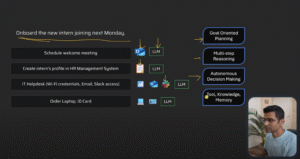
Tina Huang offers a beginner-friendly guide to building AI agents using both no-code and code-based tools. She explains agents as systems that perceive, reason, and act, often mimicking roles like customer support or coding assistants. The course introduces a modular framework—covering models, tools, memory, audio, guardrails, and orchestration—alongside workflows like prompt chaining, routing, and autonomous agents. Real-world examples include a refund bot, news aggregator, and financial research assistant. You’ll also learn a prompt-engineering framework and how to choose agent ideas by identifying workflow pain points, focusing on simplicity and real-world usefulness over unnecessary complexity.

Frequently Asked Questions
Yes, with modern frameworks and pre-built components, you can create a functional AI agent in under 44 minutes. The key is leveraging existing large language model APIs and agent frameworks that handle the complex infrastructure so you can focus on defining the agent’s behavior and tools.
The fastest approach is to use a framework like LangChain or CrewAI with an API key from OpenAI or another LLM provider. Start with a simple single-agent setup that uses one or two tools, then expand its capabilities once the basic structure is working.
Python is the most popular and well-supported language for building AI agents. It has the largest ecosystem of AI agent frameworks, libraries, and tutorials, making it the easiest path for beginners to get started quickly.
Most AI agents rely on cloud-based LLM APIs rather than local computing power, so you do not need expensive hardware. Costs come primarily from API usage, which can be managed by choosing efficient models and optimizing the number of API calls your agent makes.
Common mistakes include giving agents too many tools at once, writing vague system prompts, not handling errors from tool calls, skipping testing with edge cases, and not setting guardrails to prevent the agent from taking unintended actions.