AI in College Applications: Penn’s New Rule Turns the Essay Into an Interview
The rules on AI in college applications changed this month, and the most interesting one came from Penn. It is two sentences long and it quietly reframes the entire application.
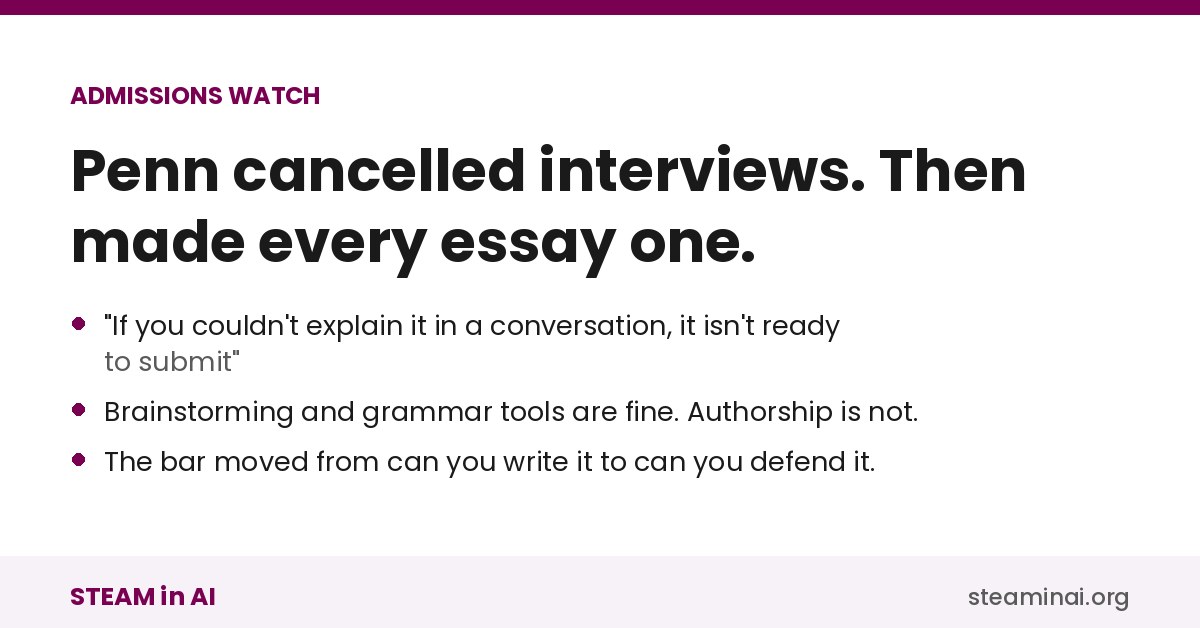
Here is the sentence that matters, from Penn’s own integrity guidance: “if you couldn’t explain, in an interview or conversation, how you arrived at what you wrote, or speak to it in your own words, it isn’t ready to submit.”
Read that again with one fact in mind. Penn does not interview applicants any more.
The interview Penn cancelled, and then brought back
Penn phased out evaluative alumni interviews, then in July 2025 discontinued the non-evaluative “alumni conversations” that had replaced them. The reason was scale. The applicant pool had grown past 72,000, and Penn said it could no longer offer those conversations fairly or on time.
So for the past cycle there has been no interview at all. Nothing was added in its place. The written application had to carry everything an interview used to catch.
Then this month Penn published its guidance on integrity and AI use in the admissions process, and the standard it sets is an interview. Not an event on a calendar. A test the student has to pass silently, alone, at their desk, about every line they submit.
The interview did not disappear. It became invisible, and permanent.
What Penn permits and forbids on AI in college applications
The guidance is more reasonable than the panicked version circulating in parent group chats. It is worth reading the real thing.
Allowed: talking an idea through with a parent, teacher or counselor. Having someone proofread. Using a tool, including an AI tool, to organize thoughts or check grammar. Penn says plainly that none of this compromises the certification.
Not allowed: submitting work, ideas or experiences that are not authentically the student’s. That covers an essay someone else wrote, responses an AI generated, and activities or honors that are embellished or invented.
Certified: applicants affirm the application is their own work, factually true and honestly presented. Penn adds that the certification does not end at submission, and that an offer of admission stays contingent on the same standards through enrollment.
The uncomfortable question this raises about your student’s activity list.
Pick the most impressive line on it. Could they talk about it for twenty minutes, without notes, to a stranger who asks why? If the honest answer is no, that line is now a liability rather than an asset, and there is still time to fix it.
AI in college applications: Penn is not alone
While Penn tightened the standard for what a student writes, a number of schools decided to ask for less writing altogether.
Reporting from The New York Times on 24 August 2026 laid out the pattern. Tulane paused its “Why Tulane?” supplemental essay, and a university spokesperson said concerns about AI-generated essays “were definitely a factor.” The University of Georgia, Cornell, the University of Virginia and Texas Christian University have all reduced essay requirements. Washington University in St. Louis is phasing out an optional essay it considers redundant. Columbia, in June 2026, became the last Ivy League school to reinstate an SAT requirement.
Christoph Guttentag, formerly dean of admissions at Duke, put the reasoning plainly: “AI has hastened the realization that the written word isn’t necessarily an accurate representation of how somebody thinks.”
Sit with that sentence, because it is the most consequential thing anyone has said about AI in college applications this year.
What replaces the essay as evidence of a mind
For a century, the personal essay was the instrument for seeing a student’s mind. It worked because writing well was slow, and slowness was proof of thought.
Now writing well is instant. So the essay is being demoted, and scores are being reinstated to fill part of the gap. But a test score measures a narrow band, and everybody involved knows it.
Which leaves an open question that admissions offices have not yet answered publicly: what is the evidence of a mind, when prose is cheap and scores are thin?
The honest answer available today is a body of work. Something the student made, over months, that has a history. Penn’s rule points at it from one direction, by asking whether the student can account for what they claim. The essay pullback points at it from the other, by removing the artifact that used to stand in for it.
Families who read those two stories as separate news items will miss what they add up to. The application is being rebuilt around demonstrable work, and it is happening quickly.
Why STEAM in AI students can answer the question Penn is really asking
The rule underneath Penn’s policy is old: can this student defend what they submitted. Every STEAM in AI project runs through a five-step framework whose third step is Ethical Considerations — what could this get wrong, and who would it affect — and whose last step is Impact and Story, explaining the work to someone who was not there.
Those two steps exist because the interview question is never which architecture a student used. It is why they built it, and what happened when it broke. A student who has spent twelve weeks stuck on their own problem, with a mentor who watched them get stuck, has an answer. That is worth more under this policy than it was under the last one.
Why AI in college applications made this rule inevitable
AI in college applications broke an assumption that held for decades. Polished writing used to be evidence. A well-turned sentence suggested a student who read carefully and revised patiently.
That inference is dead. Any student with a browser can produce clean prose in seconds, which means clean prose no longer distinguishes anyone. Admissions offices know this. They are not going to spend the next decade running detection software in an arms race they would lose.
So Penn moved the test. It is no longer about the artifact. It is about whether the person behind the artifact can account for it.
This is the right call, and it is more demanding than it sounds. A student can generate an essay about a passion for neuroscience in four seconds. Explaining, out loud, what specifically they did about that passion last October is a different problem, and no tool solves it.
What AI in college applications now means for families
The bar moved from can you write it to can you defend it. Three practical consequences follow.
1. Depth beats breadth, more than before
A student with nine shallow activities has nine things they cannot discuss in detail. A student with one real project has something they could talk about until you asked them to stop. That is what a spike in college admissions has always meant, and this rule makes it mechanical rather than aesthetic.
2. The messy parts became assets
What broke, what you tried that failed, the week you changed direction. These are the details no AI can invent for a student, because they did not happen to the AI. They are also the details that make an account sound like a person.
3. Manufactured credentials got riskier
A program that hands every student a template project now hands them something they cannot fully explain. That was always a bad trade. Penn just attached a certification to it, extending through enrollment.
How to build something your student can defend
The test is simple enough to run at your kitchen table. Ask your student to explain their main project to you as though you know nothing about it. Then ask why they chose that approach instead of an obvious alternative. Then ask what went wrong.
Students who did the work answer the third question most enthusiastically. Students who did not go quiet on it.
Building that kind of account takes months rather than weeks, which is why we design each student’s project around something they already care about, and why the middle weeks, where the first approach collapses, matter more than the finish. There is a walkthrough of that arc in what a 12-week AI project actually looks like.
FAQ: AI in college applications
Can my student use AI on their college application at all?
At Penn, yes, within limits they have published. Organizing thoughts and checking grammar are explicitly fine. Generating the responses is not. Other schools differ, so check each one rather than assuming a single standard.
Will colleges run AI detectors on college applications?
Penn’s approach sidesteps detection entirely, which is telling. Rather than policing the text, they moved the burden onto certification and authenticity. Expect more schools to follow that logic, because detection does not work reliably and certification does not need to.
What does “explain it in an interview” mean if the school has no interview?
It is a standard rather than a scheduled event. Penn is asking students to write only what they could stand behind in conversation. The absence of an actual interview does not soften it, since the certification carries through to enrollment.
Does using AI to brainstorm count as cheating?
Not under Penn’s wording. Talking an idea through with a person is permitted, and using a tool to organize thoughts sits in the same category. The line falls at authorship and at truth.
How do we make sure a project passes this test?
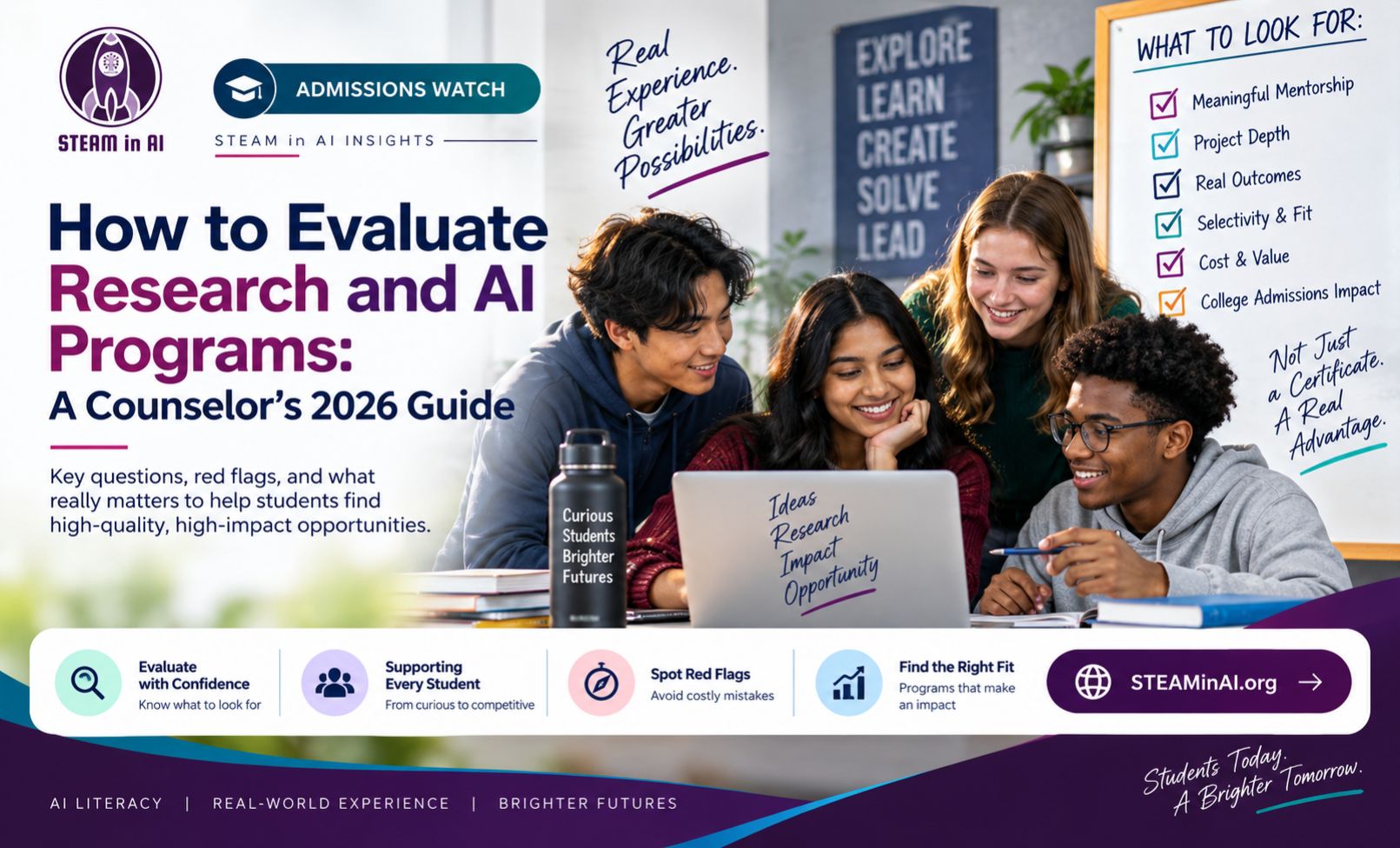
Have the student explain it to somebody who knows nothing about the field, and listen for whether they can answer the follow-up questions. Our own view on what separates a defensible project from a decorative one is in the six questions we give counselors.
Do other schools have rules on AI in college applications?
Penn published it first and most clearly. The pressure behind it is universal, and the reasonable expectation is that the standard spreads even where the wording does not.
Every applicant this cycle will submit something polished. Very few will be able to answer the second follow-up question.
That gap is the whole opportunity, and it takes a season of real work to land on the right side of it. Our cohorts are small because the projects are individually designed, which means the calendar decides this more than the budget does.