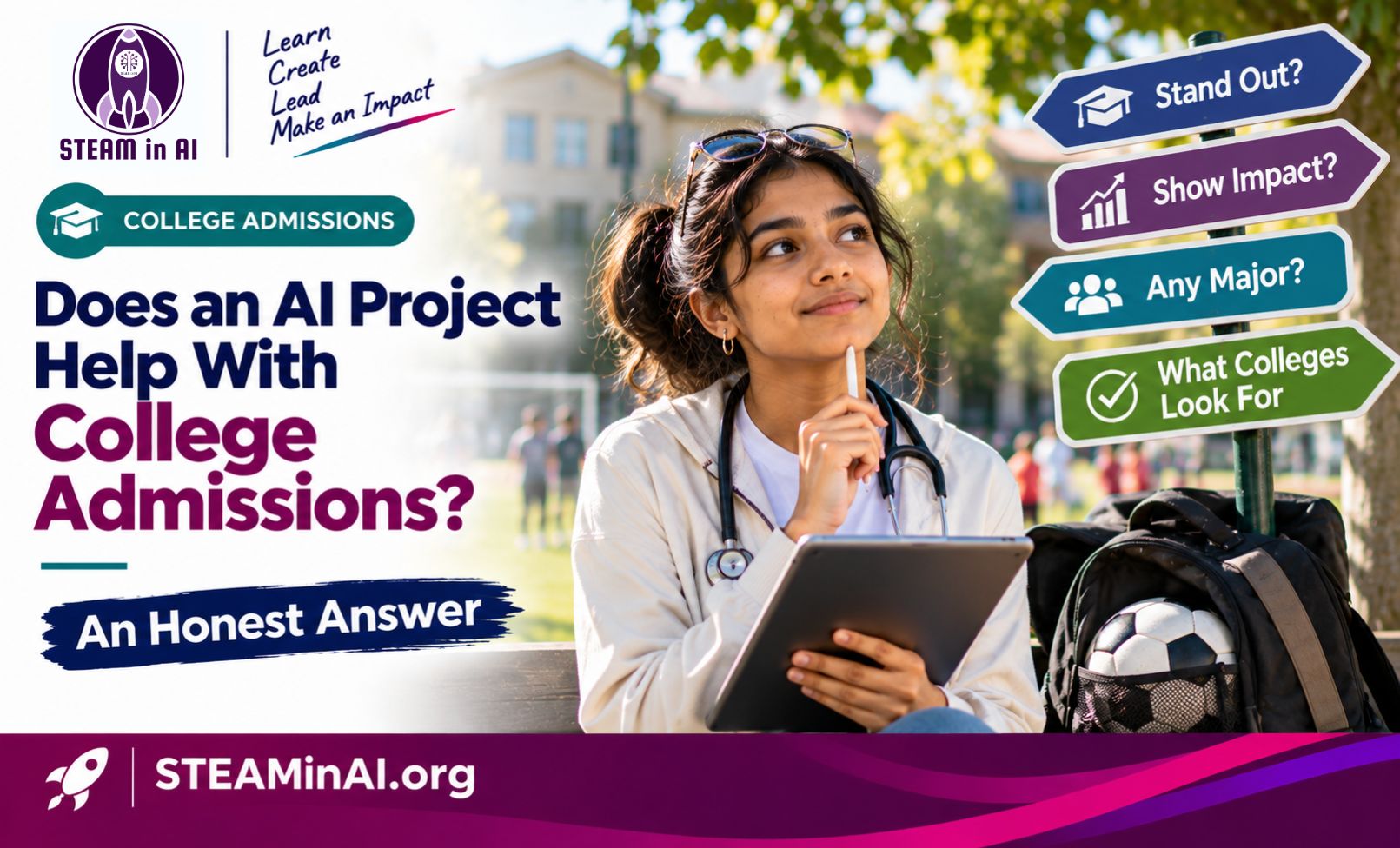
Does an AI Project Help With College Admissions? An Honest Answer
An AI project helps college admissions when it demonstrates intellectual curiosity, technical initiative, and real-world impact — not just that the student took a course. Admissions officers look for original work that connects to the student’s intended major and shows sustained effort, not a weekend hackathon certificate or a copied tutorial project.
Parents ask this in almost every first conversation, usually in a slightly apologetic tone. Does an AI project for college admissions actually help, or is it just the current version of the thing everyone is told to do? It deserves a straight answer rather than a brochure answer.
Here is ours. It helps in three specific ways, it does nothing at all in two others, and there is one situation where it quietly hurts.
What an AI project for college admissions genuinely does
Selective admissions is not a points system, so nothing on a list of activities converts directly into an admit. What a project changes is the material a student has to work with, and material is what most applications are short of.
It gives the essays something specific to hold
Readers see thousands of essays about growth, resilience and passion. Those essays fail not because the sentiment is false, but because nothing concrete anchors them. A student who spent twelve weeks discovering their original question was unanswerable has a story with a middle, and that middle is unusually hard to fake.
It answers the “why this major” supplement convincingly
Supplemental essays ask why a student wants to study a particular field, and this is where an AI project for college admissions earns most of its value. Most answers describe an interest. A student with a finished project describes evidence instead, which reads entirely differently.
It survives a skeptical reader
An admissions officer cannot verify that a summer program was meaningful. They can look at an artifact and see whether a real question sits underneath it. Consequently, work that can be examined carries more weight than experience that cannot.
The value is not the phrase “artificial intelligence” on an application. It is that the student now has something specific and true to say, at the exact moment everyone else is generalising.
What it does not do, despite what marketing implies
- It does not offset academics. Grades and rigour still come first at selective schools. No project rescues a transcript, and it is worth being wary of anyone who implies one will.
- It does not impress on the strength of the topic. “Used machine learning” stopped being remarkable several years ago. Readers now look past the method to the question.
Therefore, families who pursue an AI project for college admissions as a credential rather than as work tend to get very little from it. The credential was never the asset.
When an AI project for college admissions quietly hurts
There is one real failure mode, and we see it every cycle. A student submits a project they cannot explain.
Sometimes a parent arranged it. Sometimes a program handed over a template with the student’s name attached, which is how an AI project for college admissions turns into a liability. Occasionally a model wrote most of it. In each case the student cannot answer a follow-up question about why they chose that method, and interviewers ask exactly that.
Penn’s recent rule on disclosing AI use in application materials made the underlying expectation explicit, though the expectation itself is not new. Admissions readers have always been trying to work out whether the person in front of them did the thing on the page.
What STEAM in AI does about the defence problem
The failure mode above is a student who cannot explain their own project. Every STEAM in AI project is built to prevent it. The five-step framework ends with Impact and Story — explaining the work to someone who was not there — and its third step, Ethical Considerations, forces the student to name what their system gets wrong before anyone else does.
The project is also the student’s own from the start, designed around something they noticed rather than assigned from a list, and supervised by a named industry mentor who watched them get stuck. A student who has been through that does not fold under one follow-up question.
How readers separate a real project from a template
The tells are consistent, and anyone assessing an AI project for college admissions can check for them without any technical background.
| Signal | Template project | Real project |
|---|---|---|
| The question | Broad and borrowed | Narrow, specific, slightly odd |
| The dataset | A famous public one everyone uses | Assembled, collected, or chosen for a reason |
| The result | An impressive accuracy number | A finding, with limits stated |
| The failure | None mentioned | Named, and the student learned from it |
| The user | Hypothetical | An actual person who tried it |
Notice that four of those five have nothing to do with technical difficulty. When people ask whether an AI project for college admissions is worth it, this table is the real answer: a modest build with a real user beats an ambitious one with none.
Does the intended major change what an AI project for college admissions is worth?
It changes the shape of the project, not the value of it. In fact, the students who benefit most are frequently the ones outside computer science, since the work reads as genuinely unexpected.
A future business major who built an email assistant and tested it with older adults is doing something no other business applicant in the pile did. Meanwhile, a future computer science major submitting a classifier is one of many, and has to compete on the quality of the question rather than on novelty.
How to judge whether a program produces work worth submitting
Because families cannot easily evaluate this category, here are the four questions we would ask any program, including ours.
- Who selects the students, and on what? A program that admits everyone who pays produces a predictable range of outcomes.
- Does every student in a cohort build something different? If the projects rhyme, they came from a template.
- Who is the mentor, and where do they actually work? An AI project for college admissions is only as good as the person supervising it, so ask for names.
- What happens when a student’s idea fails at week six? The answer reveals whether the program teaches or produces.
You are welcome to run those questions at us. Any program proposing an AI project for college admissions should welcome them, and we would rather answer them now than have a family find out in March.
The honest summary on an AI project for college admissions
A project does not buy an admit, and nobody should promise that. What it reliably produces is a student who has done something real, can talk about it under pressure, and has specific material at the moment applications demand specificity.
Since that is also what a student gets out of the work itself, the admissions benefit turns out to be a side effect rather than the point. Families who treat it that way get more from it than families who do not.
According to the World Economic Forum, AI literacy ranks among the most in-demand skills for the coming decade.
The STEAM in AI Build track is designed to produce college-ready AI projects that demonstrate clarity, direction, and impact to admissions officers.
Students interested in research-oriented applications can pursue the STEAM in AI Research track to develop publishable work.


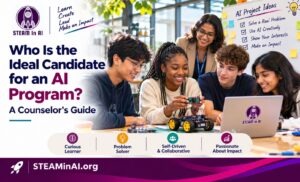
Who Is the Ideal Candidate for an AI Program? A Counselor's Guide

The Counselor’s Guide to AI Projects for College Applications