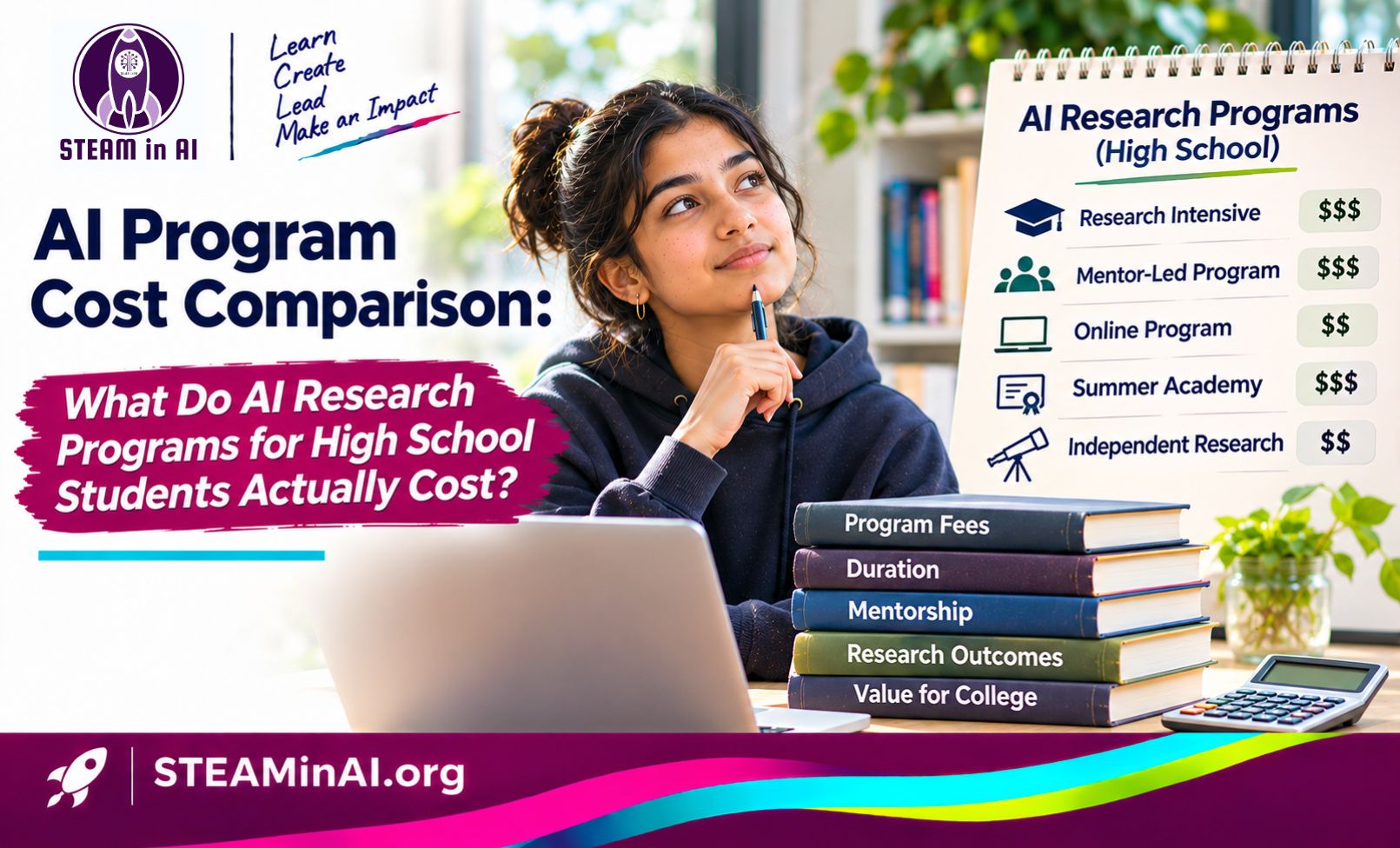
AI Program Cost Comparison: What Do AI Research Programs for High School Students Actually Cost?
AI research programs for high school students range from free (limited scope) to $7,500+ (full mentorship). Most paid programs fall between $2,000 and $6,000 for 8–16 weeks. The key cost factors are mentor quality, session length, and whether students produce original work or follow a set curriculum.
What Do AI Research Programs for High School Students Actually Cost?
If you’re a parent researching AI programs for your high school student, one thing becomes clear fast: pricing is hard to find. Most programs bury their costs behind “apply to learn more” buttons, and the ones that do publish prices range from under $1,500 to well over $20,000. This guide breaks down what the major AI research and project-based programs charge, what you get at each price point, and which questions to ask before you commit.AI Program Pricing at a Glance
Here is what the most well-known AI programs for high school students charge, based on publicly available information.Group-Based and Cohort Programs
Inspirit AI Inspirit AI charges approximately $1,400 for 10 sessions (about 25 hours of instruction). The program uses a group format with a student-to-instructor ratio of roughly 5:1. Instructors are described as coming from Stanford, MIT, and similar institutions. Students choose from pre-set project tracks. Financial aid and payment plans are available. BLAST AI BLAST AI runs a summer program priced at approximately $1,460 for 8 weeks. Mentors include undergraduate and graduate students. This is one of the more affordable options in the space. Veritas AI Veritas AI offers several tiers. The AI Trailblazers program for middle school students (Grades 6–8) costs $2,290. The AI Scholars program for high school students (Grades 9–12) costs $2,490. Specialized deep-dive programs in AI + Medicine or AI + Finance also run $2,490. Need-based financial aid is available, with some students receiving full support.One-on-One Mentorship Programs
Polygence Polygence’s core one-on-one mentorship program starts at $2,895 for 10 sessions. Their group format (Pods) starts at $495. An optional UC Irvine college credit add-on costs $1,800. A 6-installment payment plan is available with an 8% fee. Scholarships exist but are limited. Algoverse AI Research Algoverse charges $3,325 for a 12-week program requiring 5–10 hours per week. GPU and compute costs are included in the tuition. Financial aid is available. Veritas AI Fellowship Veritas AI also offers a one-on-one AI Fellowship at $5,900 for 12–15 weeks of individual research mentorship. A combined bundle of multiple programs costs $7,900. Lumiere Education Lumiere offers a range of programs from approximately $2,690 (Junior Explorer, 8 weeks) to $9,900 (Professor Premium Publication or Research Fellowship). The Research Scholar Program, their most popular option, falls in between. Financial aid is available but competitive. The Lumiere Research Inclusion Foundation provides fully funded places for students from low-income families. Pioneer Academics Pioneer’s Research Institute (PRI) charges $7,465 in tuition. Their Global Problem-Solving Institute (GPSI) costs $3,100. Some PRI concentrations add a lab and materials fee of up to $149. Pioneer has given over $11 million in need-based scholarships over 11 years, though the organization can only verify financial need for students in certain countries or at partner schools. Full-scholarship students pay a refundable deposit.Premium and Extended Programs
iResearch Institute iResearch Institute sits at the top of the price spectrum. Their Research Preparedness option costs $9,995. A two-year Research and Competition Preparedness track ranges from $12,500 (Year 1) to $15,500 (Year 2). Their most comprehensive option — Research, Competition, and Project — costs $22,000. A competition support package for students with completed research costs $17,000.Free Programs (Highly Selective)
Research Science Institute (RSI) RSI, run by the Center for Excellence in Education at MIT, is completely free — but acceptance rates are estimated at under 3%. This is a prestigious summer program, not a year-round mentorship option. University Research Labs Some university professors accept high school research assistants at no cost, but these placements are informal, competitive, and not structured as educational programs.What’s Actually Included at Each Price Point
Price alone doesn’t tell you what you’re getting. Here is what to compare across programs: Mentor qualifications. Some programs pair students with undergraduate tutors. Others use PhD students. A few provide mentorship from working professionals or faculty members. Ask who will be mentoring your child — by name, if possible — and verify their credentials before you pay. Contact hours. A $1,400 program with 25 hours of group instruction and a $3,000 program with 10 hours of one-on-one mentorship deliver very different experiences. Calculate the effective cost per hour, but also consider whether the hours are group or individual. Project personalization. Does your child choose from a list of pre-set project tracks, or do they develop a project based on their own interests? Pre-set tracks are easier to scale but may not result in work that stands out on a college application. Deliverable. What does your child walk away with? A certificate? A working prototype? A research paper? A conference submission? The more concrete and defensible the deliverable, the more value the program provides. Post-program support. Most programs end on a fixed date. Some offer continued mentorship, competition preparation, or publication support. Ask whether your child can keep building after the formal program ends. Ethics, design thinking, and communication. Technical skills matter, but admissions committees and competition judges also want to see that a student can articulate why their project matters and who it affects. Programs that integrate ethics and impact storytelling into the curriculum prepare students more completely.The Questions Every Parent Should Ask Before Paying
Regardless of which program you are considering, ask these questions before you commit: 1. Who is my child’s mentor — by name? If the program will not tell you before you pay, that is a signal. Named, verifiable mentors with real credentials are worth more than “instructors from top universities.” 2. How many hours of direct contact does my child actually get? Not “access to resources” or “self-paced modules.” Actual hours with a mentor, face to face (even if virtual). Then divide the program cost by that number. 3. Will my child build something unique, or follow a template? If every student in a cohort produces the same type of project, it is a course — not a mentored research or build experience. 4. What happens after the program ends? Can the student continue iterating? Enter competitions? Submit for publication? Or does the relationship end on a set date? 5. Is publication or competition success guaranteed? No legitimate program guarantees publication or awards. Programs that make this promise are selling the wrong thing. 6. What does the program NOT include? Compute costs, competition entry fees, conference registration, and publication fees can add up. Ask what is covered and what is extra.How to Think About Value, Not Just Price
The least expensive program is not automatically the best value, and the most expensive one is not automatically the best experience. A $1,400 group program that teaches your child the fundamentals of AI in a structured curriculum can be an excellent starting point — especially for students who are not sure whether AI is right for them. A $3,000–$7,000 one-on-one mentorship program makes sense when your child already has an interest area and wants to build something they can defend on a college application, at a science fair, or in a portfolio. Programs above $10,000 typically bundle research, competition coaching, and extended timelines. These can deliver outstanding outcomes, but only if the student is committed enough to use the full program. The right question is not “how much does it cost?” It is “what will my child have built, learned, and be able to articulate when it is over?”At the entry level, the LaunchPad intro workshop ($399) lets students test the waters before committing to a full-length program.
The STEAM in AI Intensive ($5,500) pairs each student with two mentors over 12 weeks — a different model from the bootcamp-style programs listed above.
According to the World Economic Forum, AI literacy ranks among the most in-demand skills for the coming decade.
AI programs for high school students range from free (highly selective programs like RSI at MIT) to over $20,000 (comprehensive multi-year research and competition programs). Most one-on-one mentorship programs fall between $2,500 and $8,000. Group-based programs typically cost $1,400 to $3,000. best AI programs is another approach worth considering. AI mentors is another approach worth considering.
An AI research program is worth the cost if your child walks away with a project they can explain and defend — not just a certificate. Admissions committees value depth, originality, and the ability to articulate impact. A well-designed program that produces a tangible deliverable (a working prototype, a research paper, or a competition submission) can strengthen a college application. A program that only provides instruction without a unique outcome may not justify a premium price.
Compare mentor qualifications (named, verifiable credentials versus anonymous instructors from top schools), total contact hours (group versus one-on-one), project personalization (pre-set tracks versus student-driven), what the deliverable is, whether post-program support exists, and what is not included (compute costs, competition fees, publication fees). The effective cost per hour of direct mentorship is more informative than the sticker price.
Many programs offer need-based financial aid or scholarships, though availability varies widely. Some programs (like Pioneer Academics and Lumiere Education) have dedicated scholarship funds. Others offer payment plans. Highly selective free programs like RSI exist but accept very few students. Always ask about financial aid during the application process.
Group programs (typically $1,400–$3,000) place 4–5 students with one instructor and usually follow a pre-set curriculum. One-on-one mentorship programs ($2,500–$10,000+) pair a student with a dedicated mentor and typically allow for a personalized project. Group programs work well for building foundational skills. One-on-one programs are better suited for students who want a unique project that stands out on college applications or at competitions.