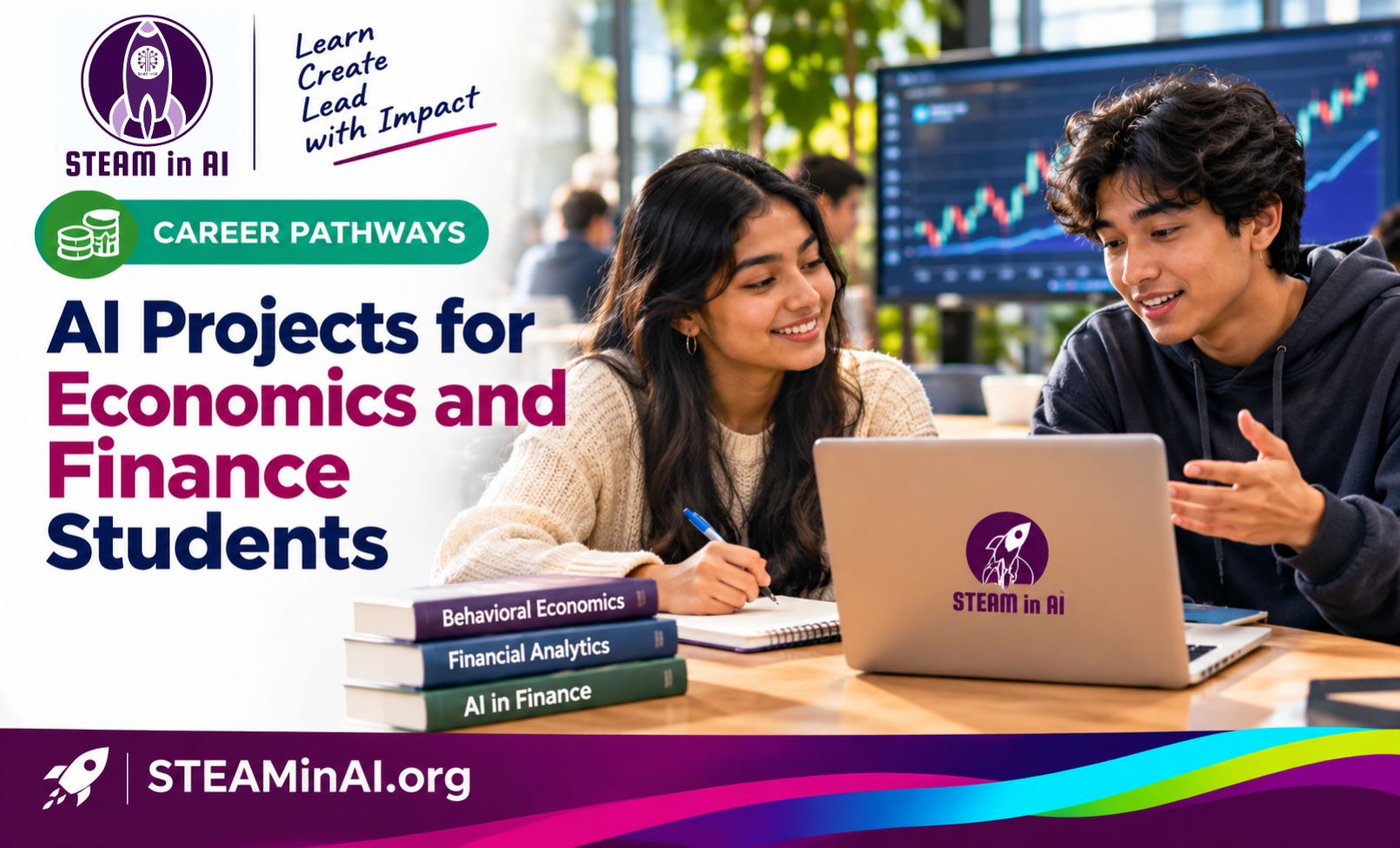
AI Projects for Economics and Finance Students: What to Build, Why It Matters, and How to Start
Ai Projects For Economics Students: Why Economics and Finance Students Should Build AI Projects
AI projects for economics students are not about becoming a software engineer. They are about understanding the technology that already drives trading floors, central bank modeling, fraud detection, and economic forecasting — and building something that proves that understanding to admissions committees and future employers.
Every top economics and finance program is integrating AI into its curriculum. MIT Sloan, Wharton, Chicago Booth, and NYU Stern now offer dedicated courses in machine learning for financial markets. Stanford’s economics department co-publishes with its computer science faculty. When an applicant arrives with a working AI project that applies economic reasoning to real data — not a class exercise but a tool they designed, built, and can explain — they demonstrate exactly the quantitative and analytical fluency these programs are selecting for.
The window is wide open. Most AI programs for high school students focus on computer science applicants. Almost nobody is building content or projects for the student headed to economics, finance, or business. That gap is your student’s advantage.
Ai Projects For Economics Students: What AI Projects for Economics and Finance Students Actually Look Like
A strong AI project for an economics or finance applicant does not look like a generic coding exercise. It looks like a tool that applies economic thinking to real-world data and produces insights a professional would find useful.
Market Prediction and Sentiment Analysis
Project idea: Build an AI system that analyzes financial news, earnings call transcripts, and social media sentiment to predict short-term market movements for a specific sector. The model ingests text data, scores sentiment, and correlates it with historical price movements. The student evaluates the model’s accuracy, identifies where it fails, and explains why human judgment still matters in the loop.
Why it works for economics applicants: This project requires understanding market microstructure, behavioral economics, and the limits of quantitative prediction — all core concerns of top economics programs. Schools like the University of Chicago and MIT value students who can think critically about models, not just build them. A student who can explain why their sentiment model breaks down during a liquidity crisis demonstrates exactly that critical thinking.
Fraud Detection Systems
Project idea: Build an AI model that identifies fraudulent transactions in a financial dataset. The challenge is extreme class imbalance — in real financial data, fewer than 1% of transactions are fraudulent, so the model must find needles in a massive haystack without flagging every unusual-but-legitimate transaction.
A STEAM in AI student built exactly this. Ivy Zhuang, now at Santa Clara University studying Computer Science and Engineering, built a fraud detection project that tackled datasets with less than 1% positive class. Her project required understanding both the technical challenge of class imbalance and the real-world consequences of false positives and false negatives — a frozen credit card versus a missed fraud case. That combination of technical precision and applied judgment is what makes this project type so powerful for finance applicants.
Why it works for finance applicants: Fraud detection sits at the intersection of data science, risk management, and financial regulation. Programs like NYU Stern’s fintech concentration and Wharton’s quantitative finance track actively recruit students who can work across all three.
Economic Policy Simulation
Project idea: Build an AI simulation that models the economic impact of a specific policy change — a minimum wage increase, a carbon tax, a universal basic income pilot, a tariff adjustment. Feed it real economic data (labor statistics, consumer spending, trade flows), define the policy parameters, and run scenarios. Present the results the way a policy brief would: projected outcomes, distributional effects, trade-offs, and confidence intervals.
Why it works for economics applicants: This is computational economics. The student is doing what researchers at Brookings, the Fed, and the Congressional Budget Office do — modeling policy impacts with real data. Economics programs at schools like Princeton, Harvard, and Stanford look for students who can think about causal inference and counterfactual reasoning. A working simulation demonstrates both.
Personal Finance AI Advisors
Project idea: Build an AI-powered tool that takes a user’s financial situation (income, expenses, debts, savings goals, risk tolerance) and generates a personalized financial plan. The AI optimizes across competing priorities — paying down student loans versus investing, emergency fund versus retirement contributions — and explains the reasoning behind each recommendation in plain language.
Why it works for business applicants: This project combines optimization algorithms with financial literacy and user experience design. It demonstrates that the student can build something people would actually use — a skill that business programs value because it bridges quantitative ability with real-world application. Eli Basurto, a STEAM in AI graduate now at USC studying Artificial Intelligence for Business, built an AI email agent that demonstrated exactly this kind of applied, user-facing AI thinking.
Supply Chain Optimization
Project idea: Build an AI system that optimizes a supply chain for cost, speed, and resilience. Feed it real data on shipping routes, supplier lead times, inventory costs, and demand forecasts. The model identifies bottlenecks, suggests alternative sourcing strategies, and stress-tests the supply chain against disruption scenarios (a port closure, a supplier failure, a demand spike).
Why it works for economics and business applicants: Supply chain optimization is one of the highest-impact applications of AI in business. Companies spend billions on it. A student who can build a working optimization model — even a simplified one — demonstrates the kind of applied quantitative thinking that MBA and economics programs develop over years.
Ai Projects For Economics Students: The Same AI Project, Five Different Economics and Business Majors
One well-designed project speaks the language of multiple programs. Take the fraud detection system:
- Economics applicant: Frame it as an empirical study of information asymmetry — how do you detect deception in transaction data when the deceiver is actively trying to look normal?
- Finance applicant: Frame it as a risk management tool — quantifying the cost of false positives versus false negatives and optimizing the threshold for a specific institution’s risk appetite.
- Business applicant: Frame it as a product with a market — who buys fraud detection, what is the competitive landscape, and how would you price and position this tool?
- Data science applicant: Frame it as a technical challenge in extreme class imbalance — what sampling, weighting, and evaluation strategies produce reliable results when fewer than 1% of observations are positive?
- Public policy applicant: Frame it as a regulatory question — should financial institutions be required to use AI-based fraud detection, and what standards should govern its accuracy and fairness?
Same project. Five completely different application essays. That is what a well-designed AI project gives an economics or finance student: a single body of work that demonstrates quantitative reasoning to any program they apply to.
Ai Projects For Economics Students: What Makes an AI Finance Project Strong Enough for College Applications
1. The project uses real data, not toy examples. Economics and finance programs care about empirical rigor. A model trained on a Kaggle tutorial dataset reads as a learning exercise. A model that uses real Federal Reserve data, SEC filings, or Bureau of Labor Statistics tables reads as research. The data source signals how seriously the student took the work.
2. The student can explain the economic reasoning, not just the technical implementation. Building a model that predicts stock prices is a data science exercise. Building a model that predicts stock prices and explaining why mean reversion works in some market conditions but not others — and what that tells us about market efficiency — is an economics project. The interpretation is what makes it admissions-worthy.
3. The project acknowledges what the model gets wrong. Every financial model fails in specific conditions. A student who can identify where their model breaks down — during high-volatility periods, in thin markets, when regime changes invalidate historical patterns — demonstrates the critical thinking that separates a strong economics applicant from someone who just ran a regression.
4. There is a clear “so what” for a decision-maker. The best economics and finance projects end with an actionable insight: a trading strategy with a defined edge, a policy recommendation backed by simulation data, a risk assessment that changes how a firm should allocate capital. The project should produce something someone in the real world could use.
Ai Projects For Economics Students: Do Economics and Finance Students Need to Know How to Code?
No. And the assumption that they should already know Python to start an AI project is exactly the barrier that keeps most economics students from building one — which is exactly why the students who do build one stand out.
At STEAM in AI, students choose between two tracks — Build (ship a working tool) or Research (investigate a question rigorously). An economics student interested in market modeling might choose Build. One interested in algorithmic fairness in lending might choose Research. The project is designed around the student’s interests and career direction, not around a fixed technical syllabus.
Every student works with two mentors: a curriculum mentor who teaches AI alongside ethics, design thinking, and entrepreneurship across every cohort, and an industry project mentor matched to the student’s specific direction. STEAM in AI matches students with mentors from companies like NVIDIA, Roblox, and Genentech — professionals who build AI systems and understand how technical choices create real-world consequences in markets, institutions, and people’s financial lives.
Over twelve weeks, the student’s technical fluency grows naturally from building something they actually care about. By the midpoint, most students are writing and modifying code themselves — not because they were assigned exercises but because they have a model they genuinely want to improve.
How to Start an AI Project as an Economics or Finance Student
Start with an economic question, not a dataset. “I want to analyze stock data” is a technique looking for a purpose. “I want to understand why small-cap stocks outperform in January” is an economic question that leads to a focused, defensible project.
Pick a domain your student already follows. A student who reads the Financial Times will build a better market sentiment tool than one who picked the topic because it sounded impressive. A student who debates monetary policy at the dinner table will build a better policy simulation. The curiosity has to be real.
Find a mentor who speaks both languages. The biggest risk for economics students doing AI projects is working with a mentor who knows machine learning but not markets, or one who knows finance but cannot help with implementation. The mentor needs to understand why a model’s assumptions matter as much as its accuracy.
AI Projects for Economics Students: The Competitive Advantage Nobody Is Talking About
Economics and finance are among the most competitive application pools at selective universities. Every applicant has strong quantitative credentials — AP Calculus, AP Economics, math competition scores. The differentiators that used to work (investment club president, business plan competition winner) are now table stakes.
An AI project changes the equation. It is not competing against other AI projects in the economics applicant pool — there are almost none. It is competing against the same roster of clubs, competitions, and internships that every strong economics applicant lists. A student who arrives with a working fraud detection model, a policy simulation, or a market sentiment analyzer is showing rather than telling. The project is the evidence that they can do the kind of quantitative, applied work these programs teach.
That is the spike. Not another AP score. A working tool that demonstrates the student thinks like an economist and builds like an engineer.
Is Your Student a Good Fit?
STEAM in AI admits students through a Fit Assessment — no test scores, no GPA cutoff, no coding prerequisites. The question is whether the student has a direction worth building toward and the discipline to spend twelve weeks doing the work.
If your student is the kind of person who reads financial news for fun, debates whether markets are efficient, or already has opinions about cryptocurrency regulation — they are exactly the kind of thinker who builds the most compelling economics and finance AI projects. A fifteen-minute conversation will tell you whether STEAM in AI is the right fit. We will be honest if it is not.
According to the World Economic Forum, AI literacy ranks among the most in-demand skills for the coming decade.
Frequently Asked Questions: AI Projects for Economics and Finance Students
Yes. The strongest AI projects for economics and finance applicants start with an economic question, not a programming language. In mentor-led programs like STEAM in AI, the technical scaffolding is handled while the student focuses on economic reasoning, data interpretation, and model evaluation. Most students develop working technical fluency over the twelve-week program because they have a model they genuinely want to improve.
It helps precisely because almost no economics applicant has one. Application pools for top economics programs are filled with AP scores, math competitions, and investment club leadership. A student who arrives with a working market model, fraud detection system, or policy simulation stands out because the project demonstrates applied quantitative thinking that most applicants only claim on paper.
Projects that apply AI to real financial or economic data and produce actionable insights. Strong examples include market sentiment analyzers that correlate news data with price movements, fraud detection models that handle extreme class imbalance, economic policy simulations that model the impact of specific legislation, and supply chain optimization tools. The common thread is real data, economic reasoning, and a clear conclusion a decision-maker could use.
Yes, and the distinction matters for applications. A CS project optimizes a model’s technical performance — accuracy, speed, scalability. An economics project uses AI as a tool for economic analysis — understanding market behavior, evaluating policy, quantifying risk. Both require technical skill, but an economics project directs that skill toward the questions that economics programs care about: causation, incentives, equilibria, and real-world impact.
A substantive AI project for economics or finance typically takes 10 to 16 weeks with dedicated weekly mentor sessions. In the STEAM in AI Intensive, students work with two mentors through a structured twelve-week program. Each student receives a personalized week-by-week project schedule designed around their specific economic question or financial application before the program begins.


AI Projects for Journalism and Media Students: What to Build, Why It Matters, and How to Start
AI Projects for Education Students: What to Build, Why It Matters, and How to Start