How to Evaluate Research and AI Programs: A Counselor’s 2026 Guide
Independent educational consultants keep asking us the same thing. You already know how to judge a research program — the category has been around long enough to have a reputation hierarchy. Evaluating research and AI programs together is harder, because most of the AI programs your clients ask you about did not exist three years ago. There is no established reputation hierarchy to fall back on, no equivalent of “well, everyone knows what RSI is.” A family forwards you a link, asks whether it is worth $5,000, and the honest answer is that you cannot tell from the website. Because every website in this category says the same four things.
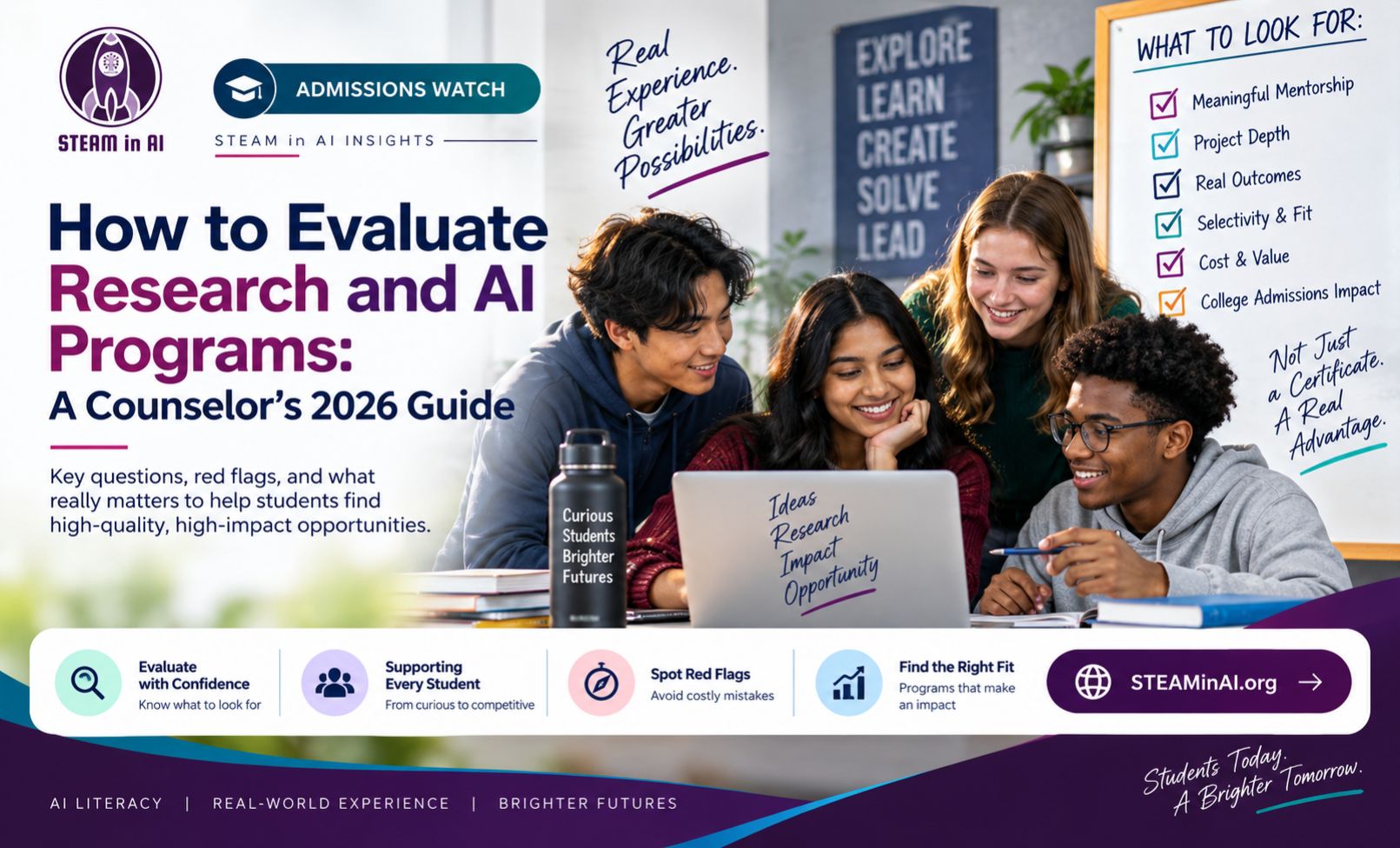
Here is one framework for evaluating research and AI programs alike, including ours. Use it on a call with a program’s admissions or advising team. Every question below has a right answer and a revealing one.
1. Ask who the mentor is, by name, before enrollment
The single most useful question in this category: who specifically will work with my client’s student, and may I see their profile?
A program that can answer with a name and a link is operating differently from one that says “you’ll be matched with a mentor from our network of PhD-level experts.” The second answer is not necessarily dishonest — large programs genuinely do match later — but it means the family is buying a category, not a person. For a relationship-based product, that is a meaningful difference.
Follow-up worth asking: what happens if the match does not work? Programs with real answers have a reassignment process. Programs without one have not thought about it.
2. Separate the curriculum from the project
Anyone learning how to evaluate AI programs misses this distinction, because it is invisible on most websites and it changes what a student actually receives.
Some programs teach a curriculum. A structured sequence every student moves through — and the “project” is the final assignment within it. Others provide project supervision, where the student brings a direction and the mentor guides it. A few do both, with different people responsible for each.
Neither model is wrong. But a student who needs foundational instruction placed in a supervision-only program will drift, and a student who already has direction placed in a fixed curriculum will be bored. Ask which one you are buying.
▶ Watch a student final presentation end to end
3. Ask what the deliverable is, in concrete nouns
“A completed independent project” is not a deliverable description. A paper of a certain length, a deployed application, a trained model with performance metrics, a dataset with an analysis. Those are.
The test that matters for your work: will the student be able to talk about this for twenty minutes in an interview, six months later, without notes? That requires the student to have made real decisions, hit real problems, and changed direction at least once. A deliverable produced on rails will not survive a follow-up question from an admissions officer or an alumni interviewer.
How STEAM in AI answers all six
Since the point of this guide is that you should run the questions at every program, here are STEAM in AI’s answers on the record. Mentors are named publicly, before anyone pays: Juliana Shihadeh, a published AI-bias researcher in AI & SOCIETY; Marius Fleischer at NVIDIA; Mustafa Shah at Roblox; Tanvir Ahmed Shaikh at Genentech; Dhruv Diddi at Turo. Every student works with two of them, a curriculum mentor and a separate 1:1 project mentor.
Admission is by fit assessment only. No GPA cutoff, no test scores, no prior coding required. The consequence, which matters more to a counselor than to a parent, is that STEAM in AI turns students away, including students who want to pay. That is what makes a referral safe to make.
4. Ask whether every student’s project looks the same
This is the failure mode that most damages the students you advise. If a program’s “independent projects” are a template with the variables swapped, an admissions reader who has seen a hundred of them will recognise it instantly. And the student will have paid thousands of dollars to look identical to everyone else who paid thousands of dollars.
A direct way to test it: ask to see two or three project plans from different students in the same cohort. If they are genuinely different problems requiring genuinely different technique, that tells you more than any brochure. If the program cannot or will not show you, note that too.
5. Ask what happens when the program ends
This is the question almost nobody asks, and in our experience the one that most changes how families feel.
Twelve weeks ends in August. The student submits the application in November of the following year. In between there is a long gap where a half-finished project either becomes something — more features, a public launch, a competition entry, a conference submission, a write-up — or quietly goes stale.
Some programs run as a single fixed engagement and end cleanly. That is honest, and for a student who wants one contained experience it is the right structure. But if your client’s student is likely to want to keep building, a program with no path past the final session will cost them momentum that is difficult to recover alone.
6. Check the price against the actual hours
Ten one-hour sessions over ten weeks and twenty-five sessions over four months are different products. If two programs cost similarly but differ substantially in contact time, the difference is being paid for something other than mentorship. That may be fine — brand, curriculum quality, mentor calibre — but the family should know what they are buying.
Evaluating research and AI programs in six questions on a call
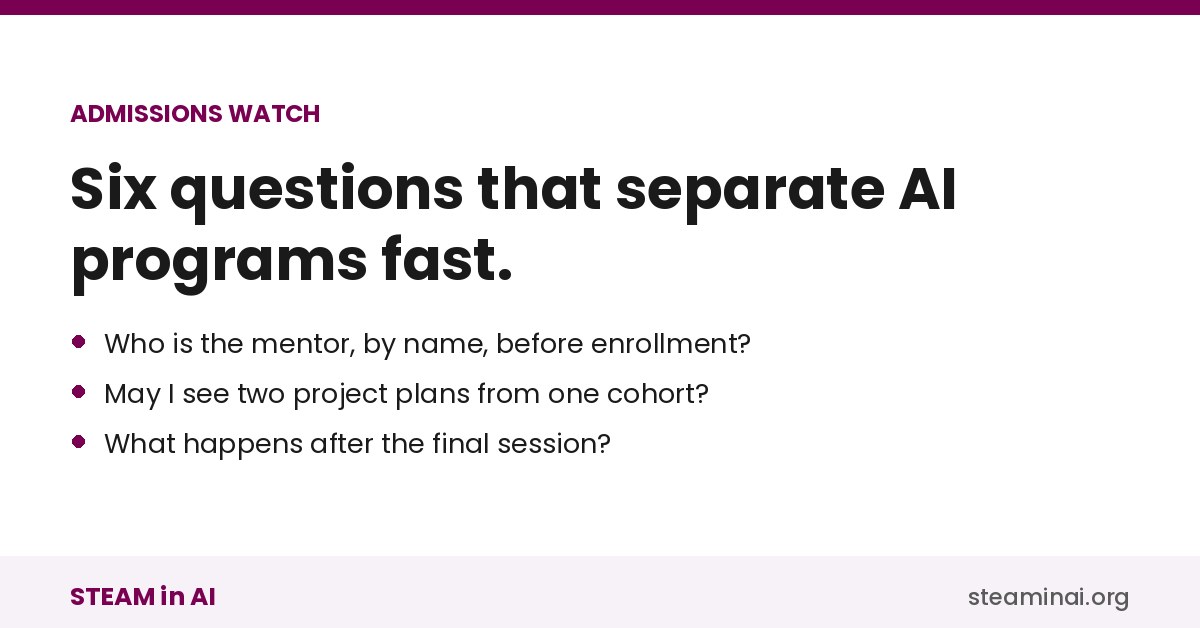
- Who is the mentor, by name, and may I see their profile?
- Who teaches the curriculum, and who supervises the project? Same person or different?
- What exactly does the student walk away with, described in nouns?
- May I see two project plans from different students in one cohort?
- What happens after the final session?
- How many contact hours, and how does that compare to the price?
Ask us these. Ask everyone these. A program that answers all six comfortably is worth your client’s consideration regardless of whose name is on it.
Evaluating research and AI programs: where STEAM in AI lands
We can name the mentor before enrollment. Students have worked with Juliana Shihadeh, a published AI-bias researcher whose paper appeared in AI & SOCIETY; Marius Fleischer at NVIDIA; Mustafa Shah at Roblox; Tanvir Ahmed Shaikh at Genentech. And Dhruv Diddi at Turo. We separate the two roles deliberately: a Curriculum Mentor teaches AI, ethics, design thinking and entrepreneurship, and a separate 1:1 Project Mentor we match to the individual student’s build. We write a week-by-week project plan for each student before the program starts, and no two are the same. And students can continue with us past the Intensive. Many do, taking projects to app stores, competitions and conferences.
If a client of yours is weighing this category, judge us against the six questions above alongside anyone else.
Book a 15-minute call to talk through a specific student
Evaluating research and AI programs against your recommendation list
Your clients are going to enroll in something this year. The programs that market hardest to families are not reliably the ones that answer these six questions well, and a recommendation that goes badly comes back to your practice, not to the program.
We would rather be on a short, well-vetted list than a long one. If a student of yours is weighing this category, bring us the specifics. And if another program fits them better, we will say so.
Evaluating research and AI programs: where the two actually differ
The six questions apply to both. What changes is the answer you should expect, and knowing the difference is most of what evaluating research and AI programs requires.
| The deliverable | A research program ends in a paper, and the quality question is whether the finding holds. An AI project program can end in a paper or a working build, so ask which, and ask whether the student chooses. |
|---|---|
| Who the mentor is | Research mentorship usually means an academic or a doctoral student. Project mentorship usually means someone who ships software for a living. Neither is better; they are better at different things. |
| What hard means | In research, difficulty lives in the method and the literature. In a build it lives in the constraint: the dataset that is wrong, the user who does not behave, the model that will not run on a phone. |
| Where it goes afterwards | A paper goes to a journal or a competition. A build can go to an app store, a real user base, or a competition. Ask which afterlife the program actually supports. |
| Prerequisites | Research programs often assume a student can already read a paper. Project programs vary enormously on coding. Ask directly rather than inferring from the marketing. |
A student who wants to be read takes the research route. A student who wants to be used takes the build. Most advisees have a clear preference the moment you put it to them that way, and it is worth asking before you shortlist anything.
FAQ: evaluating research and AI programs
How should a counselor evaluate AI programs quickly?
Run the six questions above on a call. Named mentor, curriculum versus supervision, the deliverable in concrete nouns, two project plans from one cohort, what happens after the final session, and contact hours against price. Six answers separate the field faster than any brochure.
What is the single biggest red flag?
Identical projects. If a program cannot show you two genuinely different project plans from the same cohort, your client is paying thousands to look like everyone else who paid thousands.
Are free university programs always the better recommendation?
For the students who get in, often yes. RSI and similar programs are extraordinary and admit very few. The realistic question is what the other ninety-something percent of your caseload should do instead.
How do I judge whether the mentor is real?
Ask for a name and a profile before enrolment. Ours are published before a family pays, and include a researcher whose AI-bias work appeared in AI & SOCIETY, plus engineers at NVIDIA, Roblox, Genentech and Turo.
What should I tell families about outcomes claims?
Any program implying guaranteed admission, publication or competition results should be disqualified on that basis. Nobody controls those outcomes, and saying otherwise sets a family up for disappointment.
Learning how to evaluate AI programs takes six questions. Hold us to them.
We built this framework knowing it would be used against us, and we would rather be measured by it than by a brochure. If you have a student you are unsure about, bring them to a call and we will tell you where we are the wrong fit.