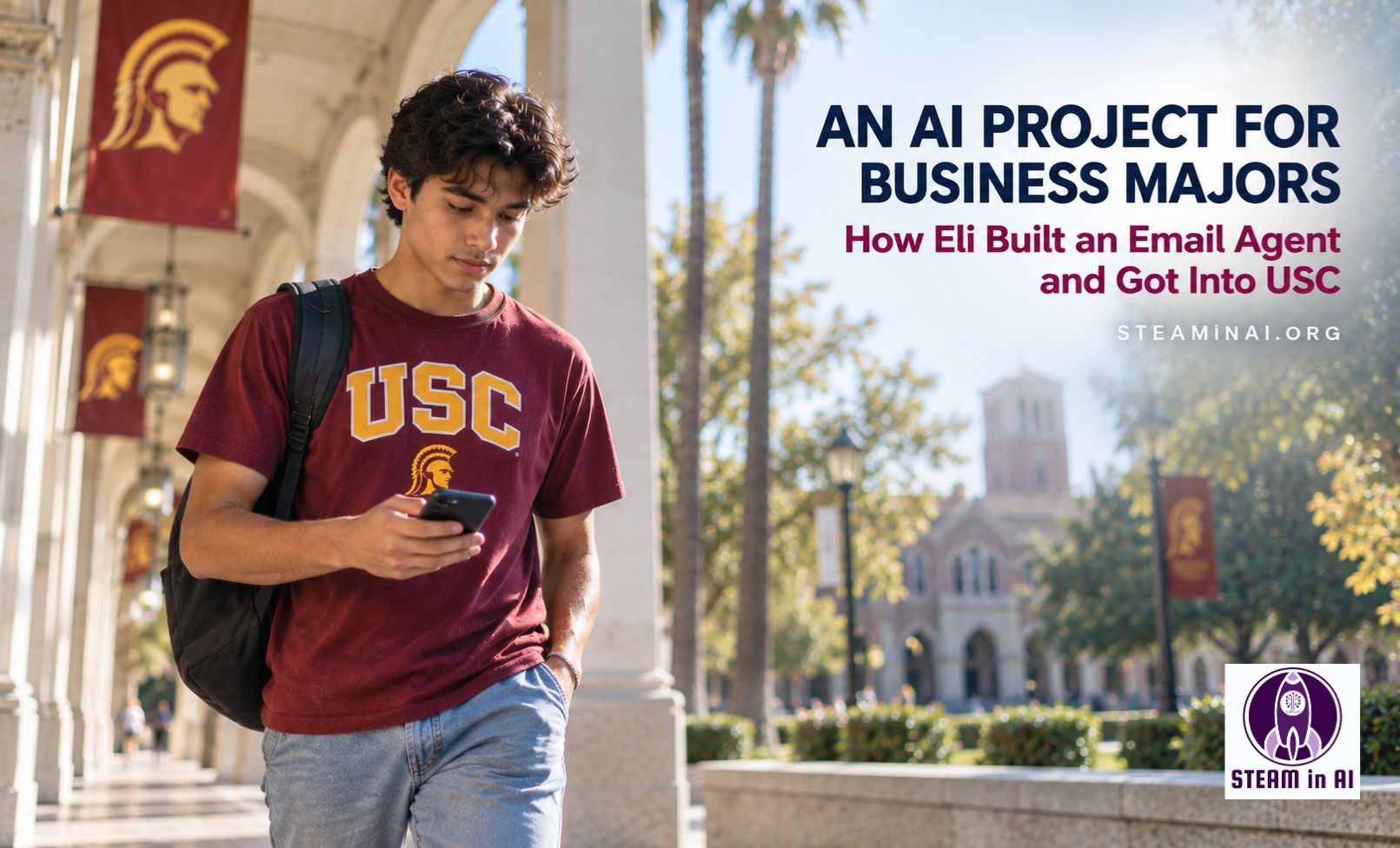
An AI Project for Business Majors: How Eli Built an Email Agent and Got Into USC
An AI project for business majors looks nothing like the one a computer science applicant builds, and almost nobody tells families that. Eli Basurto is studying Artificial Intelligence for Business at USC. That is the actual name of the degree, and most families have no idea it exists.
Which is the problem this post is about. Parents hear “AI” and think computer science, so the student heading for business school never gets told an AI project is available to them. Eli is what happens when someone does get told.
What an AI project for business majors actually looks like
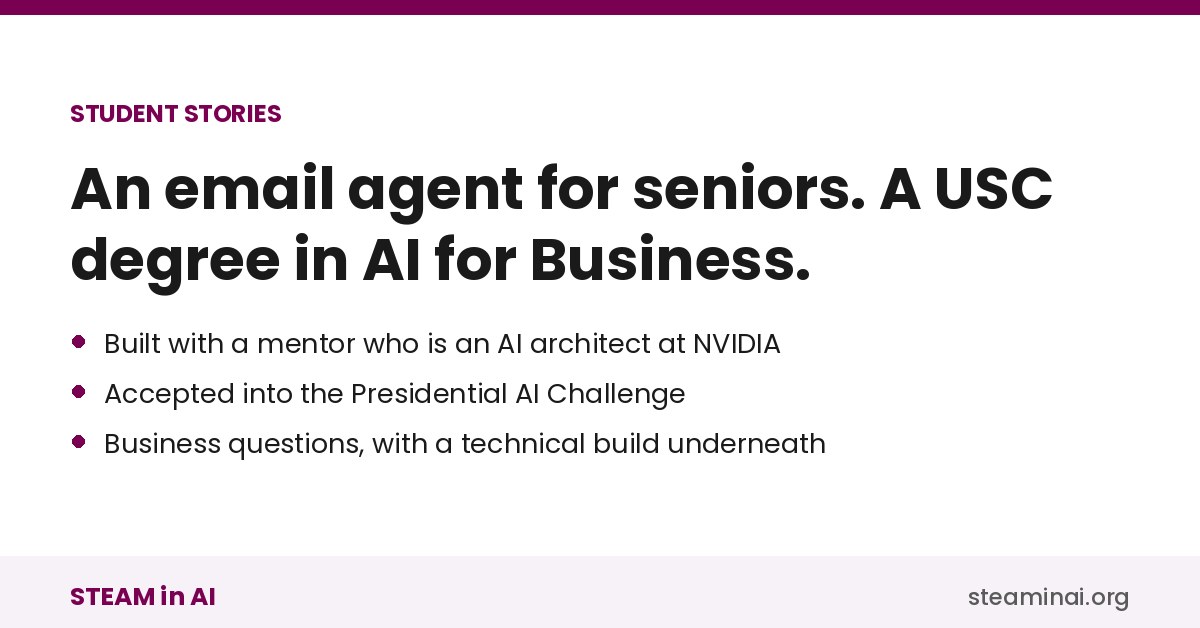
An AI agent that helps seniors manage email. Not a demo, not a class assignment, and not a problem picked from a list of suggested topics.
Notice, though, what is doing the work there. It is a technical build with a clearly identified user, an adoption problem and a reason to exist. That combination is what an AI business programme is reading for, and it is rarer than it sounds.
Eli worked with Marius Fleischer, an AI architect at NVIDIA. His project was accepted into the Presidential AI Challenge. We are careful about this wording, because acceptance is not the same as winning, and programmes that blur the two should be treated accordingly.
Why it read as a business project, not a coding project
An admissions reader assessing an AI project for business majors is not scoring the model architecture. They are looking for evidence that the applicant thinks about people, adoption and value.
Eli’s project answered questions that a purely technical build never raises. Who is this actually for. Why do they not already use the thing that exists. What has to be true for someone to adopt it. What does it cost, and who pays.
In other words, those are business questions with a technical build underneath them. That is the shape worth aiming at, and it is very different from a well-executed classifier with no user.
If your student is heading for business, this is the moment to say so out loud.
The project we would design for a future business major looks nothing like the one for a future computer scientist, and we can only build the right one if we know where the student is going. Tell us the intended major first and the project follows from it.
The same AI project for business majors, five other ways
An email assistant for seniors sounds like one narrow thing. Here is the exercise we run with families who cannot yet see the connection to their own student’s direction.
| Toward public health or gerontology | The same tool as an intervention. Does reducing email burden measurably reduce isolation, and how would you even test that honestly? |
|---|---|
| Toward design or accessibility | The interface problem. What does an assistant look like for someone with declining vision and low trust in software? |
| Toward public policy | The scale question. If this helps, who should pay for it, and what happens to the people who never get it? |
| Toward computer science | The hard part underneath. Summarisation that never drops something urgent, and how you measure a failure that only shows up as a missed message. |
| Toward marketing or communications | The adoption problem as the project. Why the people who need this most are the least likely to install it. |
Altogether, that is one build with five defensible applications. The student’s intended major decides which questions they chase, which is why we write the plan before the programme starts rather than after. That process is in our week-by-week walkthrough.
The part of STEAM in AI that made this a business project
SimpleMail is a build, but the work that got Eli into a degree called Artificial Intelligence for Business was not the model. The STEAM in AI curriculum covers design thinking, ethics and entrepreneurship alongside the AI, so the project required him to talk to the people who had the problem, decide what the system should refuse to do, and explain why it mattered.
That is also why it did not stop at week twelve. Eli carried the project forward and submitted it to the Presidential AI Challenge, where his work was accepted and certificated. STEAM in AI is built as a pathway rather than a summer, which is the part that turns a finished project into something still alive when applications are due.
What “Artificial Intelligence for Business” actually is
A degree sitting between a business school and a computer science department, for students who want to deploy AI inside organisations rather than build models for their own sake.
Moreover, the demand is obvious once you look at hiring. Companies have more AI tools than people who can judge where to point them. That gap is a job, and it is not a machine learning engineer’s job.
More on the degree and what it reads for in Artificial Intelligence for Business is now a real major.
The students who never hear about AI projects for business majors
Notably, these are not the ones who lack ability. The ones who were never told the option existed.
A student who says “I am not a math person” or “I am going into business” has usually had AI filed away for them by someone else, often years earlier. Nobody revisits it. Meanwhile the degree landscape moved.
Our own graduates went to six different majors, and only two of them are what a family would have predicted. If you are advising a student who has ruled this out, that assumption is worth checking. Counselors may find our guide to AI projects for college applications useful for exactly that conversation.
FAQ: the Artificial Intelligence for Business path
Did Eli need to be strong at coding?
He needed enough to build the thing, and he learned it as part of the project rather than before it. The differentiator was that he could explain who the tool was for and why they would use it.
What makes a good AI project for business majors?
A real user and a real adoption problem. A pricing model, a demand forecast, a support classifier or an operations tool all read as authentic. A generic image classifier does not.
Is the Presidential AI Challenge something students can enter?
Yes. Eli’s project was accepted and certificated. It is a national competition for US students, and the details are in our parent’s guide.
Which other schools offer degrees like this?
The category is growing quickly and the names vary, so check each school’s own listing rather than assuming. USC’s is the one we know first-hand because Eli is in it.
Is an AI project for business majors realistic for a non-technical student?
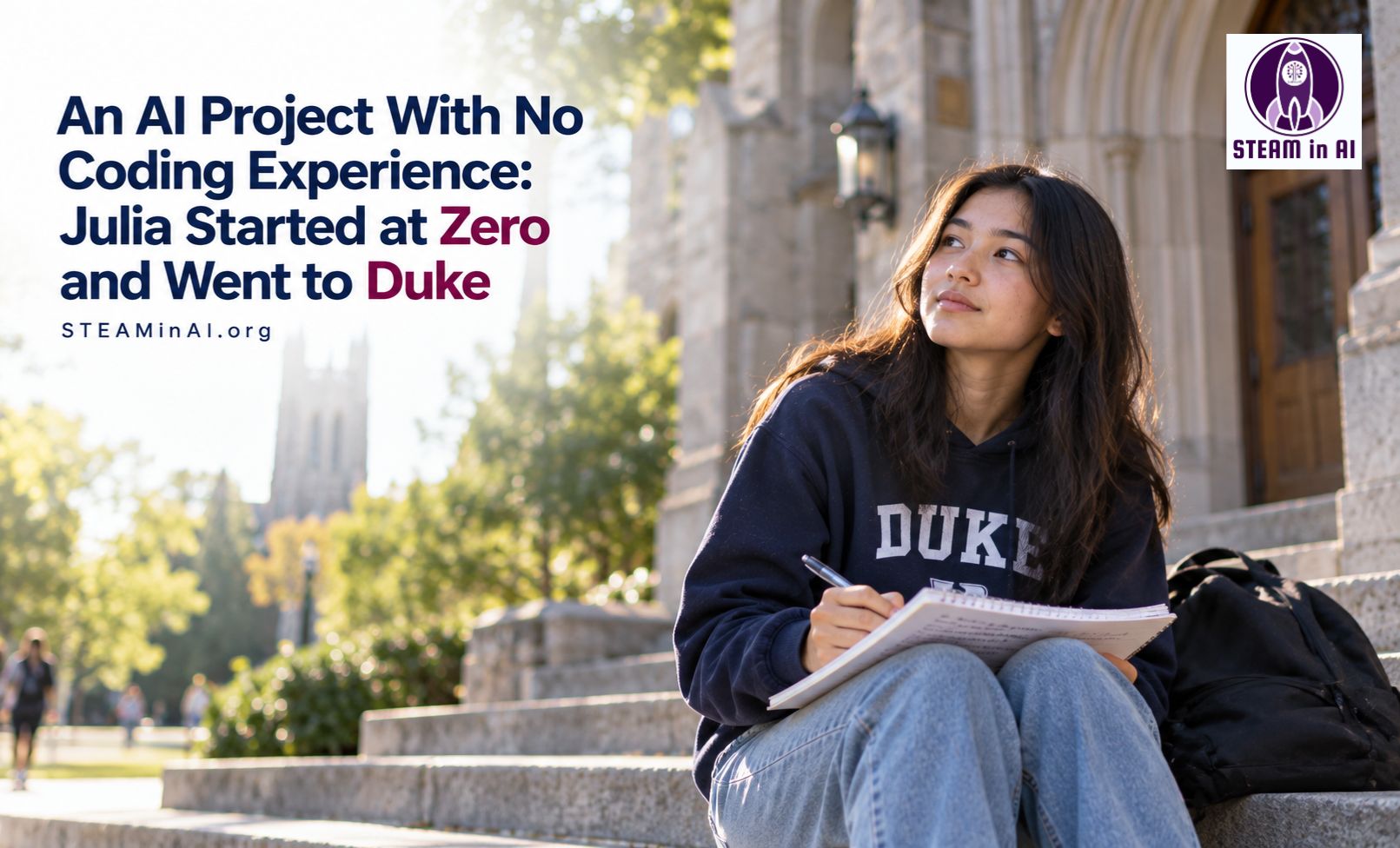
Several of our STEAM in AI graduates started with no coding whatsoever. Julia Kessman had never written Python and went to Duke for Statistical Science and Computer Science. More in her story.
Is a project like this enough to get into USC?
No, and any programme suggesting otherwise is overselling. Eli had a complete application. The project gave him something specific to write about that fit the degree exactly.
The business students are the ones nobody suggests this to, and they have the least competition when they do it.
Every AI programme is full of students heading for computer science. A well-built project with a business question at its centre stands out precisely because so few applicants bring one. If that is your student, say so on a call and we will build backwards from it.