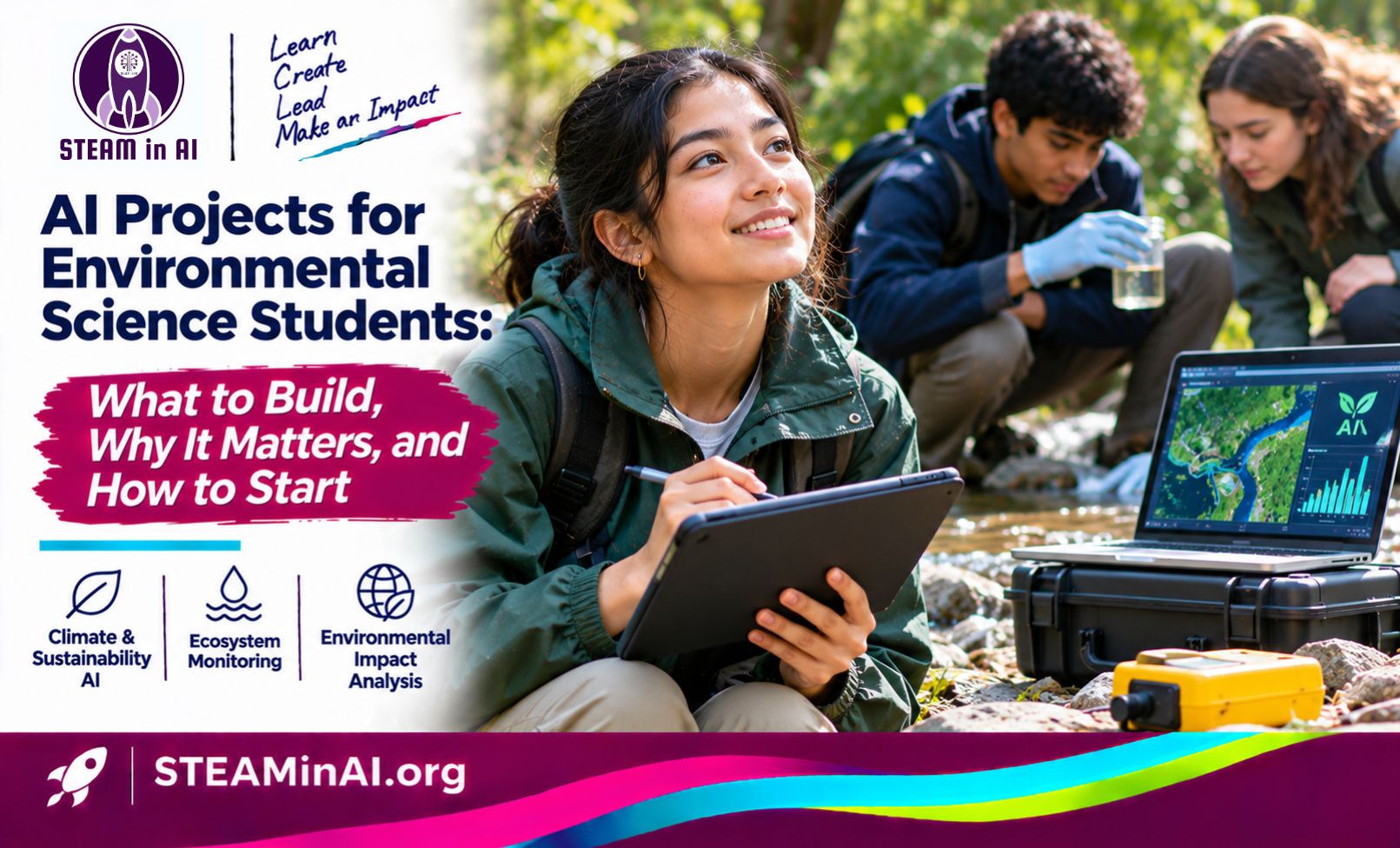
AI Projects for Environmental Science Students: What to Build, Why It Matters, and How to Start
Why AI Projects for Environmental Science Students Matter Now
AI projects for environmental science students are not about learning to code. They are about building tools that measure, predict, and respond to the most urgent problems facing the planet — climate change, biodiversity loss, pollution, resource depletion — at a scale and speed that traditional field research alone cannot achieve.
Environmental science programs at every level are integrating computational methods. Stanford’s Earth Systems program requires data science. UC Berkeley’s Environmental Science, Policy, and Management department runs machine learning labs. Yale’s School of the Environment partners with its Center for Earth Observation on AI-driven remote sensing. When an applicant arrives with a project that already uses AI to investigate an environmental question, they demonstrate the exact skill set these programs are built around.
And the gap is wide open. The AI education market talks almost exclusively to CS and engineering students. Environmental science students are left out. That creates a significant opportunity for any student willing to cross the line.
What AI Projects for Environmental Science Students Actually Look Like
The strongest AI projects for environmental science applicants start with an ecological or sustainability question and use AI as the instrument to investigate it — the way an environmental scientist uses satellite imagery or water sampling, but at computational scale.
Climate Data Prediction Models
Project idea: Build a model that predicts local climate patterns — temperature anomalies, precipitation changes, extreme weather probability — using historical data from NOAA, NASA, or the Copernicus Climate Data Store. Test the model’s predictions against recent observed data to evaluate accuracy. Present the findings as a tool a local government could use for climate adaptation planning.
Why it works for environmental science applicants: Climate modeling is one of the most active research areas in environmental science. A student who can build a working prediction model from real climate data — and interpret its limitations honestly — demonstrates both technical capability and scientific rigor. Programs at schools like MIT, Stanford, and the University of Michigan actively recruit this skill set.
Wildlife Monitoring with Computer Vision
Project idea: Build a computer vision system that identifies and counts wildlife species from camera trap images or drone footage. Train it on publicly available datasets from conservation organizations (Wildlife Insights, LILA BC). Then evaluate how the tool could reduce the time and cost of biodiversity surveys compared to manual identification.
Why it works for ecology and conservation applicants: Conservation biology programs at schools like UC Davis, Cornell, and Duke are investing heavily in AI-assisted monitoring. A student who arrives having already built a working species identification tool has demonstrated practical research capability that most applicants only read about.
Pollution Source Tracking
Project idea: Build a tool that combines air or water quality sensor data with geographic and industrial data to identify likely pollution sources. Use publicly available EPA or state environmental agency datasets. Present the results as an interactive map showing pollution hotspots and their probable causes.
Why it works for environmental policy applicants: Environmental policy programs value students who can connect data to action. A tool that traces pollution to its source — and presents findings in a format policymakers can use — demonstrates both analytical and communication skills.
Sustainable Agriculture Optimization
Project idea: Build an AI system that recommends crop rotation patterns, irrigation schedules, or soil management strategies based on satellite imagery, weather data, and soil composition. Optimize for both yield and environmental sustainability — minimum water use, maximum carbon sequestration, biodiversity protection.
Why it works: Agricultural sustainability is one of the most pressing applications of AI in environmental science. A project that balances productivity with ecological impact demonstrates the systems thinking these programs develop.
Carbon Footprint Calculators
Project idea: Build an AI-powered tool that estimates the carbon footprint of a specific product, institution, or community by analyzing supply chain data, energy use, transportation patterns, and waste generation. Go beyond simple calculators by using machine learning to find hidden emissions sources that standard tools miss.
Why it works: Carbon accounting is a rapidly growing field. A student who can build a tool that finds emissions others miss — and explain the methodology clearly — stands out in any environmental program.
AI Projects for Environmental Science Students: Five Different Majors, One Project
Take the climate prediction model from above:
- Environmental science applicant: Frame it as earth systems research — modeling climate patterns at the local level using real observational data.
- Urban planning applicant: Frame it as infrastructure resilience — a tool cities can use to prepare for climate-driven flood risk, heat islands, or water scarcity.
- Public health applicant: Frame it as a health risk assessment — predicting where climate change will drive heat-related illness, vector-borne disease, or air quality emergencies.
- Economics applicant: Frame it as climate risk modeling — quantifying the economic cost of inaction for specific regions or industries.
- Data science applicant: Frame it as a time-series forecasting challenge — benchmarking model architectures against real-world climate data with noisy, incomplete observations.
Same project. Five completely different application narratives.
AI Projects for Environmental Science Students at STEAM in AI
Nila came to STEAM in AI with an interest in environmental sustainability and no coding background. She built a RAG-powered recycling chatbot with a go-to-market plan — a tool that helps users identify what is recyclable, find local recycling facilities, and understand the environmental impact of their choices.
Nila is now studying Information Science at UIUC. Her project cross-fit environmental science, business, public policy, sustainability, and data science — one build, multiple application angles. That is what a well-designed AI project gives an environmental science student.
Do AI Projects for Environmental Science Students Require Coding?
No. STEAM in AI matches every student with two mentors — a curriculum mentor who covers AI ethics and design thinking, and an industry project mentor from companies like NVIDIA, Roblox, and Genentech. The mentor handles the technical scaffolding while the student focuses on the environmental question, the data interpretation, and the impact framing.
The Intensive teaches AI alongside ethics, design thinking, and entrepreneurship. For an environmental science student, that means learning to build tools that not only work technically but address real sustainability questions responsibly.
Is Your Student a Good Fit?
STEAM in AI admits students through a Fit Assessment — no test scores, no GPA cutoff, no coding prerequisites. If your student cares deeply about the environment and wants to build something that addresses a real problem, a fifteen-minute conversation will tell you whether this is the right fit.
Frequently Asked Questions: AI Projects for Environmental Science Students
According to the World Economic Forum, AI literacy ranks among the most in-demand skills for the coming decade.
Yes. The strongest AI projects for environmental science applicants start with an ecological or sustainability question. In mentor-led programs like STEAM in AI, the technical scaffolding is handled while the student focuses on the environmental research question and data interpretation.
It helps because environmental science programs are integrating computational methods and almost no applicants arrive with AI experience. A student with a working climate model, wildlife monitoring tool, or pollution tracker stands out immediately.
Projects that use AI to investigate environmental questions at scale: climate prediction models, wildlife monitoring with computer vision, pollution source tracking, sustainable agriculture optimization, and carbon footprint analysis. The best projects use real environmental data from sources like NOAA, NASA, or the EPA.
Yes. Publicly available datasets from NOAA, NASA, the Copernicus Climate Data Store, EPA monitoring networks, and conservation organizations like Wildlife Insights provide the real-world data that makes these projects credible for applications.
A substantive AI project typically takes 10 to 16 weeks with weekly mentor sessions. In the STEAM in AI Intensive, students work with two mentors through a structured twelve-week program with a personalized project schedule designed before the program begins.


AI Projects for Psychology Students: What to Build, Why It Matters, and How to Start

AI Projects for Journalism and Media Students: What to Build, Why It Matters, and How to Start