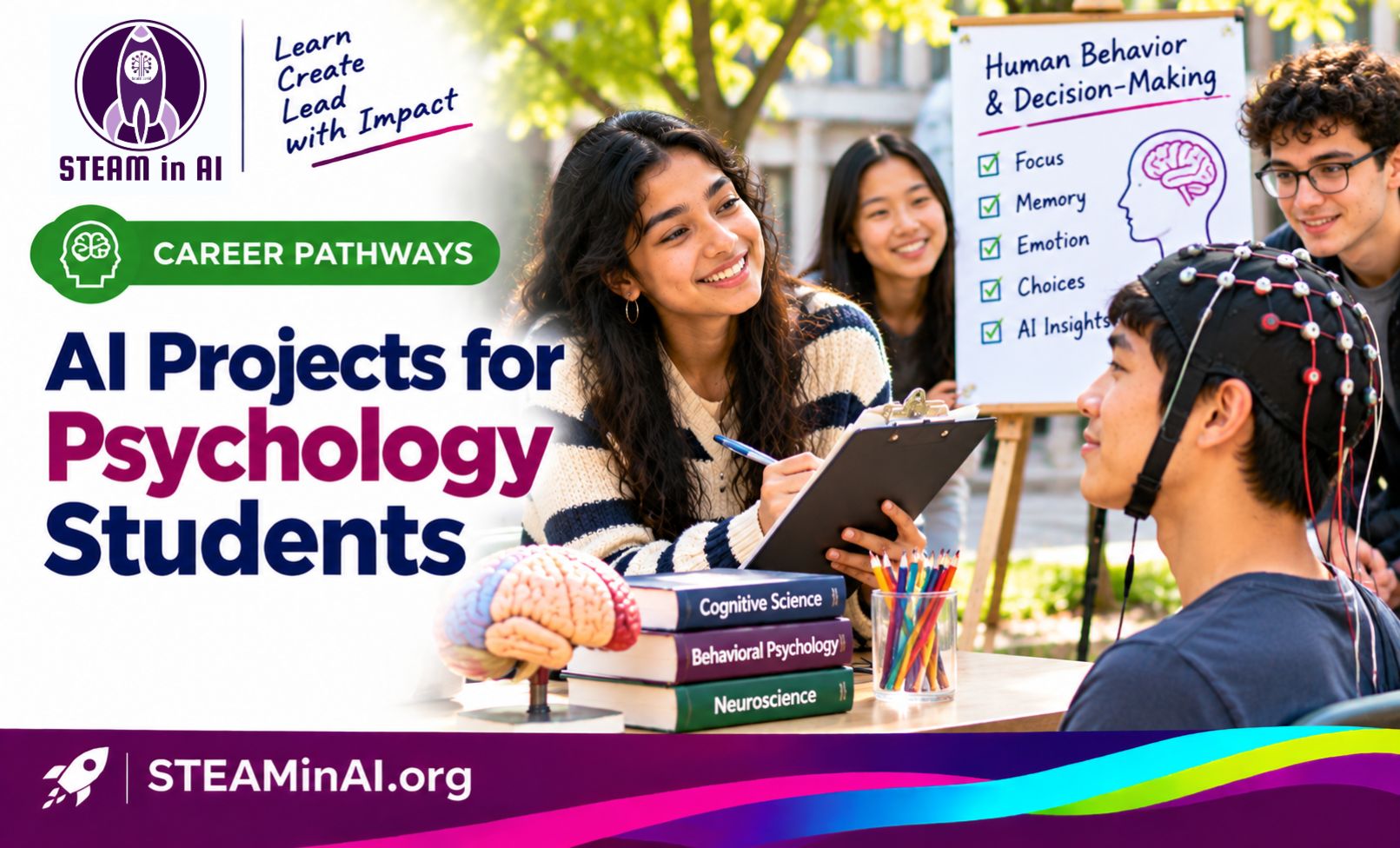
AI Projects for Psychology Students: What to Build, Why It Matters, and How to Start
Why AI Projects for Psychology Students Matter Now
AI projects for psychology students are not about switching career tracks or learning to write software. They are about using computational tools to investigate the questions that already drive the field — how people think, decide, perceive, and behave — at a scale and precision that traditional methods alone cannot reach.
Psychology programs at every level are integrating computational methods. Stanford’s psychology department runs a Computation and Cognition Lab. Princeton’s neuroscience program requires data science fluency. NYU’s Center for Data Science partners directly with its psychology faculty. When an applicant arrives with an AI project that investigates a genuine psychological question — not a coding exercise, but a real investigation — they demonstrate exactly the skill set these programs are building their future around.
The gap is wide open. The AI education market talks almost exclusively to CS students. Psychology students are hearing, implicitly, that AI is someone else’s territory. That creates an extraordinary opportunity for the student who steps across.
What AI Projects for Psychology Students Actually Look Like
The strongest AI projects for psychology applicants start with a behavioral or cognitive question and use AI as a research instrument — the same way a psychologist uses statistical analysis, but with tools that can process patterns at scale.
Emotion Recognition and Sentiment Analysis
Project idea: Build a tool that analyzes facial expressions, vocal tone, or written text to detect emotional states. Test it against established psychological frameworks like Ekman’s basic emotions or Russell’s circumplex model. Then investigate where the AI’s classifications diverge from human raters — and what those divergences reveal about how emotion actually works.
Why it works for psychology applicants: This project sits at the intersection of affective science and machine learning. The student is not just building a classifier — they are testing a psychological theory using computational methods. Programs with strong emotion research labs (UC Berkeley, Northeastern, Wisconsin-Madison) look for students who can bridge these worlds.
Cognitive Bias Detection Tools
Project idea: Build an AI tool that identifies cognitive biases in decision-making contexts — news articles, product reviews, political speeches, medical information. Train it to flag anchoring, confirmation bias, framing effects, and availability heuristic patterns. Then test how accurately the tool detects biases that human readers miss.
Why it works for psychology applicants: Cognitive bias research is one of the most active areas in behavioral science. A project that operationalizes bias detection — turning theoretical constructs into measurable signals — demonstrates the kind of computational thinking that programs at schools like Carnegie Mellon, UChicago, and Duke’s psychology departments value.
Mental Health Chatbot Evaluation
Project idea: Build a tool that evaluates the quality and safety of AI mental health chatbots (Woebot, Wysa, Youper) by testing their responses against clinical guidelines. Feed the chatbot a range of scenarios — mild anxiety, crisis language, ambiguous distress signals — and score how each chatbot responds. Present the findings as a comparative safety analysis.
Why it works for psychology applicants: This project tackles one of the most pressing questions in clinical psychology: whether AI tools help or harm people seeking mental health support. It requires understanding both the clinical standards and the technology. Programs with strong clinical or health psychology tracks will recognize this immediately.
Behavioral Pattern Analysis
Project idea: Build a system that analyzes behavioral data — screen time patterns, social media usage, sleep-wake cycles, activity levels — to identify correlations with self-reported wellbeing measures. The AI finds patterns in the data; the student interprets those patterns through a psychological lens and proposes hypotheses for further research.
Why it works for psychology applicants: Quantitative behavioral research is the direction the field is moving. A student who can collect, process, and interpret behavioral data computationally — while maintaining the theoretical grounding to ask the right questions — is exactly what research-oriented psychology programs recruit.
Neuroscience Data Visualization
Project idea: Build a tool that takes publicly available neuroimaging datasets (from repositories like OpenNeuro) and creates interactive visualizations of brain activity patterns associated with specific cognitive tasks. The student designs the visualization to communicate neuroscience findings to a non-specialist audience — patients, educators, policymakers.
Why it works for neuroscience applicants: Neuroscience programs at schools like MIT, Johns Hopkins, and UCLA increasingly expect data visualization skills. A project that makes complex brain data accessible demonstrates both technical capability and the communication skills that translate research into impact.
AI Projects for Psychology Students: Five Different Majors, One Project
A single well-designed project reframes for multiple programs. Take the cognitive bias detection tool:
- Psychology applicant: Frame it as behavioral science research — operationalizing cognitive bias theory into measurable computational signals and testing where human intuition fails.
- Neuroscience applicant: Frame it as a computational cognition study — modeling the neural basis of decision-making errors and testing predictions against behavioral data.
- Sociology applicant: Frame it as an institutional analysis — how cognitive biases embedded in AI systems reproduce social inequalities at scale.
- Public health applicant: Frame it as a health communication study — detecting bias in medical information that leads to disparate health outcomes across populations.
- Education applicant: Frame it as a learning science project — building a tool that helps students recognize and correct their own reasoning errors.
Same project. Five completely different application narratives. A well-designed AI project gives a psychology student a single body of work that demonstrates analytical rigor, computational fluency, and domain expertise to any program they apply to.
What Makes an AI Psychology Project Strong Enough for College Applications
1. The project tests a psychological question, not just a technical one. Admissions committees in psychology can immediately tell the difference between a project that asks “can AI detect emotions?” (a CS question) and one that asks “what does the gap between AI emotion classification and human raters reveal about how emotion categories work?” (a psychology question). Start with the behavioral question.
2. The student can explain the methodology as a researcher would. Psychology programs train researchers. A project that uses clear hypotheses, controlled comparisons, and honest reporting of results — including where the findings were surprising or inconclusive — signals that the student already thinks like a researcher.
3. The ethical dimensions are addressed directly. Psychology has its own deep history with research ethics. A student who engages with the ethical implications of AI in behavioral science — consent, privacy, the risk of pathologizing normal behavior, the danger of using AI to manipulate — shows awareness that psychology programs consider essential.
4. The data is real, not simulated. Working with actual behavioral data (publicly available datasets, survey responses, observational data) makes the project credible in a way that simulated data cannot. The messiness of real data is part of the learning.
Do Psychology Students Need to Know How to Code?
No. And programs that require coding prerequisites for AI projects are filtering out exactly the students whose perspective the field needs most.
At STEAM in AI, every student’s project is designed around their interests and career direction. A student headed for a clinical psychology program works on a fundamentally different project than a student headed for computational neuroscience — each receives a personalized week-by-week project schedule before the program begins.
Every student works with two mentors: a curriculum mentor who covers AI ethics and design thinking across every cohort, and an industry project mentor matched to the student’s individual direction. STEAM in AI matches students with mentors from companies like NVIDIA, Roblox, and Genentech — professionals who build AI systems and understand how design choices shape the human experience of technology.
How to Start an AI Project as a Psychology Student
Start with the question that already interests them. What aspect of human behavior fascinates your student? What would they study if they could observe a thousand people at once? The best AI projects for psychology students grow from genuine curiosity about how people work.
Look for the behavioral question, not the AI technique. “I want to use natural language processing” is a technology-first approach. “I want to understand how people’s language changes when they’re under cognitive load” is a psychology question that might use NLP as a research tool — and it produces a far more compelling project.
Find a mentor who respects the science. The biggest risk for psychology students doing AI projects is ending up with a mentor who treats the behavioral dimension as window dressing for a technical project. The mentor needs to understand that the psychological question drives the work.
AI Projects for Psychology Students: The Advantage Nobody Sees Coming
Here is what makes an AI project exceptionally powerful for psychology applicants: psychology programs are actively looking for students with computational skills, and almost none of their applicants have them.
The students applying to psychology programs come overwhelmingly from traditional social science backgrounds. They have research experience, strong writing, and interesting questions. Almost none of them can build a tool that investigates those questions computationally. An AI project does not replace the traditional strengths — it stacks on top of them.
That is the spike. Not a coding credential. A research project that demonstrates the student can investigate human behavior with tools the field is just beginning to adopt.
Is Your Student a Good Fit?
STEAM in AI admits students through a Fit Assessment — no test scores, no GPA cutoff, no coding prerequisites. The question is whether the student has a genuine interest worth building toward and the curiosity to spend twelve weeks investigating a real question.
If your student is the kind of person who notices patterns in how people behave, questions why people make the decisions they do, or reads about psychology research for fun — they are exactly the kind of thinker who builds the most compelling AI projects in this space. A fifteen-minute conversation will tell you whether STEAM in AI is the right fit.
Frequently Asked Questions: AI Projects for Psychology Students
According to the World Economic Forum, AI literacy ranks among the most in-demand skills for the coming decade.
Yes. The strongest AI projects for psychology applicants start with a behavioral or cognitive question, not a programming language. In mentor-led programs like STEAM in AI, the technical scaffolding is handled while the student focuses on the research question, methodology, and psychological interpretation. Most students develop working technical fluency by the midpoint of the twelve-week program.
It helps precisely because almost no psychology applicant has one. Psychology applicant pools are dominated by traditional social science backgrounds. A student who arrives with a computational research project that investigates a genuine psychological question demonstrates analytical capabilities most applicants only claim. Programs integrating computational methods (Stanford, Princeton, NYU, Carnegie Mellon) actively recruit this profile.
Projects that use AI as a research instrument to investigate behavioral or cognitive questions. Strong examples include emotion recognition tools tested against psychological frameworks, cognitive bias detection systems, mental health chatbot safety evaluations, behavioral pattern analysis from real data, and neuroscience data visualizations. The common thread: the project starts with a psychology question and uses AI to investigate it.
Yes. A CS project optimizes a system’s technical performance. A psychology project uses AI to investigate human behavior, cognition, or emotion. Both require understanding the technology, but a psychology project directs that understanding toward questions about how people think and behave — the questions psychology programs care about.
A substantive AI research project typically takes 10 to 16 weeks with dedicated weekly mentor sessions. In the STEAM in AI Intensive, students work with two mentors through a structured twelve-week program. Each student receives a personalized week-by-week project schedule designed around their specific research question before the program begins.


AI Projects for Pre-Law and Policy Students: What to Build, Why It Matters, and How to Start
AI Projects for Environmental Science Students: What to Build, Why It Matters, and How to Start