An AI Project for Biomedical Engineering: How Siyona Turned a Knee Injury Into a Major
An AI project for biomedical engineering does not have to start in a lab. Siyona Agarwal’s started with a knee injury on a dance floor. Today she is a junior at UC Davis studying Biomedical Engineering, and she is moving into biomechanics.
Most stories about high school projects stop at the acceptance letter. This one keeps going. Siyona is the rare student we can follow from the first project, through the major it pointed at, and into what she is building now.
Where her AI project for biomedical engineering really began
It began years before any AI. Siyona grew up watching her older brother’s robotics team, and she loved what they built together. So in 8th grade she started her own team with friends. At thirteen, they were writing block code and rebuilding a robot that kept falling apart at competitions.
She also danced. She started at three, later competed, and now captains a dance team in college. Dance was her life away from school, not a career plan. Then, in 10th grade, a minor knee injury changed how she saw it.
The injury made her curious about sports injuries in general. Why are they so common? Could technology catch them earlier? That question became her first real project.
What her AI project for biomedical engineering actually did
Before her senior year, Siyona built an AI model that classified knee MRI images. It flagged each scan as healthy or unhealthy, based on whether it detected an ACL tear.
She came in with AP Computer Science A behind her, so Java was familiar. Python, however, was new. Along the way she learned to train a model, validate it, and read its outputs. When validation broke, she worked the problem first. Then she brought it to her mentors.
She is honest about the project’s scope. “We weren’t solving a new problem,” she said. “But going through the steps of building it taught me a lot.” She calls it the strongest thing on her college application.
How the project was set up. At the time, STEAM in AI students worked from a shared group project, and each student built their own version of it. Siyona made hers about the question her injury had raised. Today we go further: every student gets a personalized AI project, designed around their own interests from the start.
Why the project pointed her to biomedical engineering
For a while, Siyona wanted to be a doctor. Over time, though, she realised she did not want another eight years of school after college. So she asked a different question: what is doctor-adjacent?
Biomedical engineering answered it. The major combined the building she loved from robotics with the biology and chemistry she enjoyed in class. In addition, it kept her close to healthcare, which the knee project had made real for her.
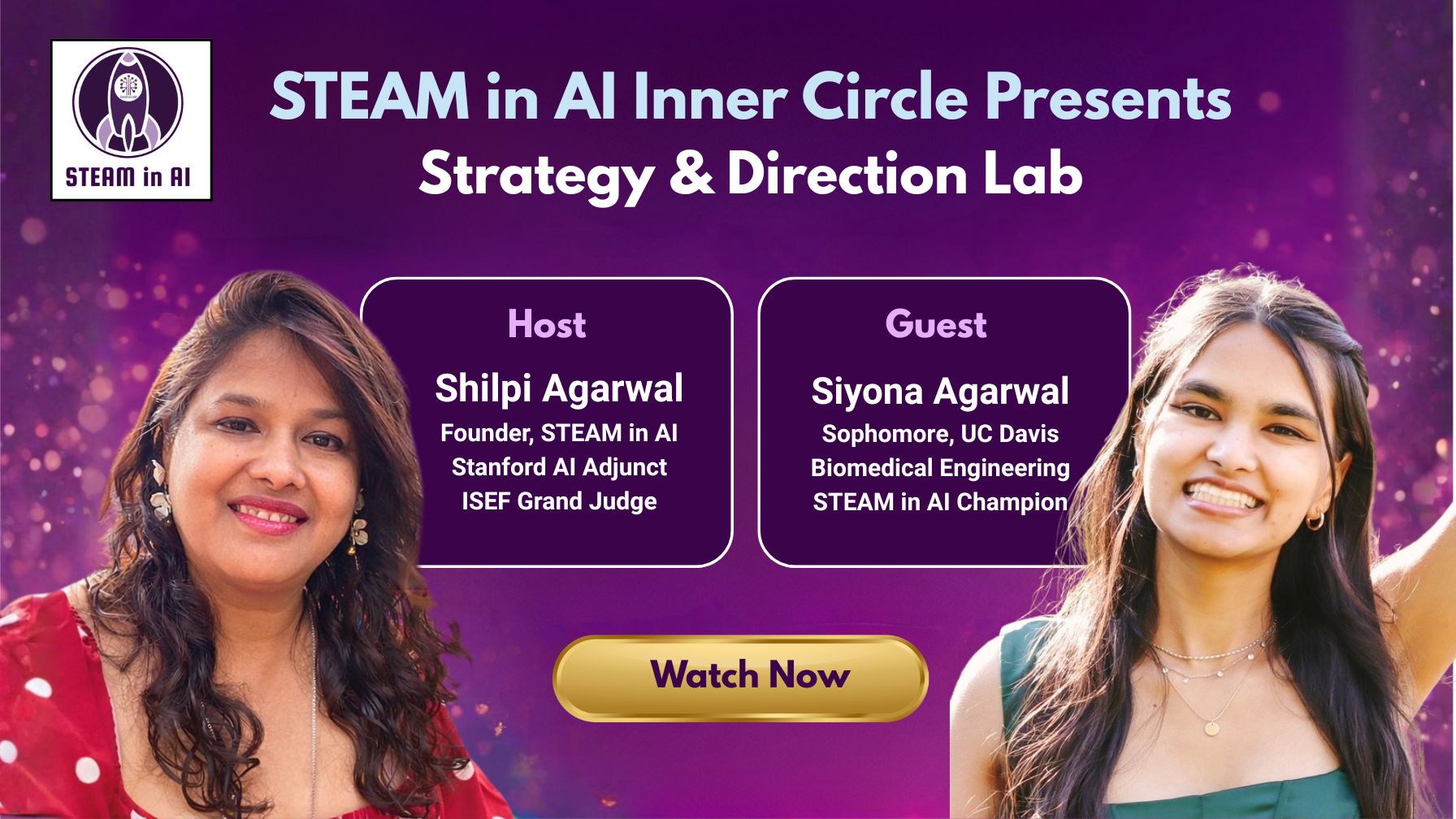
Hear it from Siyona.
Here is a short clip from her Strategy and Direction Live Lab, on why a real project says more about a student than “I like AI” ever can.
The full lab goes much further: the robotics team she started in 8th grade, the knee MRI model, how she chose biomedical engineering, and the essay she was proudest of.
Where an AI project for biomedical engineering can lead
The knee project did not end with her application. Instead, it opened a direction. Siyona is now focused on biomechanics, which uses technology to analyse how the body moves. Her goal is sports medicine: reducing injury risk so athletes can perform without further harm.
Her dream job is with a Formula 1 team. F1 crashes are dangerous because drivers sit in an open cockpit. Right now she is working on a project that analyses injury risk in current cars through simulation. She hopes it can inform safer helmets, halos, and car design.
“I honestly would not have thought that BME really had a place in F1,” she said. A little research showed her otherwise. That is the pattern worth noticing in any AI project for biomedical engineering. One project became a major, and the major is now becoming a career direction.
What Siyona says actually mattered
Problem-solving logic beats coding fluency
Siyona does not call herself a proficient coder. In her view, the logic matters more than the syntax. “If you can verbally problem solve,” she explained, “you can much more easily translate words to syntax.” Students start from very different places, and that is fine.
Mentors make the hard parts survivable
Her project mentor was there whenever something stopped working. She also urges students to reach out to people in fields they are curious about. “People are a lot nicer than you think,” she said. Alumni of your own school are an easy first step.
Connected interests beat a generic list
She warns against an application full of the same activities everyone lists. Instead, she connected dance to her project through the knee injury. Two unrelated interests became one story, and that story was hers.
Keep the interests that do not seem useful
This was her strongest advice. “Don’t be like, ‘Oh, it’s not helping me get into college, so it’s useless.’ Please never do that.” Her dance and her F1 obsession both ended up mattering.
How STEAM in AI designs an AI project for biomedical engineering
Siyona’s project worked because it started from something she already cared about. At STEAM in AI, that is now the starting point for every student. Each project is built around the student’s own interests and story, then matched with an industry mentor. A dancer with a knee injury and a future economist should not build the same thing.
Her advice, grade by grade
| 8th and 9th grade | Explore widely. Learn, talk to people, and look things up. Do not limit yourself yet. |
|---|---|
| 10th grade | Use summers for real projects. Take an interest you already have and apply it to a problem. |
| 11th grade | Start your college essays early. You will want time for many rounds of edits. |
| One skill for everyone | Communication. You can be introverted, but you need to communicate well with anyone. |
She also had a message for parents: stop worrying so much about which college. “Every college will teach students something,” she said. The growth comes from the experience itself.
Frequently Asked Questions
One that connects a real health question to something the student can build and explain. Siyona’s knee MRI classifier came from her own injury, which made it easy to talk about for twenty minutes.
No. Siyona had AP Computer Science A and learned Python during the project. She credits problem-solving logic, not syntax, for getting her through.
No. A project is raw material. How a student frames it, and which questions they chase, is what points it toward a major. Siyona framed hers around injury and the body, which led straight to biomedical engineering.
For Siyona, it became a direction. She is now heading into biomechanics and working on an F1 injury-risk simulation. More on this in what happens after an AI program ends . More on what our STEAM in AI students build AI project ideas for high school students, grouped by intended major What makes a high school AI project stand out in college applica
An AI project demonstrates computational thinking, data analysis, and interdisciplinary problem-solving skills that admissions committees value. It shows initiative beyond coursework and proves a student can apply technology to real-world health and engineering challenges, which is exactly what top biomedical engineering programs look for.