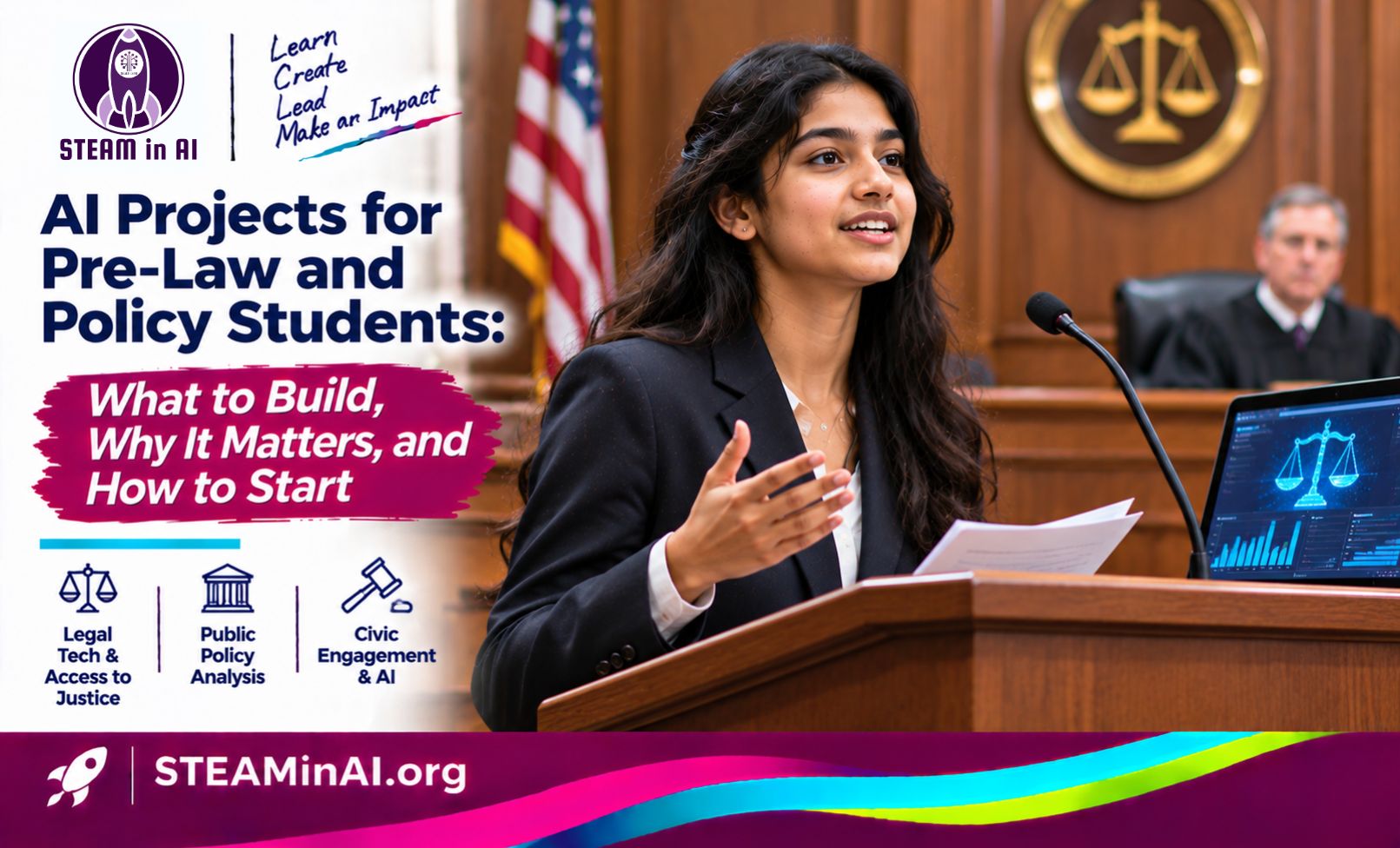
AI Projects for Pre-Law and Policy Students: What to Build, Why It Matters, and How to Start
Why AI Projects for Pre-Law Students Matter More Than Ever
AI projects for pre-law and policy students are not about becoming a programmer. They are about understanding the technology that will define the next generation of legislation, regulation, and legal practice — and having something concrete to show for that understanding. This guide covers ai projects for pre-law students — what to build, why it matters, and how to get started.
Every major law school and public policy program is reckoning with AI right now. Georgetown, Stanford Law, Harvard’s Berkman Klein Center, and NYU’s Information Law Institute are all building AI governance into their curricula. When an applicant arrives with a project that already engages these questions — not as a class paper but as a working tool they designed and built — they are not just another strong candidate. They are the candidate the program was designed for.
The opportunity is wide open: almost nobody in the AI-for-high-schoolers space is writing for students headed to law or policy. The entire market assumes AI education equals CS education. That assumption is wrong, and it creates a gap your student can walk through.
What AI Projects for Pre-Law Students Actually Look Like
A strong AI project for a law or policy applicant does not look like a typical coding project. It looks like a tool that interrogates how AI systems make decisions, who is affected, and what should be done about it.
Algorithmic Bias Auditing Tools
Project idea: Build a tool that audits a publicly available AI system — a hiring algorithm, a recidivism prediction model, a credit scoring system — for demographic bias. Feed it test cases, measure disparate outcomes, and present the findings in a format a policymaker could act on: not just “the model is biased” but “here is the specific variable driving disparate impact, and here is how existing anti-discrimination law does or does not address it.”
Why it works for law applicants: This is applied legal reasoning. The student is doing what a civil rights lawyer does — finding evidence of disparate impact — using the tools the next generation of lawyers will need. Programs like Georgetown Law’s Institute for Technology Law and Policy and Stanford’s CodeX are specifically looking for students who can bridge this gap.
AI Ethics Policy Analyzers
Project idea: Build an AI system that reads proposed AI legislation (the EU AI Act, state-level AI bills, executive orders) and flags provisions that conflict with existing law, leave enforcement gaps, or create unintended consequences. The tool does the first-pass legal analysis; the student provides the critical interpretation.
Why it works for policy applicants: Public policy programs at schools like Princeton’s School of Public and International Affairs and the University of Chicago’s Harris School value students who can analyze real legislative text. Building a tool that parses regulation and identifies structural weaknesses demonstrates exactly the analytical thinking these programs develop over four years.
Privacy and Surveillance Analysis
Project idea: Build a tool that maps how personal data flows through a commonly used application — a social media platform, a school attendance system, a health app. Trace what data is collected, where it goes, who has access, and what existing privacy law (FERPA, COPPA, state consumer privacy acts) applies at each step. Present the results as an interactive visualization a non-technical audience can follow.
Why it works for law applicants: Privacy law is one of the fastest-growing areas of legal practice. A student who can trace a data flow and map it to regulatory requirements is demonstrating a skill that privacy-focused firms and government agencies are hiring for right now.
Judicial Decision Pattern Analysis
Project idea: Build a tool that analyzes a body of judicial opinions on a specific legal question — Fourth Amendment search and seizure cases involving digital evidence, for example — and identifies patterns in reasoning, outcome predictors, and jurisdictional splits. The AI does the corpus analysis; the student writes the legal brief interpreting the results.
Why it works for law applicants: This is legal research at a scale no individual can do manually. Law schools increasingly teach computational legal reasoning, and a student who arrives having already done it — not as an exercise but on real case law — has a tangible advantage.
AI Projects for Pre-Law Students: Five Different Law and Policy Majors
One project can speak the language of multiple programs. Take the algorithmic bias auditing tool:
- Pre-law applicant: Frame it as applied civil rights investigation — using computational tools to find evidence of disparate impact that would ground a legal challenge.
- Public policy applicant: Frame it as a regulatory gap analysis — where current policy fails to prevent algorithmic discrimination and what a new framework should include.
- Political science applicant: Frame it as a study of institutional power — how algorithms redistribute decision-making authority from humans to systems, and what that means for democratic accountability.
- Philosophy/ethics applicant: Frame it as applied ethics — operationalizing abstract fairness principles into measurable criteria and discovering where those principles conflict.
- International relations applicant: Frame it as a comparative governance study — how the EU, US, and China approach AI regulation differently and what each framework misses.
Same project. Five completely different application narratives. A well-designed AI project gives a pre-law student a single body of work that demonstrates analytical rigor, ethical reasoning, and technical fluency to any program they apply to.
What Makes an AI Ethics Project Strong Enough for Law School Applications
1. The student takes a position, not just a survey. Law and policy programs want argumentation, not description. “I investigated bias in hiring algorithms” is a project summary. “I found that the algorithm penalizes candidates who attended community colleges, and here is why that likely violates Title VII” is a legal argument. The best projects arrive at a conclusion the student is prepared to defend.
2. The analysis touches real law or regulation. An ethics project that discusses fairness in general terms reads as a philosophy paper. One that maps its findings to the EU AI Act’s risk classification, or to a specific state privacy statute, reads as legal analysis. The specificity is what signals readiness for law school.
3. The project produces evidence, not just opinion. The difference between a blog post about AI bias and a project about AI bias is data. The student ran the tool, measured the outcomes, and the results either support or complicate their thesis. That empirical grounding is what makes the work credible.
4. The student can explain the technical mechanism to a non-technical audience. Lawyers and policymakers spend their careers translating complex systems into plain language. A student who can explain how a neural network makes a decision — clearly enough for a judge or a legislator — is demonstrating the exact skill law school demands.
Do AI Projects for Pre-Law Students Require Coding?
No. The goal is not to produce a software engineer. The goal is to produce a future lawyer or policymaker who understands the technology well enough to regulate it, litigate it, or advise on it.
At STEAM in AI, the Intensive teaches AI alongside ethics, design thinking, and entrepreneurship — not as a standalone technical skill. That combination is exactly what pre-law students need: enough technical fluency to understand what an algorithm does, deep ethical reasoning to evaluate whether it should, and the communication skills to make the case either way.
Every student works with two mentors: a curriculum mentor who covers AI ethics and framework thinking across every cohort, and an industry project mentor matched to the student’s individual direction. For a pre-law student, that means a mentor who understands both the technical implementation and the governance questions the project raises.
STEAM in AI matches students with mentors from companies like NVIDIA, Roblox, and Genentech — professionals who build AI systems and understand firsthand how design choices create downstream consequences. That real-world perspective is what gives a pre-law student’s ethics argument credibility.
AI Projects for Pre-Law Students: The Ethics Advantage in Law School Admissions
Law schools have a specific problem right now: they need students who understand AI, and almost none of their applicants do. The students who apply to law school overwhelmingly come from humanities and social science backgrounds. They write well, argue well, and score well on the LSAT. Almost none of them have built anything with AI.
That makes an AI ethics project extraordinarily distinctive in a law school application pool. It is not competing against other AI projects — there are almost none. It is competing against traditional humanities extracurriculars: model UN, debate, mock trial, political campaigns. All of those demonstrate verbal and analytical ability. An AI project demonstrates all of that plus something most applicants cannot show: the ability to engage with the technology that will define the next era of legal practice.
This is the spike. Not a coding credential. An ethics project that demonstrates the student can think about technology the way a lawyer thinks about anything else: rigorously, critically, and with a position worth defending.
Is Your Student a Good Fit?
STEAM in AI admits students through a Fit Assessment — no test scores, no GPA cutoff, no coding prerequisites. The question is whether the student has a direction worth building toward and the intellectual curiosity to spend twelve weeks investigating a real question.
If your student is the kind of person who argues about fairness at the dinner table, questions how systems make decisions, or has strong opinions about what rules should exist and why — they are exactly the kind of thinker who builds the most compelling AI ethics projects. A fifteen-minute conversation will tell you whether STEAM in AI is the right fit, and we will be honest if it is not.
Frequently Asked Questions: AI Projects for Pre-Law and Policy Students
According to the World Economic Forum, AI literacy ranks among the most in-demand skills for the coming decade.
Yes. The strongest AI projects for law and policy applicants start with an ethical or regulatory question, not a programming language. In mentor-led programs like STEAM in AI, the technical scaffolding is handled while the student focuses on the legal analysis, ethical reasoning, and policy implications. Most students develop working technical fluency over the twelve-week program because they have a question they genuinely want to investigate.
It helps precisely because almost no law school applicant has one. Law school applicant pools are dominated by humanities and social science backgrounds with traditional extracurriculars. A student who arrives with an AI ethics project — one that engages real legislation, produces empirical evidence, and takes a defensible position — demonstrates analytical ability that most applicants only claim. Programs with AI governance tracks (Georgetown, Stanford Law, Harvard’s Berkman Klein Center) are actively recruiting this profile.
Projects that interrogate how AI systems make decisions and who is affected. Strong examples include algorithmic bias auditing tools that map findings to civil rights law, AI policy analyzers that identify enforcement gaps in proposed legislation, privacy data-flow trackers mapped to specific statutes, and judicial decision pattern analysis tools. The common thread is that the project produces evidence and takes a position, not just a description.
Yes, and the distinction matters for law and policy applicants. An engineering project optimizes a system’s performance. An ethics project evaluates a system’s impact — who benefits, who is harmed, what rules should govern it, and whether existing law is adequate. Both require understanding how the technology works, but an ethics project directs that understanding toward the governance questions that law and policy programs care about.
A substantive AI ethics project typically takes 10 to 16 weeks with dedicated weekly mentor sessions. In the STEAM in AI Intensive, students work with two mentors through a structured twelve-week program. Each student receives a personalized week-by-week project schedule designed around their specific research question before the program begins.



AI Projects for Art and Design Students: What to Build, Why It Matters, and How to Start
AI Projects for Psychology Students: What to Build, Why It Matters, and How to Start