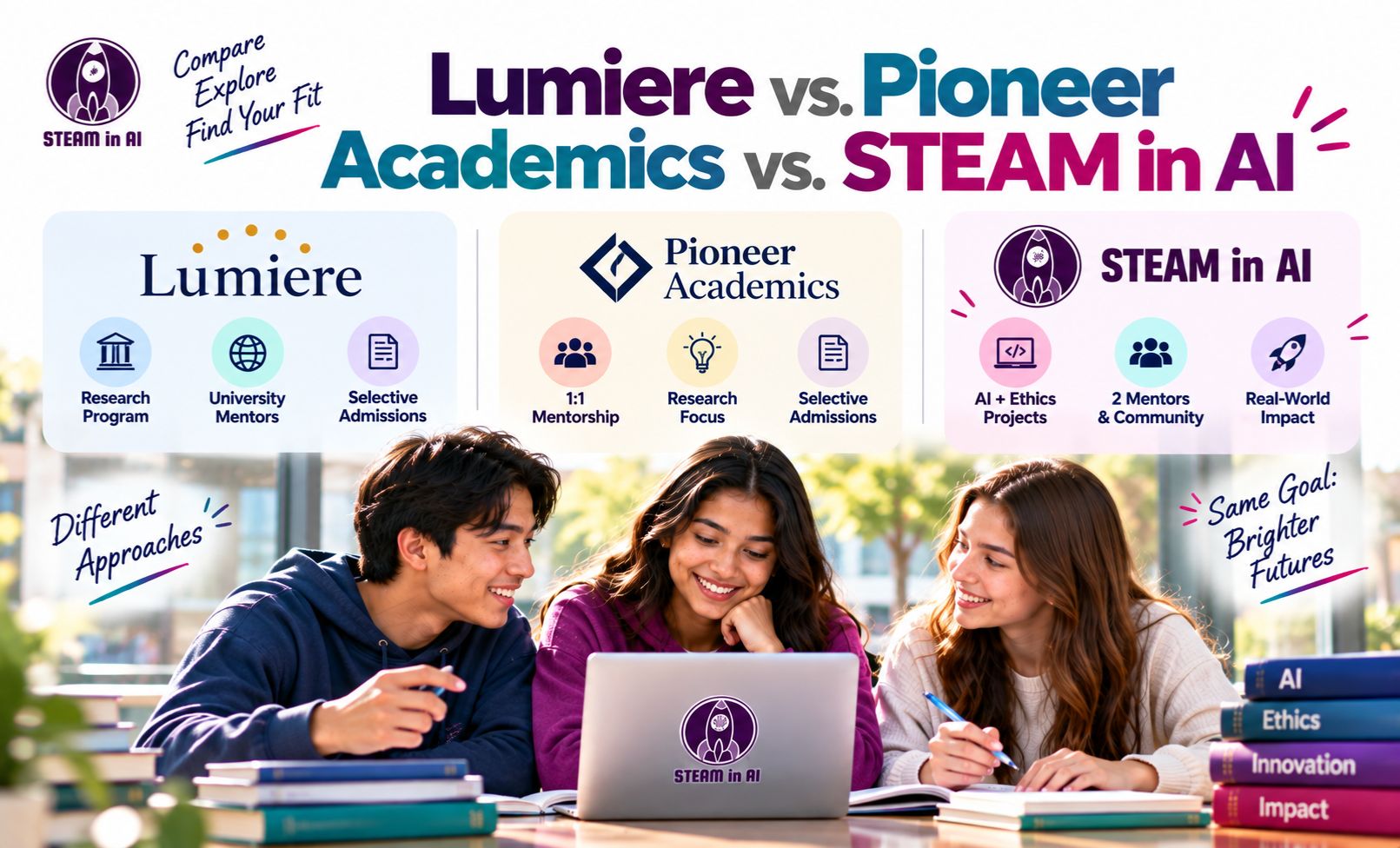
STEAM in AI vs. Algoverse vs. iResearch Institute vs. Future Forward Labs: Comparing AI Research Programs
Parents researching AI programs for high school students find a crowded market. In particular, websites blur together. After all, every program claims world-class mentorship. Likewise, every one promises college-application impact. As a result, sorting the real differences from the marketing takes work — and most families don’t have weeks to do it.
This post compares four AI programs for high school students side by side: STEAM in AI, Algoverse AI Research, iResearch Institute, and Future Forward Labs. In addition, we already published a separate comparison covering Polygence and Inspirit AI. Also, read that one if those programs are on your list.
What These AI Programs for High School Students Share
All four programs target high school students who want real AI or research experience before college. Similarly, all four run virtually. Furthermore, all four promise mentorship plus a finished project. However, that’s where the similarities end.
The differences that actually matter come down to four things. First, who does your student work with? Second, what do they produce? Third, how long does the program last? Finally, does the program adapt to your student — or does your student adapt to the program?
How STEAM in AI’s Two-Mentor Model Works
Generally, most programs assign one mentor per student. In contrast, STEAM in AI assigns two.
Every student works with a 1:1 Project Mentor matched to their interest area. Specifically, these are named industry professionals from companies like NVIDIA, Roblox, or Genentech. In other words, you can look up their LinkedIn before your student’s first session. Meanwhile, a Curriculum Mentor — the program’s founder and Stanford Adjunct — designs each student’s personalized project plan. In fact, she teaches AI for Business to working Silicon Valley professionals.
One mentor owns the technical depth. The other owns the curriculum arc, the ethics framework, and the design thinking layer. Together, they make the work college-application ready. Consequently, your student doesn’t get one perspective — they get two, from professionals with different vantage points.
Clearly, no other program on this list offers this structure.
Algoverse AI Research
Cost: $3,325 for 12 weeks
Mentors: Research PIs affiliated with Meta FAIR, OpenAI, Google DeepMind, Stanford, and CMU
Format: Virtual, rolling cohorts year-round
Output: Publication-ready research papers targeting top AI conferences (NeurIPS, ICML, ICLR workshops)
Algoverse focuses exclusively on AI research publication. To begin with, students choose between Fundamental AI Research and Applied AI Research tracks. From there, they work through a structured pipeline — literature review to conference submission. To date, the program reports a 68–73% conference acceptance rate. Additionally, it covers GPU compute costs.
What parents should weigh: This is a strong option for a student who already wants to publish AI research. Some ML background helps. Moreover, the price point is competitive. However, the trade-off is scope. Algoverse is a research pipeline, not a personalized learning experience. Students who want to build an app, explore ethics, or connect AI to a non-technical interest won’t find that here.
iResearch Institute (IRI)
Cost: $6,978 for 5 weeks (summer session only)
Mentors: A mix of undergraduates, graduate students, and PhDs selected by program founder Dr. Serena McCalla
Format: Virtual, summer only (June–July 2026)
Output: Research papers, abstracts, verbal presentations, competition-ready projects
Unlike the other AI programs for high school students on this list, iResearch Institute covers multiple STEM disciplines — biology, chemistry, physics, data science, and AI. In essence, the five-week summer intensive combines research methods coursework with mentor-guided projects. Notably, alumni have won prizes at Regeneron ISEF, JSHS, and Science Talent Search.
What parents should weigh: IRI’s strength is competition prep across all STEM fields, not just AI. That breadth helps a student who might pivot between disciplines. On the other hand, the trade-off is timing — summer only, so you commit to a fixed five-week window. Mentor variability matters too. For instance, your student could work with a PhD or an undergraduate. At nearly $7,000 for five weeks, the per-week cost is high. Therefore, ask who will mentor your student before enrolling.
Future Forward Labs
Cost: Not publicly listed (available on request)
Mentors: PhD-level researchers with experience at institutions like Stanford and MIT
Format: Virtual, year-round with rolling admissions
Output: Research papers, science fair submissions, working prototypes
Future Forward Labs sits at the intersection of robotics and AI. Students work with PhD-level mentors on individual research projects. Specifically, the program targets grades 9–12 and claims that 91% of students earn regional STEM awards or higher.
What parents should weigh: The year-round format appeals to families who can’t commit to a fixed summer window. However, the pricing is undisclosed — so request a quote and compare before committing. Mentor credentials reference “institutions like Stanford and MIT” without naming individuals. As a result, parents should ask for the specific mentor’s name and background before signing up.
Side-by-Side Comparison of AI Programs for High School Students
| STEAM in AI | Algoverse | iResearch Institute | Future Forward Labs | |
|---|---|---|---|---|
| Duration | 3–12 months | 12 weeks | 5 weeks (summer only) | Flexible |
| Mentors Named? | Yes — LinkedIn-checkable | Affiliated PIs listed | Selected by program founder | Credentials described, not named |
| Mentor Count | Two per student | One | One | One |
| AI-Specific? | Yes — AI + Ethics + Design | Yes — AI research only | No — multi-STEM | Robotics + AI hybrid |
| Build or Research? | Student chooses either track | Research only | Research only | Both (project-dependent) |
| Prerequisites | None | ML background helpful | None stated | None stated |
| Admission | Fit Assessment (no test scores) | 5-minute application | Application + financial aid option | Rolling admissions |
| Personalized Plan | Week-by-week schedule per student | Structured research pipeline | Coursework + project | Individualized projects |
| Continues Past Initial Term? | Yes — students can extend | Per-cohort | Post-program academy available | Flexible scheduling |
How to Choose the Right AI Program for Your High Schooler
Start with your student, not the program. Before comparing AI programs for high school students, ask these questions:
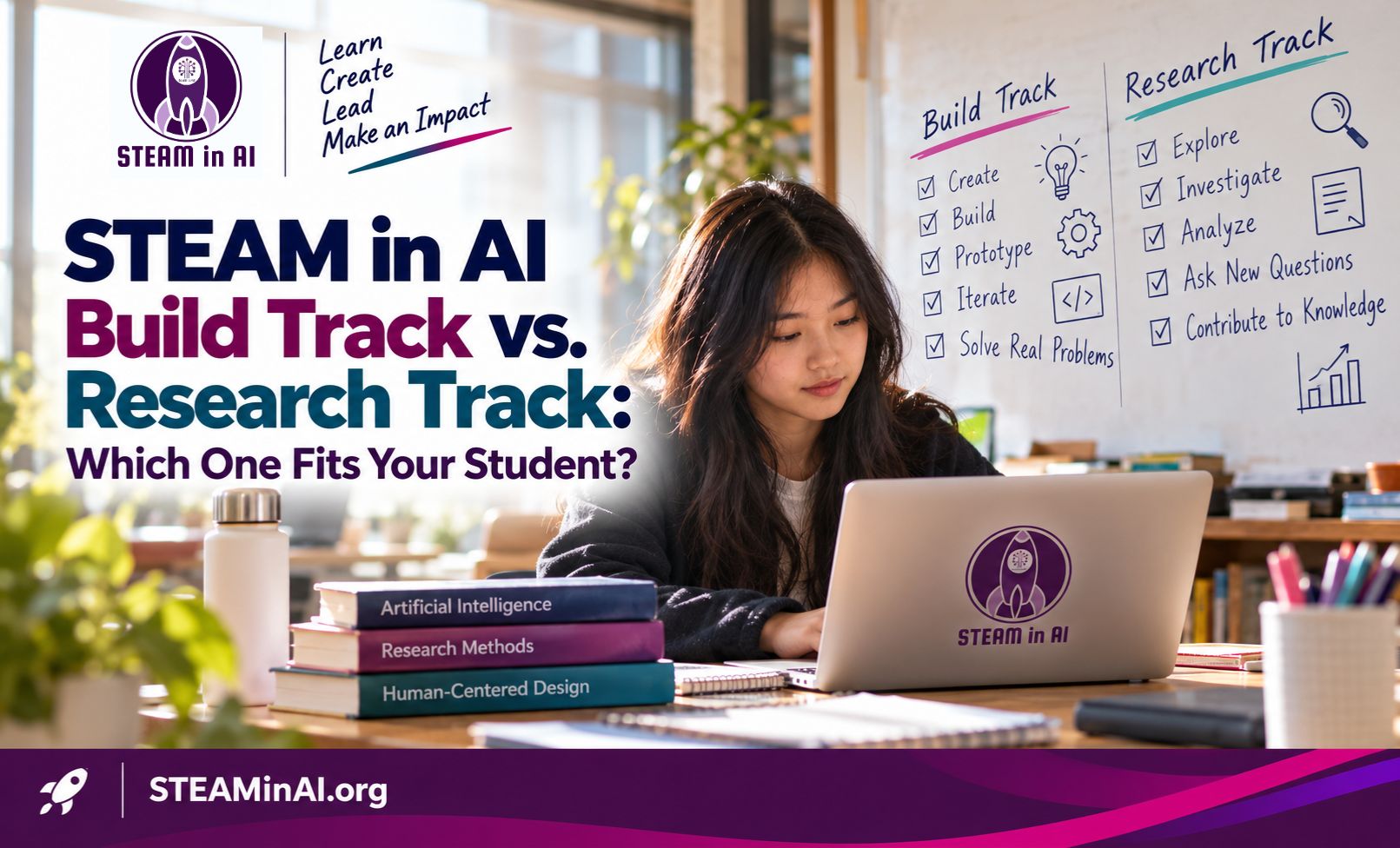
Does your student want to publish research, build something, or both? Algoverse is a research publication pipeline. Future Forward leans toward prototypes and competitions. In contrast, STEAM in AI lets your student choose. The Build Track ships a working AI application. The Research Track produces original research. Meanwhile, iResearch covers research across multiple STEM fields, not just AI.
Does your student have a coding background? Algoverse expects students to implement ML algorithms. STEAM in AI, on the other hand, requires no prerequisites. Indeed, students have started with zero coding experience and gone on to launch apps and earn university acceptances.
Can you name your student’s mentor before enrollment? Above all, this is the question most parents forget to ask. STEAM in AI publishes mentor names and credentials. Algoverse lists affiliated PIs. For the others, request the specific mentor’s name before you commit.
Does the program adapt to your student? Of course, a fixed curriculum works for students who already know what they want. A personalized plan, by contrast, works for those who need the program to meet them where they are. STEAM in AI gives every student a week-by-week project schedule built around their goals.
Frequently Asked Questions
Algoverse AI Research pairs high school students with mentors for AI and machine learning research projects. It focuses on algorithm-driven approaches and typically involves structured timelines. Pricing varies by program tier and project length.
The iResearch Institute (IRI) offers high school students research mentorship across STEM fields including AI. Students work on research papers with guidance from graduate-level mentors. Whether it is worth it depends on your student’s goals — IRI emphasizes academic research output, while programs like STEAM in AI combine research with building working AI applications.
STEAM in AI uses a two-mentor model where students work with both a research advisor and a technical mentor. Unlike programs focused solely on writing papers, STEAM in AI students build real AI applications while conducting applied research, giving them both a tangible project and a research deliverable for college applications.
Key factors include mentor qualifications and accessibility, whether the program produces tangible deliverables like working projects or research papers, the level of personalization in mentorship, program duration and time commitment, cost relative to outcomes, and whether students can present or publish their work.
Yes. AI research programs can strengthen college applications by demonstrating initiative, technical ability, and intellectual depth. The strongest applications come from students who can speak specifically about what they built or discovered. Programs that produce both a research component and a working project give students the most material for application essays and interviews.
Your Student’s Spot Isn’t Guaranteed
Every program on this list fills its cohorts. If your student is comparing options, that means they’re serious — and serious students are exactly who these programs want. The risk isn’t choosing the wrong program. Instead, the risk is researching so long that the right program’s next cohort fills.
Curious whether your student is a good fit for STEAM in AI? We’ll tell you honestly. It starts with a free Fit Assessment. In fact, we turn students away when we’re not the right match.