STEAM in AI Build Track vs. Research Track: Which One Fits Your Student?
Your student wants to do something real with AI — not watch lectures, not follow a tutorial, not add another line to an already-crowded activity list. The question is what shape that “something real” should take: build a working AI application, or conduct original AI research and publish it. When you compare the STEAM in AI Build Track vs Research Track, the answer depends on how your student thinks — and what they want to walk away with.
STEAM in AI offers both. The STEAM in AI Ethics Build Intensive is for students who want to ship something — an app, a tool, a prototype that solves a problem they care about. The STEAM in AI Ethics Research Intensive is for students who want to investigate a question rigorously and publish their findings in a peer-reviewed journal.
A Stanford AI Adjunct Faculty member and ISEF Grand Award Judge designed both tracks. Both pair your student with two mentors. Both integrate ethics, design thinking, and entrepreneurship alongside the technical work. The difference is the deliverable — and the kind of student each track serves best.
This post walks through both tracks in detail so you can figure out which one fits.
What Does the STEAM in AI Build Track Actually Look Like?
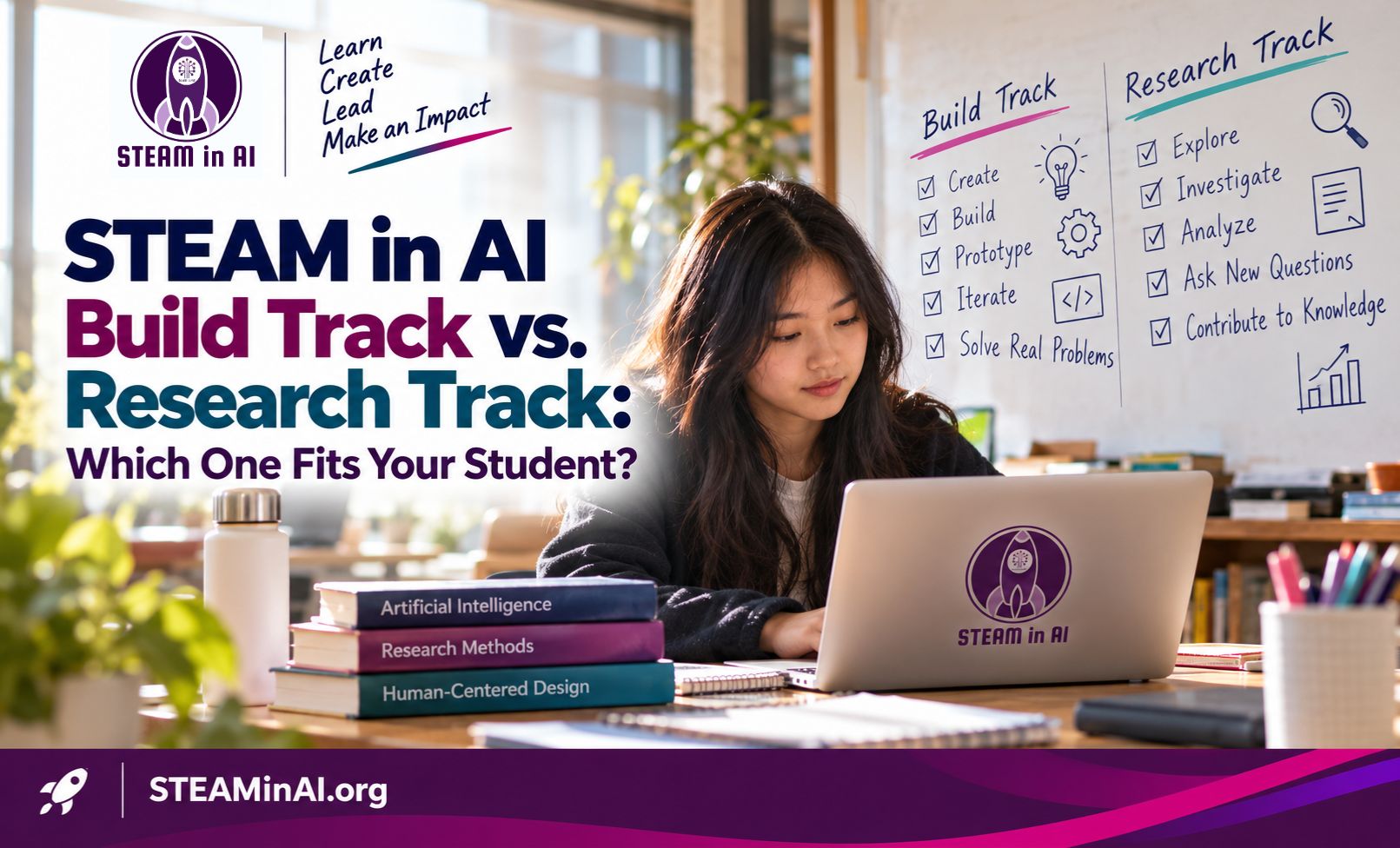
The Build Track is a cohort-based intensive. Your student joins a small group — five students maximum — and builds a working AI project from scratch over 12 weeks.
Nobody assigns the project from a menu. Before the 12-week intensive begins, your student works through a structured onboarding process where we design the project around their specific interests, activities, and career goals. A student interested in biomedical engineering builds something different from a student interested in business strategy or environmental science. The project belongs to them — it comes from what they care about.
The Build Track delivers a working MVP — a minimum viable product that actually runs. Students who continue past the initial 12 weeks can iterate on that project, launch it on the App Store, prepare it for competitions like the Presidential AI Challenge, and present it at conferences.
Who it fits best: Students who want to make something tangible. Students who light up when they see their code actually work. Students applying to computer science, engineering, business, design, information science, or any field where showing “I built this” carries weight.
What Does the STEAM in AI Research Track Actually Look Like?
The Research Track is a 1:1 rolling enrollment — no cohort, no fixed start date. Your student works individually with a Research Advisor and a named Principal Investigator to develop an original research question, conduct the study, and prepare findings for peer-reviewed journal submission.
Nobody picks the research question from a list. During onboarding, we work directly with your student to develop a personalized question from their interests — iterating until it is sharp, original, and answerable within their timeframe. A student interested in the intersection of AI and healthcare develops a different question from a student interested in AI bias in hiring or AI applications in environmental science.
The Research Track delivers a manuscript ready for journal submission — with full publication support, including identifying appropriate peer-reviewed venues and preparing the paper to meet their standards. The Principal Investigator’s name and credentials appear alongside your student’s on every publication.
Who it fits best: Students who are drawn to questions more than products. Students who want to understand why something works, not just that it works. Students applying to fields like statistics, data science, public policy, pre-med, neuroscience, or any discipline where published research demonstrates serious intellectual commitment.
How STEAM in AI’s Two-Mentor Model Works in Each Track
Both tracks give your student two mentors. This is not standard — ask any program you are evaluating how many mentors your student works with, and whether you will know their names before you enroll.
In the Build Track:
- A Curriculum Mentor (Shilpi Agarwal — Stanford AI Adjunct, ISEF Grand Award Judge in Robotics & ML) leads every cohort through AI fundamentals, ethics, design thinking, and entrepreneurship.
- A dedicated 1:1 Project Mentor from industry — engineers and researchers from organizations like NVIDIA and Roblox — matched to your student’s specific project area. Weekly sessions, every week, for the full program.
In the Research Track:
- A Principal Investigator (Shilpi Agarwal) whose credentials appear on every publication. The PI provides the research framework, ethical grounding, and strategic oversight that journal reviewers look for.
- A dedicated 1:1 Research Advisor — a researcher matched to your student’s specific topic area — for the weekly technical sessions that move the research forward.
Two mentors means your student gets both breadth (the framework, the ethics, the “so what”) and depth (the technical expertise specific to their project or research area). One mentor cannot deliver both credibly.
Build Track vs. Research Track: A Side-by-Side Look
To make the STEAM in AI Build Track vs Research Track decision easier, here is what each track offers at a glance:
| Build Track | Research Track | |
|---|---|---|
| Format | Cohort (max 5 students) | 1:1 rolling enrollment |
| Duration options | 3, 6, or 12 months | 3, 6, or 12 months |
| Primary deliverable | Working AI application (MVP) | Research manuscript for journal submission |
| Mentors | Curriculum Mentor + 1:1 Project Mentor | Principal Investigator + 1:1 Research Advisor |
| Mentor credentials | Named, verifiable — LinkedIn shared before sessions begin | Named, verifiable — PI credentials on every publication |
| Prerequisites | None | None |
| Admission | Fit Assessment only — no GPA or test score cutoff | Fit Assessment only — no GPA or test score cutoff |
| Framework | AI + Ethics + Design Thinking + Entrepreneurship | AI + Ethics + Design Thinking + Entrepreneurship |
| After the program | Continue to iterate, launch, compete, present | Continue to publish, submit to more journals, compete, present |
What Makes STEAM in AI Different From Every Other AI Program
The table above tells you what each track includes. But if you are comparing STEAM in AI to anything else on the market, there are structural differences worth understanding — because they change what your student actually walks away with.
The project is designed around your student, not assigned from a catalog. Before the program begins, your student goes through a multi-step onboarding process where we build the project or research question from their interests, their academic direction, and their career goals. A week-by-week project schedule document exists for every student, written by their mentor before sessions begin. No two are alike.
You know who the mentors are — by name — before you enroll. STEAM in AI shares mentor names, credentials, and LinkedIn profiles before the first session. The question worth asking any program is simple: will I know my child’s mentor’s name and background before we pay?
It is not just AI. Every student — Build or Research — works through the STEAM in AI Framework: Identify the Problem, Research and Empathy, Ethical Considerations, Prototype or Build, Impact and Story. The framework integrates ethics, design thinking, and entrepreneurship alongside the technical work. This is why STEAM in AI students can talk about why their project matters, not just how it works. That distinction shows up in essays, interviews, and competition presentations.
There are no prerequisites. Julia Kessman had never written a line of code when she started STEAM in AI. She is now studying Statistical Science and Computer Science at Duke. Raina Agarwal was fourteen with zero coding experience. She launched an app on the App Store. This is not a program that assumes prior Python and filters out everyone who does not have it.
The relationship does not expire on a calendar date. After the initial engagement, students can continue — refining a project, launching it, entering competitions, submitting to additional journals, presenting at conferences. Parents say this is what reassures them most: it is not a 10-session package with a fixed end date. It is a pathway.
Questions Worth Asking Before You Choose Any AI Program
Whether you are looking at a Build-style program or a Research-style program, these questions will help you compare what is actually being offered:
- Who is the lead mentor or PI, and what are their credentials? Can you verify them independently? STEAM in AI’s Curriculum Mentor and PI is a Stanford AI Adjunct Faculty member, ISEF Grand Award Judge in Robotics and Machine Learning, and NeurIPS presenter.
- Will your student’s project or research question be personalized — or selected from a preset list? STEAM in AI designs every project from scratch, around the student.
- How many mentors does your student work with? STEAM in AI pairs every student with two — one for framework and curriculum, one for the 1:1 technical work.
- Does the program teach ethics, design thinking, and entrepreneurship — or just the technical part? STEAM in AI integrates all four through the 5-step STEAM in AI Framework.
- How many hours of direct mentor contact are included, and what is the effective cost per hour? Know the number before you compare prices.
- What happens after the program ends? Can your student continue building, publishing, competing — or does the relationship end on a set date?
- Will you know your student’s mentor’s name before you enroll? The answer should be a person, not a category.
These are not trick questions. They are the questions that separate programs built around the student from programs built around a curriculum template. Whether you are weighing the STEAM in AI Build Track vs Research Track or looking at other programs entirely, ask them everywhere — the answers make the differences clear.
Which STEAM in AI Track Should Your Student Choose?
When it comes to the STEAM in AI Build Track vs Research Track, here is the simplest way to think about it:
Choose the Build Track if your student wants to make something that works — an app, a tool, a system — and show it to the world. The deliverable is a working product. The story is “I identified a problem and built the solution.”
Choose the Research Track if your student wants to investigate a question rigorously and contribute original findings to the field. The deliverable is a published paper with a named PI. The story is “I asked a question nobody had answered and found something worth sharing.”
Both stories are powerful. Both demonstrate intellectual initiative, technical skill, and the ability to see something through. The right choice depends on how your student thinks — whether they reach for the wrench or the microscope first.
And if your student is not sure? That is exactly what the Fit Assessment is for. We will tell you honestly whether this is the right program — and which track fits — based on who your student actually is, not what looks best on a list.
Ready to Find Out Which Track Fits Your Student?
Every student earns their spot in STEAM in AI through a Fit Assessment — and cohort sizes are small by design. We say no to students we are not the right fit for, which is what makes the yes mean something.
If your student has a spark of interest in AI — whether they want to build or research, whether they have coded before or not — the question is not whether they are ready. The question is whether there is a spot open.



AI Restrictions in Schools: A State-by-State Guide for Parents

STEAM in AI is a Proud Bronze Sponsor of Evergreen Valley High School's Double Dhamaka Dandiya Night