What Is AI Project Mentorship for High School Students?
AI project mentorship for high school students is the least understood product in this category, largely because five different things are sold under the same name. Parents researching AI programs for their kids run into a naming problem fast: “AI program” gets used for five genuinely different things, and the marketing language rarely makes the distinction clear. Here’s the actual taxonomy, and where AI project mentorship. A category most families haven’t heard named before — fits into it.
The short answer
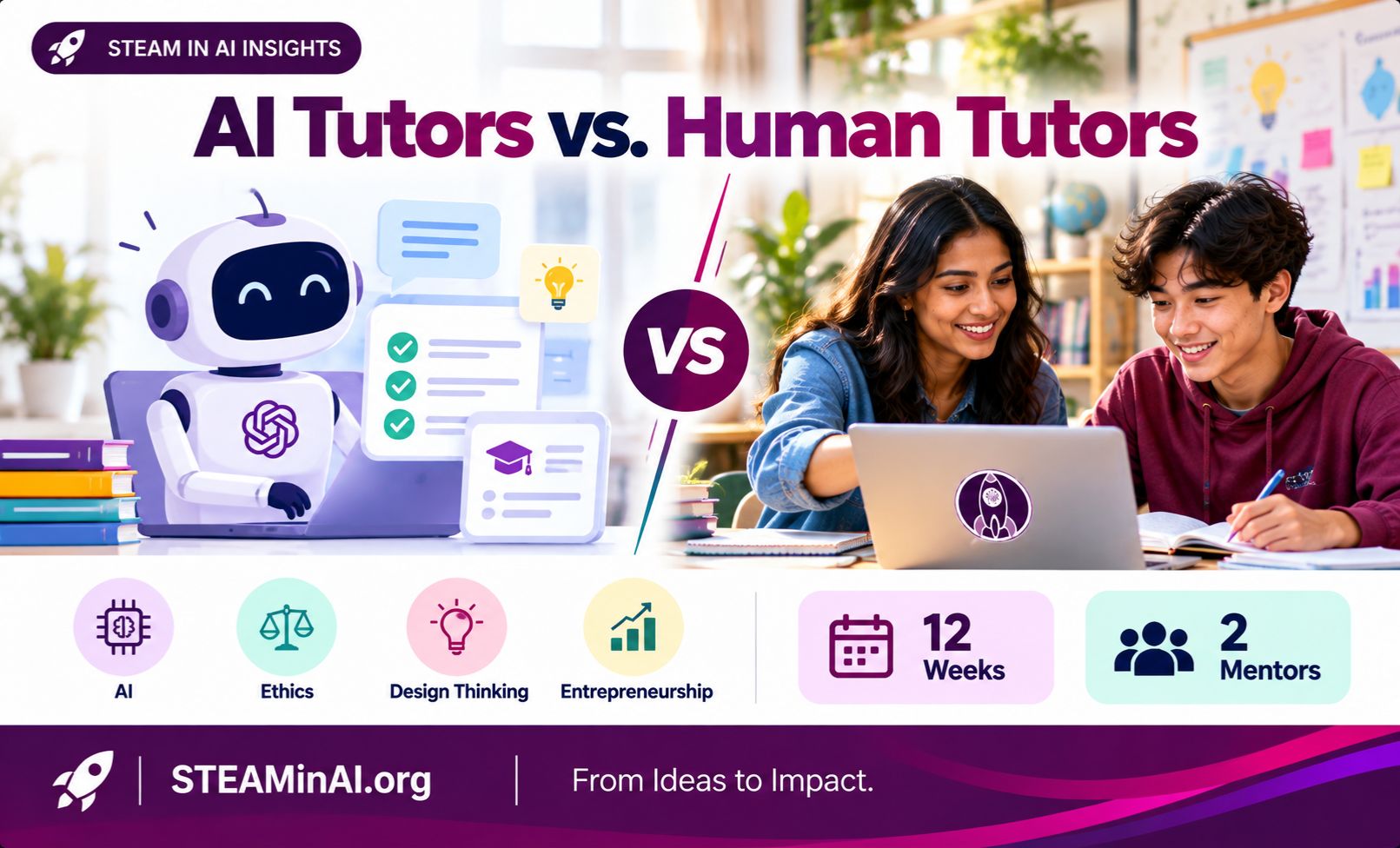
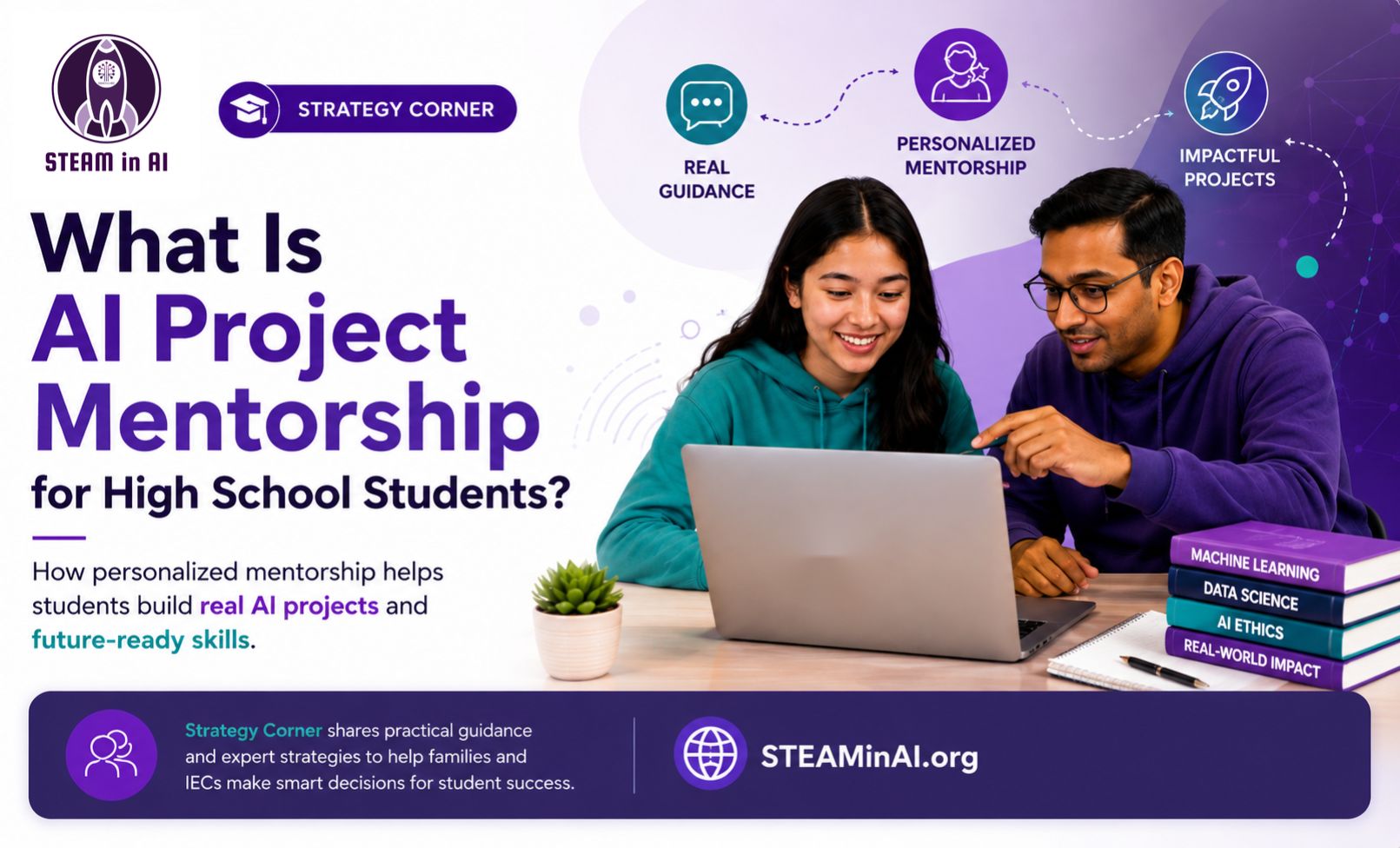
AI project mentorship pairs a high school student one-to-one with a working practitioner to build something original over roughly three months. It differs from a course (fixed syllabus, same output for everyone) and from research mentorship (the deliverable is always a paper). At STEAM in AI the student works with two mentors — a curriculum mentor across the cohort and a separate 1:1 project mentor from NVIDIA, Roblox, Genentech or Turo — and chooses an AI Build or AI Research track. No prior coding required.
New to us? Sit in on a free STEAM in AI Live Lab before you decide anything — no form, no call, just watch a session.
The five types, defined by what the student is actually doing
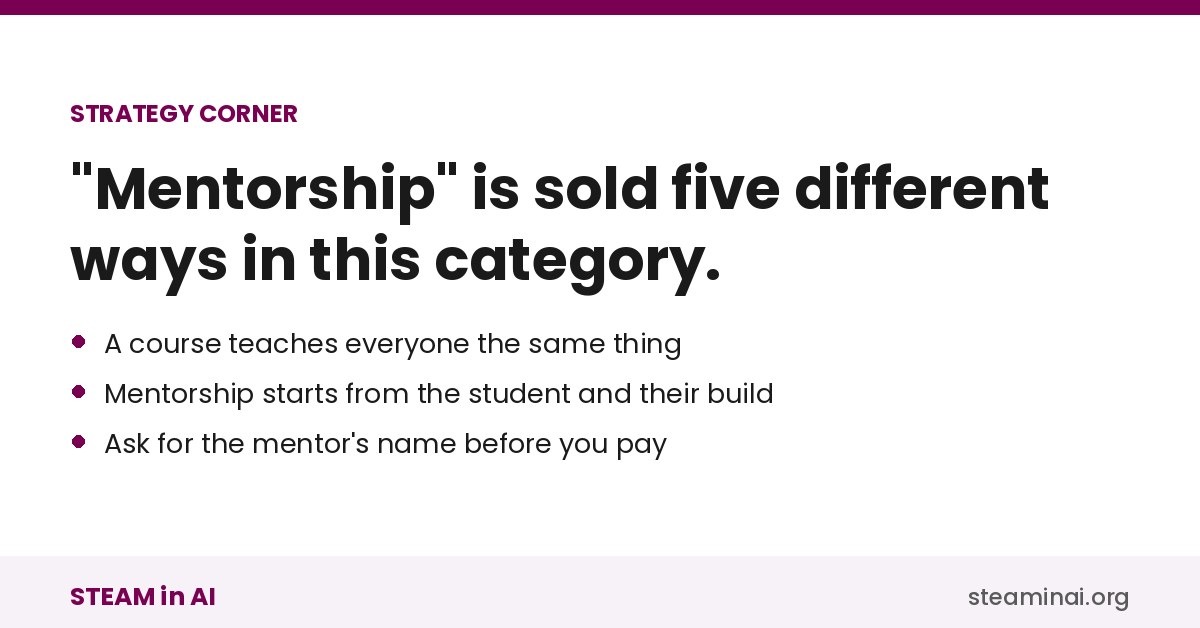
A course teaches skills through a fixed curriculum. The student follows a syllabus. The end product, if there is one, is largely the same across every student in the cohort. Good for building a foundation. Not designed to produce an individual accomplishment.
A camp is a short, often social, often exposure-focused experience. Strong for sparking interest, especially in younger students. Rarely long enough to produce depth.
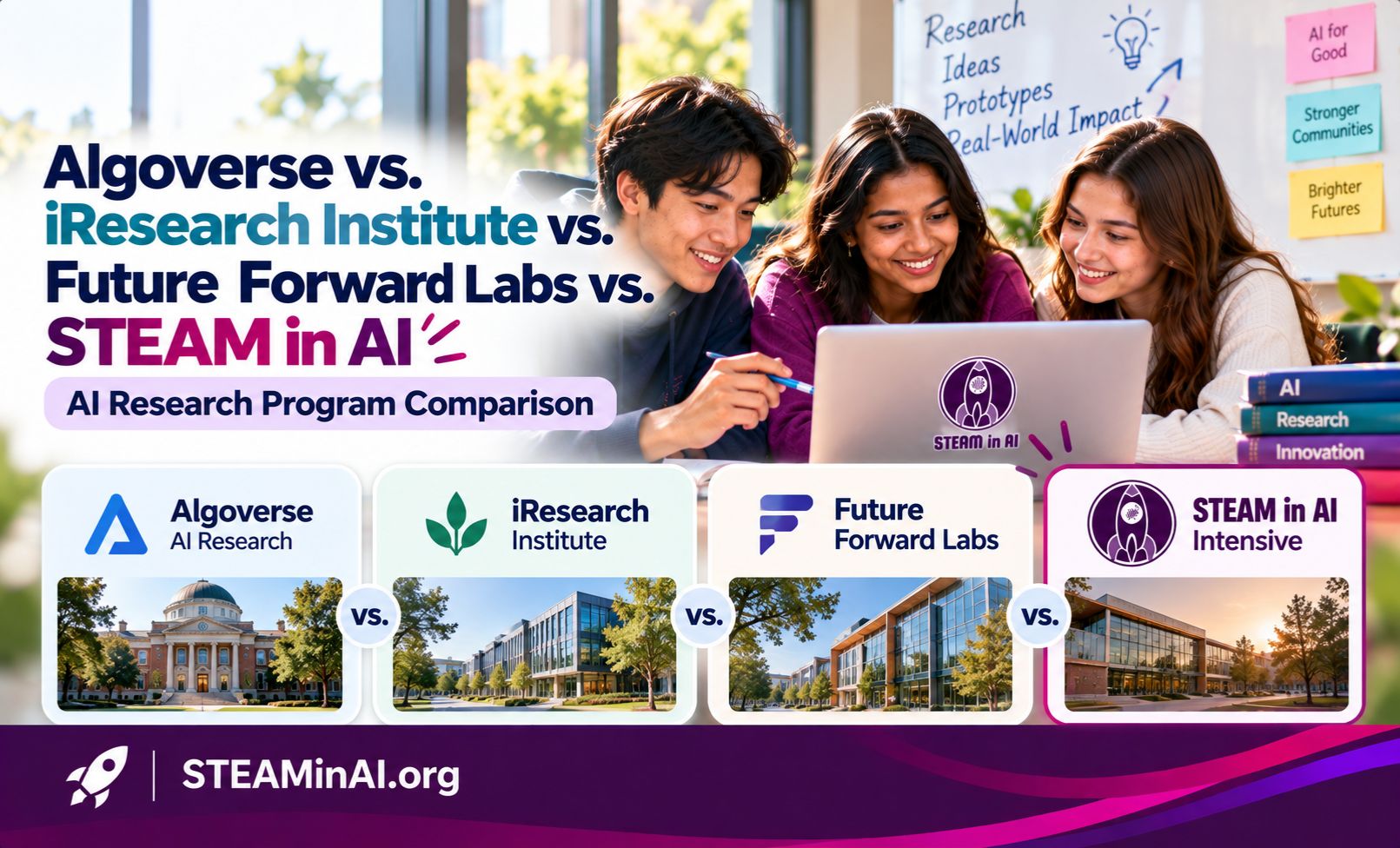
Elite research programs (RSI, PRIMES, CMU AI Scholars) place already-exceptional students into a real research environment, usually for free, through a highly competitive admissions process. The research is genuinely rigorous. The bottleneck is getting in, not the quality once you’re there.
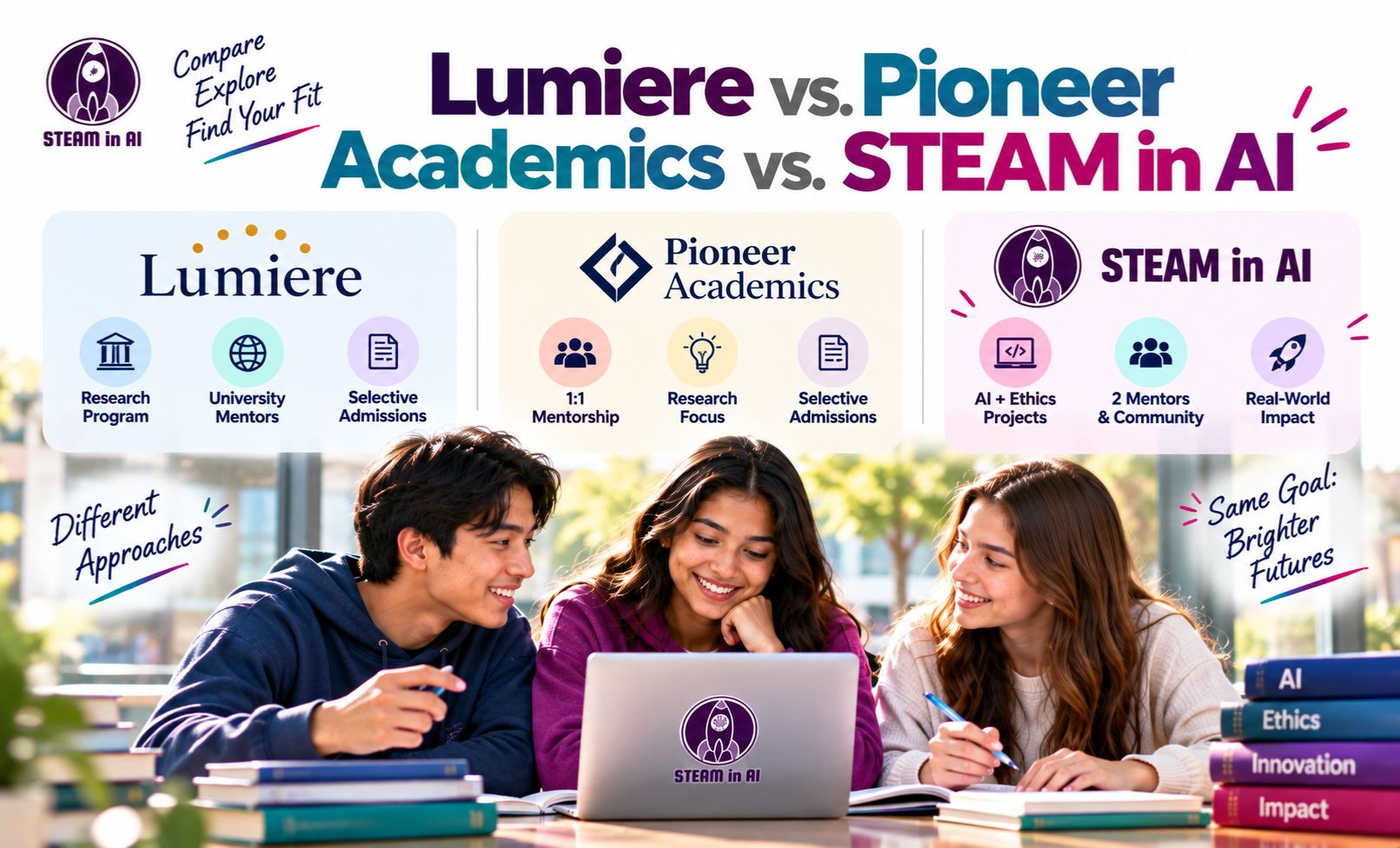
Research mentorship pairs a student 1:1 with a researcher, usually PhD-level, to produce an original research paper over a period of months. The methodology is fixed: identify a question, review literature, run experiments, write it up. Polygence, Lumiere, and Inspirit AI’s research track all work this way.
Project mentorship also pairs a student 1:1 with an expert mentor over a period of months. But the deliverable isn’t locked to a research paper. It can be a working product, a deployed tool, a research project, or a hybrid, chosen around what the student actually wants to build or investigate. STEAM in AI runs on this model, structured into two tracks: AI Build (create something functional) and AI Research (investigate a question rigorously). With the student choosing based on interest, not the program dictating the format.
The one distinction in AI project mentorship for high school students that matters
Every parent comparing these programs eventually lands on the same real question, whether they phrase it this way or not: does the student pick the topic, or does the program?
In a course or camp, the topic is fixed by the curriculum. In elite research and most research-mentorship programs, the topic is usually student-proposed but must fit a research methodology. A testable question, a literature review, a written paper as the endpoint. In project mentorship, the constraint loosens further: a student interested in AI and medicine, AI and small-business operations, or AI and creative writing can build toward an outcome that actually matches that interest, rather than forcing it into a research-paper shape.
Neither approach is “better.” A student who already knows they want to do graduate-level research is well served by the research-methodology track. A student who wants to build something they can point to and say “I made this”. An app, a tool, a model that does something specific — is usually better served by project mentorship.
▶ Watch Nila present her project
What “the student picks the topic” looks like in practice
The distinction above is easy to assert and harder to demonstrate, so here is what student-chosen actually produces.
Eli volunteered at a senior centre every Tuesday and watched older people struggle with email software designed for someone forty years younger. His project became an AI email agent driven by plain English — “read my last three emails,” “move my college emails to a folder.”
Raina had spent years in dermatologist waiting rooms with no straightforward way to know whether her skin was actually improving. Her project became an agent that tracks a condition over time.
Nila led her school’s environmental club and knew exactly how confusing recycling rules were, and how they changed from one city to the next. Her project became a chatbot that retrieves each city’s real guidelines.
None of those came from a list of suggested topics. Each came from somewhere the student already spent time. That is the mechanism the category name is pointing at, and it is why a project mentorship programme cannot really hand a student their subject.
How AI project mentorship works at STEAM in AI
STEAM in AI runs this model with two mentors rather than one. Shilpi Agarwal, who teaches AI for Business at Stanford Continuing Studies to working Silicon Valley professionals, is the curriculum mentor for every cohort. A separate industry project mentor, from NVIDIA, Roblox, Genentech or Turo, is matched to the individual student.
Before the twelve weeks begin, that mentor writes a week-by-week project schedule for that one student, built around their interests, activities and intended major. No two schedules are alike, and that is the practical difference between a program that is personalized and a program that says it is. Admission to STEAM in AI is by fit assessment only: no GPA cutoff, no test scores, and no requirement that the student has ever written code.
The structural detail most families never learn to ask about
There is a second distinction inside project mentorship that changes what a student receives, and almost nobody explains it publicly: whether the person teaching the curriculum is the same person supervising the project.
They are different jobs. Teaching AI foundations, ethics, design thinking and entrepreneurship to a cohort is one skill. Guiding one student through the specific technical problem their project happens to require is another — and the second one changes per student. A project on cardiac signal processing needs a different supervisor from a project on imbalanced fraud data.
Programmes that use one person for both tend to produce projects that cluster around that person’s expertise, which is one reason “every student’s final project looks the same” is such a common complaint in this category.
When you evaluate any program, ask which model it runs. The answer tells you a lot about how personalized the projects can actually be.
Why AI project mentorship for high school students matters for college applications
Admissions officers see a lot of “attended AI research program at [university]” language. What reads as distinctive is specificity: what the student actually did, what broke, what they learned, and what they built or found. That specificity is available in any of these categories. But it’s the design goal of project mentorship in a way it isn’t for a fixed-curriculum course or a short camp.
Build or research — a choice that belongs to the student
One more distinction, because it determines what the student ends up with.
Most research-mentorship programs produce a paper. That is their methodology and it is a good one. But it means a student who wants to ship something has to force their interest into a research shape, and a student who wants to investigate rigorously has no route in a build-only program.
Project mentorship can accommodate both, and the choice should sit with the student. Our two tracks are AI Build — produce something that works and that people can use — and AI Research — investigate a question properly and write it up. Neither has prerequisites, and the track is chosen with the student rather than assigned.
The reason this matters for applications is that the two produce different sentences. “I built X and people use it” and “I investigated Y and found Z” are both strong. What is weak is a research paper written by someone who wanted to build, or a hasty prototype from someone who wanted to think.
Quick reference: AI project mentorship for high school students
| If your student… | Look at |
|---|---|
| Is already exceptional and free time is flexible | Elite research programs (reach) |
| Wants a formal research paper and has a specific question | Research mentorship (Polygence, Lumiere, Inspirit) |
| Wants to build a working AI product or tool | Project mentorship (STEAM in AI, Build track) |
| Wants rigorous investigation but not necessarily a paper | Project mentorship (STEAM in AI, Research track) |
| Just wants exposure and foundational skills first | A course, then revisit mentorship next year |
Compare programs by cost and structure · STEAM in AI vs. Polygence vs. Inspirit AI
Naming the category is the easy part
Knowing that project mentorship exists does not tell you whether your student is ready for it. A student who needs foundations first will struggle inside a supervision model, and a student who already has direction will be bored by a curriculum. Getting that judgement wrong costs a year, and most families only discover it in month three.
Our AI Project & Fit Assessment exists to make that call honestly, before anyone pays anything. We will tell you if a course is the better first step, or if another program suits your student more than ours does.
FAQ: AI project mentorship for high school students
What is AI project mentorship for high school students?
It is a structure where a student builds or researches something of their own with a working professional guiding the process. The mentor does not deliver a syllabus. They react to what the student is actually building, which means the direction changes as the project does.
How is mentorship different from an online AI course?
A course teaches the same material to everyone and ends with the same assignment. Mentorship starts from the student and produces something only that student would have made. Both have value. They are not interchangeable, and they should not carry the same price.
How many hours of 1:1 time should a student expect?
Ask for the number before you enrol, and ask whether it is genuinely one-to-one. A program with a 5:1 ratio is running a small class. That can be excellent, and it is not mentorship.
Who are the mentors, and can I see them before paying?
You should be able to. Ours are practising engineers and researchers, including Marius Fleischer at NVIDIA, Mustafa Shah at Roblox, Tanvir Ahmed Shaikh at Genentech and Dhruv Diddi at Turo. Meet them in Meet the mentors.
Does AI project mentorship help with college applications?
Indirectly, and only through the work. A project a student can defend gives them something specific to write about. That is different from a program name on an activity list. See what a spike actually is.
The word means five different things. Find out which one your student needs.
Fifteen minutes on a call is usually enough for us to tell you whether your student wants a course, a cohort or real 1:1 mentorship. We would rather send you to the right structure than sell you ours.


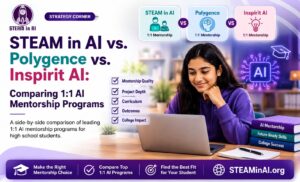
STEAM in AI vs. Polygence vs. Inspirit AI: Comparing 1:1 AI Mentorship Programs

An AI Project for Business Majors: How Eli Built an Email Agent and Got Into USC