AI Projects for Data Science Applicants (and Statistics Majors)
AI projects for data science applicants fail in one specific way: most take a public dataset and run it through a model everyone already uses. Statistics and data science sit awkwardly in the admissions landscape. They are technical enough that families assume a student needs to arrive already advanced, but they are not computer science, and the things that impress a CS reader are not quite the things that impress a statistics department.
The distinction is worth getting right, because it changes what a project should demonstrate.
What statistics programs read for in AI projects for data science applicants
Not engineering ability. Not the size of the model. Rigour — evidence that the student understands what a result does and does not support.
Most student projects in this space fail the same way. They reach a confident conclusion drawn from a shaky method. High accuracy on data that leaked. A correlation described as a finding. A model that saw its test data during training. These are not exotic mistakes. They are the default outcome when nobody is supervising the statistics.
A project that shows the student anticipating those traps is doing something an admissions reader in a statistics department will actually notice.
The AI projects for data science applicants we know best
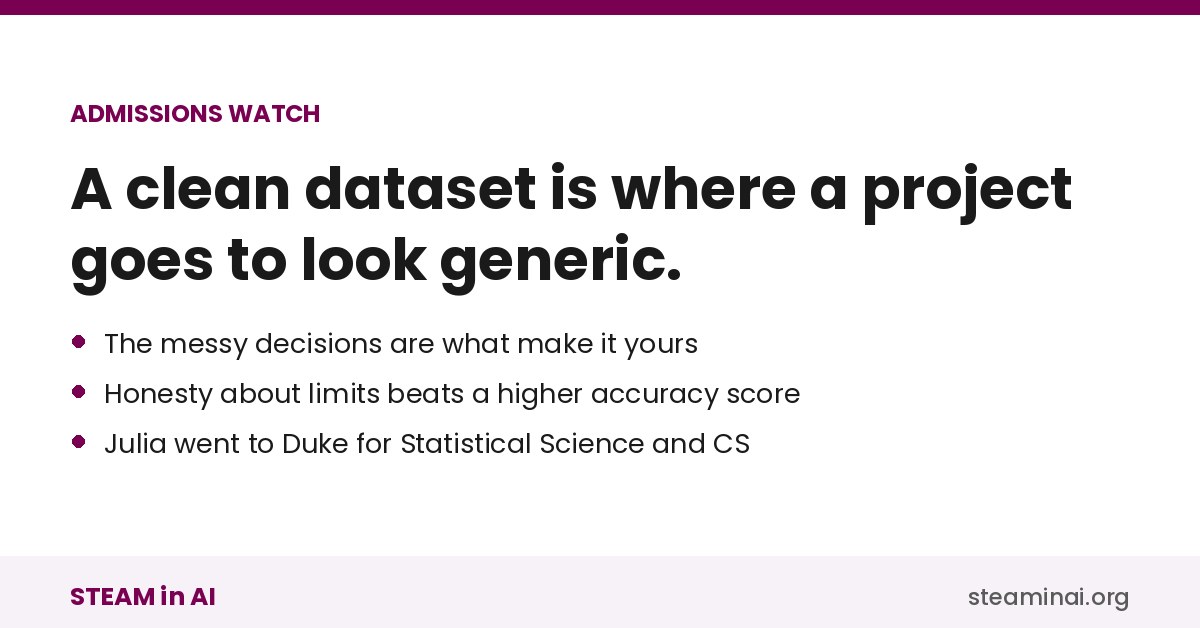
Julia had never written a line of code when she started. She now studies Statistical Science and Computer Science at Duke.
What she had at the outset was a researcher’s temperament: she had run a nonprofit, done two years of science research electives, and was comfortable with analytics and writing. Her mentor Juliana Shihadeh, herself a published researcher on bias in AI systems, therefore spotted someone who could learn to work with real medical data rather than someone who needed to be taught to code first.
She built a health technology AI application using Stanford Health imaging data, working on detecting anterior cruciate ligament tears in MRI scans. People remember the medical framing. The reason it worked for a statistics application is the part underneath: real clinical imaging data, a genuine classification problem, and the constant question of whether a result means what it appears to mean.
Why “zero coding” is not the obstacle families think
It is worth dwelling on this, because it is the assumption that keeps the most suitable students out of the field.
Statistics rewards a particular kind of mind. Careful, sceptical, comfortable with uncertainty, and reluctant to be impressed by its own results. However, that disposition owes nothing to prior programming experience, and students who have it are often exactly the ones who assume the technical fields are closed to them.
Julia is the clearest case we have. Zero code at intake, and now in a statistical science major at Duke. The coding was learnable in weeks. The disposition was already there.
The step in the STEAM in AI Framework that data projects live on
Every STEAM in AI project runs through five steps, and the third one is Ethical Considerations: what could this get wrong, and who would it affect. For a statistics or data science applicant that step is not a formality. It is where class imbalance, sampling bias and the cost of a false positive stop being homework problems and start being decisions with a person on the other end.
It is also the easiest step to skip, and the one admissions readers notice. A student who has genuinely wrestled with what their model gets wrong writes about it differently, and a reader who assesses thousands of applications can tell.
The other shape a strong project takes
Where Julia’s project derives its rigour from working with real clinical data, another route is to pick a problem where the statistics themselves are the difficulty.
Ivy, now at Santa Clara studying computer science and engineering, built a fraud detection model on a dataset where fewer than one percent of transactions were fraudulent. That single property makes the problem statistically hard in a way a reader immediately grasps: predict “not fraud” every time and you are 99% accurate and useless. Everything interesting happens in how you handle that imbalance. Sampling, feature selection, choosing metrics that are not accuracy, and testing whether an apparent improvement is real.
Her project would serve a statistics application as well as it serves a computer science one, which is exactly the point.
Four things worth building into AI projects for data science applicants
A metric that fits the question. Knowing why accuracy is the wrong measure for a rare event, and saying so, demonstrates more than a high number would.
An honest validation approach. Held-out data, plus an explanation of how the student avoided leakage.
A stated limitation. What the result does not show. Students fear this weakens the project. It is the single strongest signal of statistical maturity available to them.
A real dataset. Public research datasets exist in almost every domain. Working with one that nobody cleaned for teaching purposes changes what the student learns.
The through-line across strong AI projects for data science applicants
Ultimately, the most impressive-sounding project does not win a statistics application. Instead, the student who can be trusted with a conclusion wins it. Moreover, caution demonstrates that trust far better than confidence does.
AI programs for students who aren’t coders yet · What is AI project mentorship?
The disposition is the rare part. The coding is not.
The students most suited to this field are frequently the ones who rule themselves out earliest. Careful, sceptical, strong at analysis, and convinced that the absence of a programming background disqualifies them. Every year that assumption goes unchallenged is a year of depth they do not get back.
Indeed, we have taken students with no coding experience at all, although we have also told families honestly when we were not the right fit. A free AI Project & Fit Assessment is where we make that call, before anyone commits to anything.
The same project, five other ways
Fraud detection sounds like a finance project, or a computer science one. Ivy studies Computer Science and Engineering at Santa Clara, and her model had to find fraud in a dataset where under one percent of transactions were fraudulent. Here is the same build, pointed in five other directions — the exercise we run at STEAM in AI before a project is designed.
| Toward mathematics or statistics | The imbalanced-class problem itself. What accuracy means when ninety-nine percent of your data carries one label, and why the obvious metric lies to you. |
|---|---|
| Toward finance | Money-laundering typologies. What the patterns look like as human behaviour, before a model ever sees a row of data. |
| Toward economics | What a false positive costs a real customer whose card is declined at a checkout, and how to price that against the cost of a missed fraud. |
| Toward cybersecurity | Adversarial behaviour. What happens to a detector once the people it detects start adapting to it. |
| Toward public policy | Anti-money-laundering regulation: what it obliges banks to catch, and where the obligation and the technology come apart. |
Same data, same model, five different questions. A statistics applicant writes about the third one and a policy applicant writes about the fifth, and both are describing work they actually did.
FAQ: AI projects for data science applicants
What makes a strong data science project for applications?
A question worth asking and honest handling of the messy parts. Where the data came from, what was missing, what assumptions the student made, and what the result does not prove. Readers notice the honesty more than the accuracy score.
Is a Kaggle competition enough?
It shows competence and rarely shows a person. Kaggle hands you a clean dataset and a defined target, which removes precisely the decisions that make a project yours.
Should a statistics applicant do research or a build?
Research suits students drawn to evidence and inference. A build suits students who want a product. Students choose their track with us rather than inheriting whichever one the program prefers.
Where have our statistics-bound students gone?
Julia went to Duke for Statistical Science and Computer Science, having arrived with no coding experience at all. Nila went to Illinois for Information Science.
Can one project work for several majors?
Yes, and this is the part families underestimate. The same healthtech imaging build supported a Duke statistics application and a UC Davis biomedical engineering application, because the framing and emphasis differed.
The best AI projects for data science applicants start from a messy question, not a clean file.
The interesting decisions live in the messy version, which is why we start from a question your student cares about rather than a leaderboard. Bring us the question and we will help shape it into something defensible.