AI Programs for High School Students Who Aren’t Coders Yet
Some AI programs for high school students who aren’t coders yet assume a year of Python that your student does not have, without saying so on the page. A lot of parents start researching AI programs assuming their student needs to already know how to code. Most program marketing doesn’t correct that assumption. It’s easier to write copy for students who are already technical than to actually design for beginners. But “interested in AI” and “already programs in Python” are two different starting points, and conflating them shuts a lot of genuinely curious students out before they start.
The short answer
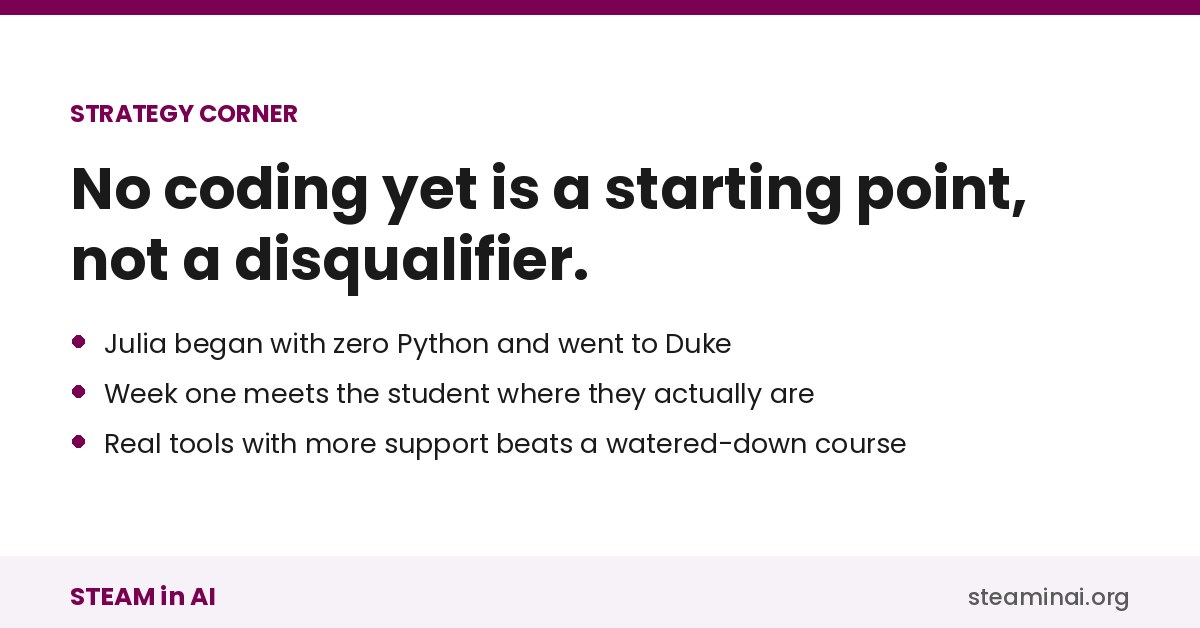
Yes — and roughly half of every STEAM in AI cohort arrives having never written a line of code. Week one is written for the individual student, so a beginner starts by installing Python while a fluent coder starts at problem framing. Julia had written no Python at all and left with a working build; she now studies Statistical Science and Computer Science at Duke. Raina was fourteen with no coding and took her app to the App Store. There is no prerequisite and no test score. Admission is by fit assessment only.
New to us? Sit in on a free STEAM in AI Live Lab before you decide anything — no form, no call, just watch a session.
▶ Watch Raina’s full Live Lab on YouTube
Here’s what actually requires coding experience, what doesn’t, and what a real beginner-friendly path looks like.
Two students who started at zero
Before the categories, the two cases that make the argument better than any explanation could.
Julia had never written a line of code — ever. She brought a researcher’s temperament instead. Two years of science research electives. A nonprofit she founded. Real comfort with analysis and writing. Her mentor, Juliana Shihadeh, is a published researcher whose work on bias in AI image generation appeared in AI & SOCIETY. She saw someone who could learn to handle real medical data. Not someone who needed coding lessons first.
Julia built a health technology AI application using Stanford Health imaging data. She now studies Statistical Science and Computer Science at Duke. Zero code at intake, a quantitative major at one of the most selective universities in the country.
Raina was fourteen and had not started high school. No coding. No extracurricular record. She did have one problem she had lived with for years: dermatologist appointments that never told her whether her skin was improving. She worked with Marius Fleischer, an AI architect at NVIDIA, and built an AI agent that tracked her condition over time. From there it became a web application, then a mobile app. The finished app went to the App Store, and the 2026 Presidential AI Challenge accepted her project.
Neither was technical when they arrived. Both were curious about something specific, which turns out to be the part that cannot be taught in twelve weeks.
What “learning to code” actually looks like inside a project
It is worth seeing the mechanics, because “we start from scratch” is easy to say.
Here is the opening of a real project plan, written by a mentor for one of our STEAM in AI students before his program began. His project was detecting atrial fibrillation. An irregular heart rhythm that raises stroke risk. In electrocardiogram recordings.
Week one: install Python. Syntax, strings, conditionals, functions, lists and dictionaries. The end-of-week session covers getting Python running on his own laptop and plotting a Mandelbrot set.
Week two: loops, classes, file input and output. By the end of that session he has used scikit-learn for the first time and downloaded a published research database of ECG recordings.
Week three: the cardiac cycle, how to read an ECG, and signal denoising. Loop through every recording, strip out the noise, and adjust the filter until the result looks right. He is not given the correct settings. He is told to experiment until he can see the difference.
Two weeks from no programming to a professional dataset open on his laptop. That is the actual shape of it. Prior coding gates far less than families assume.
Where prior coding is usually required
Elite research programs (RSI, PRIMES, CMU AI Scholars) generally assume strong existing technical background as a baseline for admission. These are reach programs for already-advanced students, not entry points.
Most research-mentorship programs default to a methodology built on running experiments and analysing results computationally. Some accept true beginners. Many are built around students who already have foundational Python and statistics.
AI/ML-specific bootcamps and courses often assume the student can already write and debug basic code. Curriculum time goes to AI concepts, not programming fundamentals.
What “no prerequisites” actually means at STEAM in AI
STEAM in AI does not ask for Python, a prior course, or a test score. Admission is by fit assessment only. Week one is written for the individual student, so a beginner may start by installing Python while a fluent coder starts at problem framing. Nobody sits through the wrong week.
Julia arrived at STEAM in AI having never written a line of code and left with a working build. She now studies Statistical Science and Computer Science at Duke. Raina was fourteen with no coding at all, built an AI skin-health app, took it to the App Store, and had her work accepted into the Presidential AI Challenge.
Where AI programs for high school students who aren’t coders should start
Introductory group courses. A structured course that starts from zero is a reasonable first step, before any mentorship program, if your student is curious but has never coded. This buys foundational literacy without a large financial commitment.
Project mentorship built for beginners. A smaller number of 1:1 mentorship programs are explicitly designed to start with a student who has no programming background. STEAM in AI’s Build track is one of these. The mentor works with the student from first principles, building both the technical skill and the project simultaneously, rather than assuming the skill already exists. The project scope adjusts to the student’s actual starting point rather than a fixed curriculum built for a technical baseline.
Domain-first framing, technical second. Some students come to AI through medicine, business, or creative work. They have no wish to become software engineers. For them, motivation lasts longer when a program opens with “what problem do you want to solve” instead of “here’s the Python syllabus.” The coding becomes a tool in service of the interest, not a prerequisite gate in front of it.
What beginner-friendly AI programs for high school students who aren’t coders look like
It doesn’t need to be technically simple. It needs to be scoped to where the student actually is. Give a student with zero coding background a patient 1:1 mentor and several months, and a working AI tool is a realistic target. A classifier. A simple recommendation system. A chatbot with one clear purpose. An image-recognition demo tied to a question they actually care about. The mentor supplies the scaffolding a self-taught beginner would spend months building alone.
For a true beginner, honesty about pace matters most. Watch for any program promising a “fast track” to an impressive AI project in two weeks. It is either overselling the outcome, or quietly leaning on the mentor to do the work. Real beginner-to-builder progress, done honestly, takes real time — which is exactly why multi-month 1:1 mentorship formats tend to serve non-coders better than short intensives.
No prerequisites: AI programs for high school students who aren’t coders, with both tracks open
Worth stating plainly for any family reading this and doing the mental arithmetic on whether their student qualifies: there are no prerequisites. Not for the Build track. Not for the Research track. We decide admission on a fit assessment, not on grades or test scores.
Julia had written no code at all and chose work that was research-shaped. Raina had written no code and chose to build and ship. Both routes stayed open to both of them. The student chooses the track with us. We never assign it.
That matters more than it sounds, because the most common reason a non-coder’s project goes badly is not the coding. It is being pushed into the wrong shape of work by a program that only offers one.
The bottom line on AI programs for high school students who aren’t coders
Not knowing how to code yet disqualifies nobody from a serious AI program. It does narrow the field sharply. Some programs genuinely design for that starting point. Others simply never mention the assumption out loud. Ask one question directly, before enrolling: has this program worked with a student who had never coded, and what did that project look like? A program with a real answer to that question is worth far more than one with a polished brochure.
What is AI project mentorship? · Best AI programs for high schoolers: full guide
The students who lose most are the ones who never ask
Almost every family that writes AI off does it quietly. Nobody writes to say “my daughter has never coded, so we assumed this was not for her.” They just stop reading. A student who would have thrived spends the year on something forgettable instead. The assumption costs more than a wrong choice would.
We take students who have never written a line of code, and we also turn students away when the fit is wrong. The only way to know which one your student is, is to ask us and let us answer honestly.
One beginner’s project, five other ways
Raina was fourteen and had written no code at all. She started from a skin condition she had lived with for years, built an AI agent to track it over time, took it to the App Store, and had her work accepted into the Presidential AI Challenge. A project that starts with nothing technical is not a smaller project — it is one with more directions available to it.
| Toward pre-med | Longitudinal symptom tracking. What a photograph taken weekly shows that a single clinic visit cannot. |
|---|---|
| Toward data science | Image data over time, and the awkward problem of a dataset that shifts because the light in a bathroom shifts. |
| Toward business | Shipping to an app store at fourteen: pricing, a privacy policy, the review process, and the first ten users. |
| Toward design | An interface for someone anxious about their own skin. What the app should not show them, and when. |
| Toward public health | Access. Who has a dermatologist within an hour’s drive and who does not. |
None of those five requires a student to arrive knowing Python. Each requires them to care about the question, which is the thing STEAM in AI selects for and the thing no program can teach in twelve weeks.
FAQ: AI programs for high school students who aren’t coders
Can my student join an AI program with no coding experience?
Yes. We admit on fit rather than on prior coding, and several of our strongest graduates began at zero. Julia had never written Python when she started and finished with a working build, then went to Duke for Statistical Science and Computer Science.
What can a complete beginner realistically build in 12 weeks?
More than parents expect. A first week spent on Python fundamentals still leaves eleven weeks of building. Hugo started at the introduction to Python and finished with an ECG model for detecting atrial fibrillation.
Do AI programs for non-coders teach real AI or a simplified version?
Look for programs that teach the real tools with more support, rather than a watered-down curriculum. Our STEAM in AI students work in Python with the same libraries professionals use, including scikit-learn and PyTorch, with a mentor beside them.
Is an AI research track better than a build track for a beginner?
Neither is better by default. A student who wants a product picks the build track; a student drawn to questions and evidence picks research. We let students choose, because forcing a beginner down the wrong track is how programs lose them in week four.
How do I tell whether a program secretly requires coding?
Ask what happens in week one. If the answer is a project kickoff rather than instruction, the program is assuming skills your student may not have yet.
AI programs for high school students who aren’t coders should start where the student is. It is a starting point we plan around.
Every project plan we write begins where the student actually is, which is why week one looks different for a beginner than for a student who has been coding since ninth grade. Tell us where yours is starting and we will show you what twelve weeks could produce.



Best AI Programs for High School Students: 2026 Parent's Guide
Is a $5,000 AI Program Worth It for a High School Student?