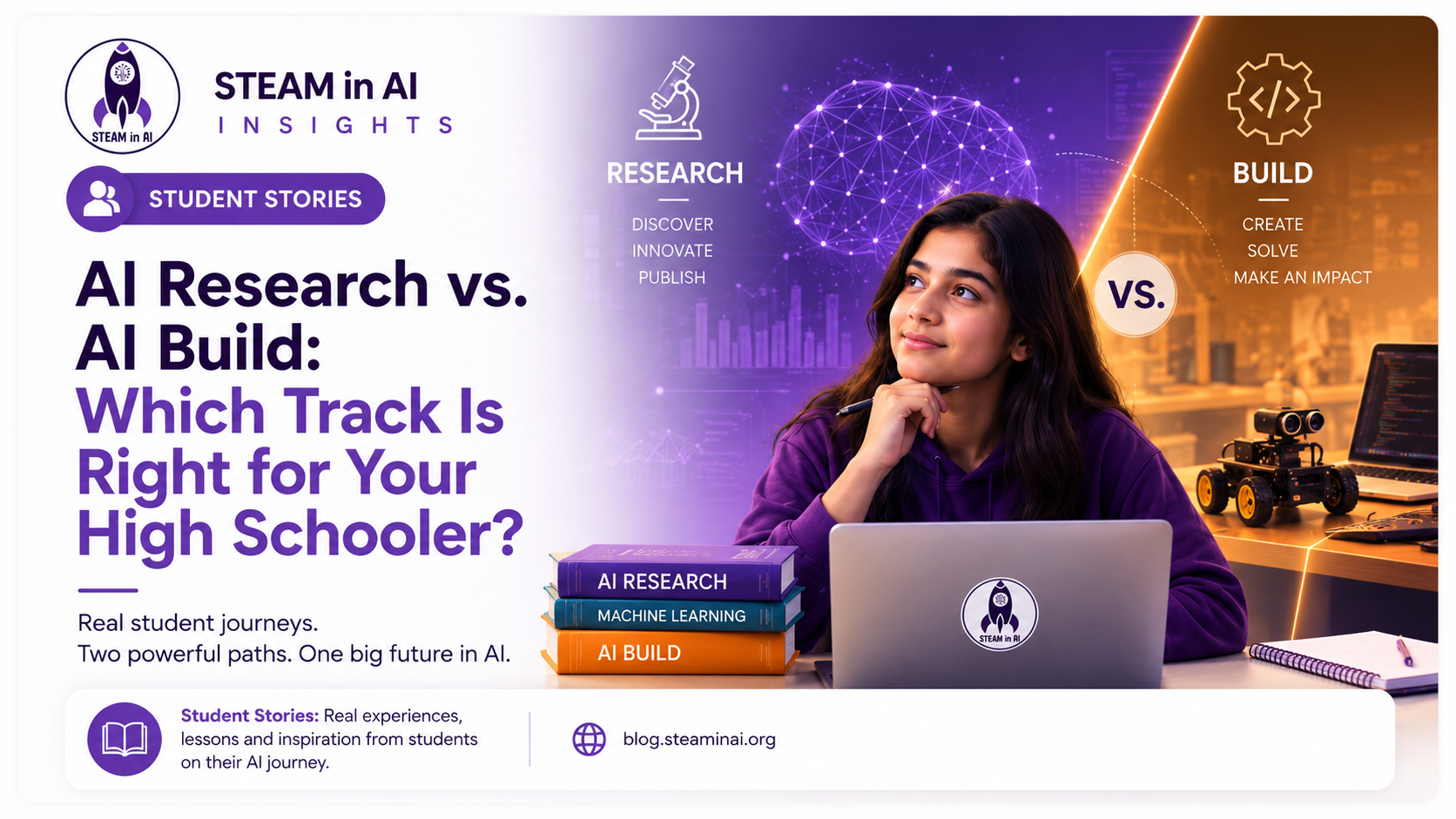
AI Research vs. AI Build: Which Track Is Right for Your High Schooler?
Not every student who wants to work with AI has the same goals—and they shouldn’t. Some students want to publish research. Others want to build something that solves a problem they care about, in a domain they already love. Both are legitimate paths. Both produce strong college application outcomes. The question is which one fits your student.
At STEAM in AI, students work in one of two distinct tracks: Computational AI Research and AI Build. Here’s what each means, who it’s designed for, and how to decide.
The AI Research Track: Computational, Original, Publishable
The AI Research track is designed for students who want to do real research—not read about it. Students work directly with an industry professional mentor on an original problem in machine learning, computer vision, natural language processing, or a related computational area.
This isn’t a curriculum. There’s no predetermined topic or step-by-step tutorial. Students identify a research question, design an approach, build and test a model, and produce work that can be submitted to competitions or publications.
What students in this track produce:
- Original machine learning models or experiments
- Research papers suitable for submission to science fairs, academic journals, or student research competitions
- Competition placements—STEAM in AI students have earned recognition in the U.S. Presidential AI Challenge
- GitHub portfolios demonstrating genuine technical depth
Who this track is for: Students with intellectual curiosity about how AI systems work—not necessarily students who already know how to code. If your student asks “how does this work?” more than “what can I build with this?”, the research track may be the better fit.
Why Mentor Credentials Matter in AI Research
AI research is a field where credentials are verifiable. A recommendation letter from a mentor who has presented at NeurIPS—the world’s leading machine learning conference—published peer-reviewed work, or judged at ISEF, the most prestigious pre-college science competition in the world, carries weight that a graduate student instructor cannot.
STEAM in AI’s program director, Shilpi Agarwal, is a NeurIPS presenter and has served as a Grand Judge at ISEF. The mentors in our research track are industry professionals with real technical backgrounds—not graduate students running a curriculum. This matters because admissions readers and competition judges can assess whether a student’s claimed research is credible. When the mentor is credible, the work is credible.
The AI Build Track: Personalized, Domain-Agnostic, Accessible
The AI Build track is built around a different premise: every student has a domain they care about. A student interested in public health, fashion, music, environmental science, sports analytics, or education can apply AI to problems in that domain—without needing a computer science background to start.
Students in this track begin by identifying a real problem in an area they already know and care about. Their mentor—an industry professional with experience in applied AI—helps them scope the project, understand what’s technically feasible, and build toward a working solution.
What students in this track produce:
- A working AI application, tool, or model tied to a domain the student owns
- A project narrative with a clear origin story, technical decisions, and real results
- Demonstrated ability to connect AI to a non-CS field—a rare and valued combination in college applications
Who this track is for: Students who know what they care about but don’t yet know how to apply AI to it. Students who aren’t planning to major in computer science but want AI in their toolkit. Students who want to build something, not just study something.
Raina, a STEAM in AI student, came in with a health problem she was trying to understand—not a project idea. Working with her mentor, she built an AI-powered skin health application. It became the centerpiece of her college application portfolio.
How to Choose
Ask your student two questions:
Do you have a problem you want to solve, even if you don’t know how yet? → AI Build track.
Are you curious about how AI systems actually work—the math, the models, the underlying mechanics? → AI Research track.
If the answer to both is yes, the Strategy Consult is where we work that out together. Both tracks produce real, verifiable outcomes. The difference is in where the student’s curiosity naturally points.
What Both Tracks Share
Regardless of track, every STEAM in AI student gets:
- A 1:1 match with an industry professional mentor—not a grad student or teaching assistant
- A maximum cohort of five students, which means real attention, not a classroom
- A student-owned project from day one
- A program structure designed to produce something tangible and verifiable by the end
We don’t offer certificates of participation. We offer outcomes students can point to, speak about in depth, and build on.
Ready to Find the Right Fit?
Book a free Strategy Consult with our team. We’ll talk through your student’s interests, timeline, and goals—and help identify which track will produce the most meaningful work before their application deadlines.
STEAM in AI is currently forming Cohort 2. Spots are limited to five students by design.