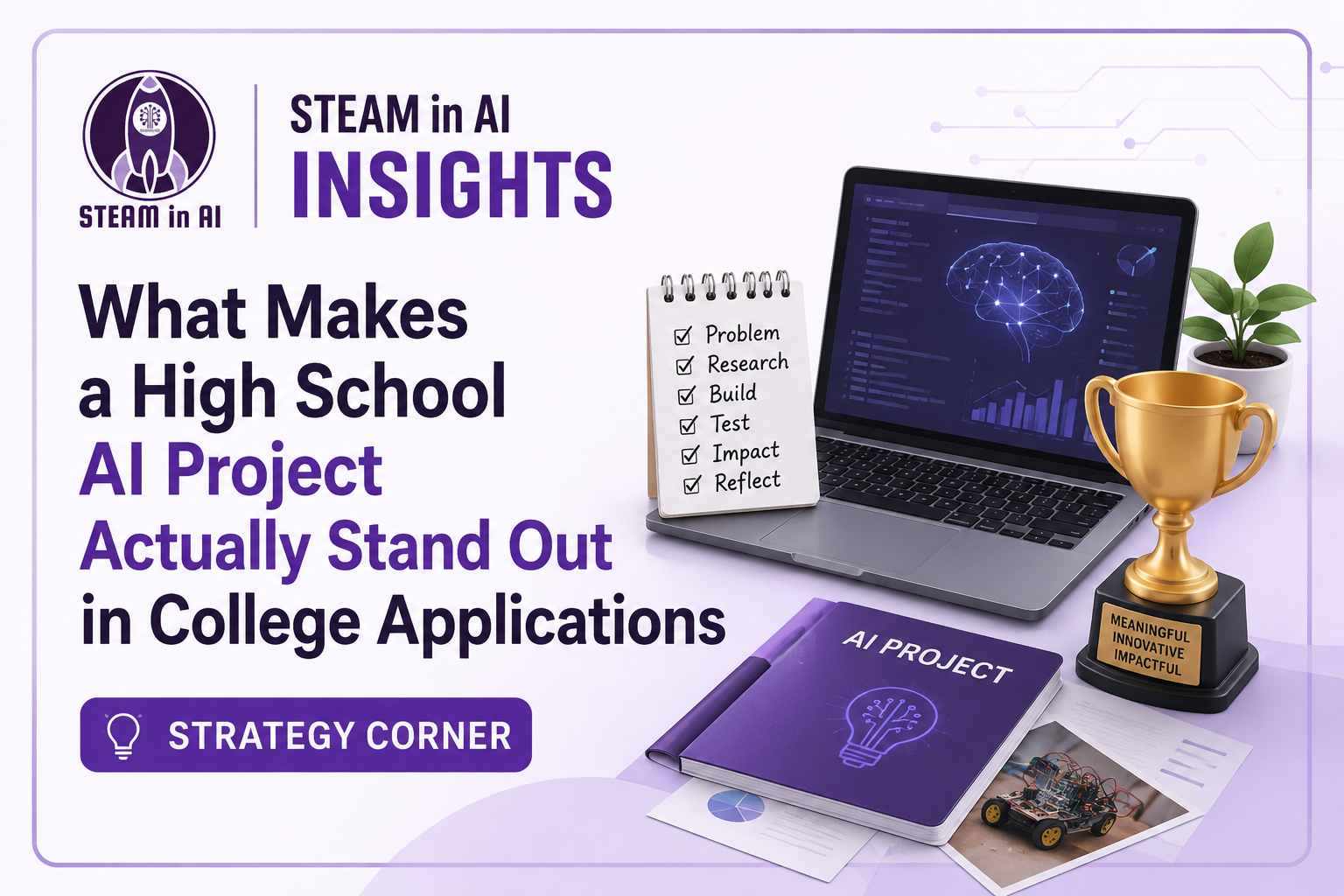
What Makes a High School AI Project Actually Stand Out in College Applications
When a student says “I built an AI project,” admissions officers at selective colleges hear it dozens of times per application cycle. Disease detectors. Climate models. Chatbots. The same handful of templates, built from the same tutorials, written about in ways that sound nearly identical.
The problem isn’t that AI is a bad extracurricular. It’s that most AI programs give every student the same project to build.
What actually makes a high school AI project stand out isn’t the technology. It’s the story behind it—and the evidence that the student made real decisions, solved a real problem, and had a mentor worth mentioning.
The Problem With Template AI Projects
Most AI programs work like this: a cohort of students goes through a curriculum together, learns how neural networks work, and builds a project in a predetermined domain—healthcare, climate, finance. Everyone finishes with something real, but nothing original.
That’s a good starting point. But it’s not differentiation.
Admissions officers at MIT, Stanford, and selective liberal arts colleges have said publicly that they look for depth of commitment and ownership—not just completion of a program. A project a student built because it was assigned to them reads differently than a project a student built because they genuinely noticed a problem and decided to solve it.
What Admissions Officers Actually Look For
Three things consistently distinguish the AI projects that show up in compelling college applications:
1. A real problem with a personal origin story. Not “I’m interested in AI and climate,” but “I noticed that my community’s air quality data wasn’t publicly accessible, so I built a tool to visualize it.” The problem is specific. The reason for building it is personal. The student can speak about it with detail and conviction.
2. A tangible artifact. Something that exists and works—a deployed app, a published paper, a tool with actual users, a competition placement. Not a certificate of completion. Not a slide deck.
3. A mentor with real credentials. A recommendation letter from an industry professional who can speak to the student’s technical choices, problem-solving, and growth carries far more weight than one from a program instructor. Mentors who work in the field know what good looks like—and can say so specifically.
What This Looks Like in Practice
At STEAM in AI, we have seen what this produces.
Mustafa, a high school student, identified a problem he cared about and built an AI project that earned him a place in the U.S. Presidential AI Challenge—one of the most recognized AI honors for young Americans.
Raina came to us not with an idea, but with a problem: she struggled to find reliable information about a skin health issue affecting her. Her mentor helped her turn that frustration into a working AI application. She did not need a coding background to start. She needed a problem worth solving and a mentor who could help her build toward it.
Eli worked through our program and went on to the University of Southern California. His project was his own from the beginning—and that showed in every part of his application.
None of these students built the same project. None of them followed a template. All of them had something real to say.
Two Tracks, One Principle
The AI Research track is for students who want to pursue computational AI research—working on original problems in machine learning, computer vision, or natural language processing alongside an industry professional mentor. This track can lead to competition placements, publications, and research credentials that hold up to scrutiny.
The AI Build track is for students in any domain—biology, economics, music, public health, social science—who want to apply AI to a problem they care about. No coding background required. The student identifies the problem; the mentor helps them build toward a solution.
Both tracks share the same principle: the student owns the idea. The mentor brings the expertise. The outcome is something real.
Why Starting Early Matters
The students who produce the most compelling AI projects for college applications are rarely the ones who started the summer before senior year. A student who begins in 9th or 10th grade—or even in middle school—has time to develop a problem worth solving, build iteratively, and arrive at senior year with a multi-year arc rather than a sprint project.
Admissions readers notice the difference between “I did this program last summer” and “I have been working on this since 10th grade.” The latter suggests genuine interest. The former suggests strategic resume-building.
What to Do Next
If your student is in grades 6–12 and is considering an AI extracurricular, the most important question to ask is: Will my student own the project idea, or will they follow someone else’s template?
STEAM in AI accepts a maximum of five students per cohort. We keep it small by design—so every student gets the mentorship, attention, and intellectual challenge they actually need.
Schedule a free Strategy Consult to talk through which track fits your student’s goals, interests, and timeline. Cohort 2 is now forming.


Does AI Experience Help High School Students Get Into College?
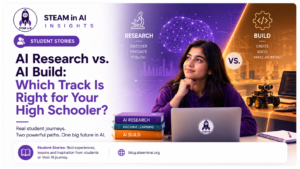
AI Research vs. AI Build: Which Track Is Right for Your High Schooler?