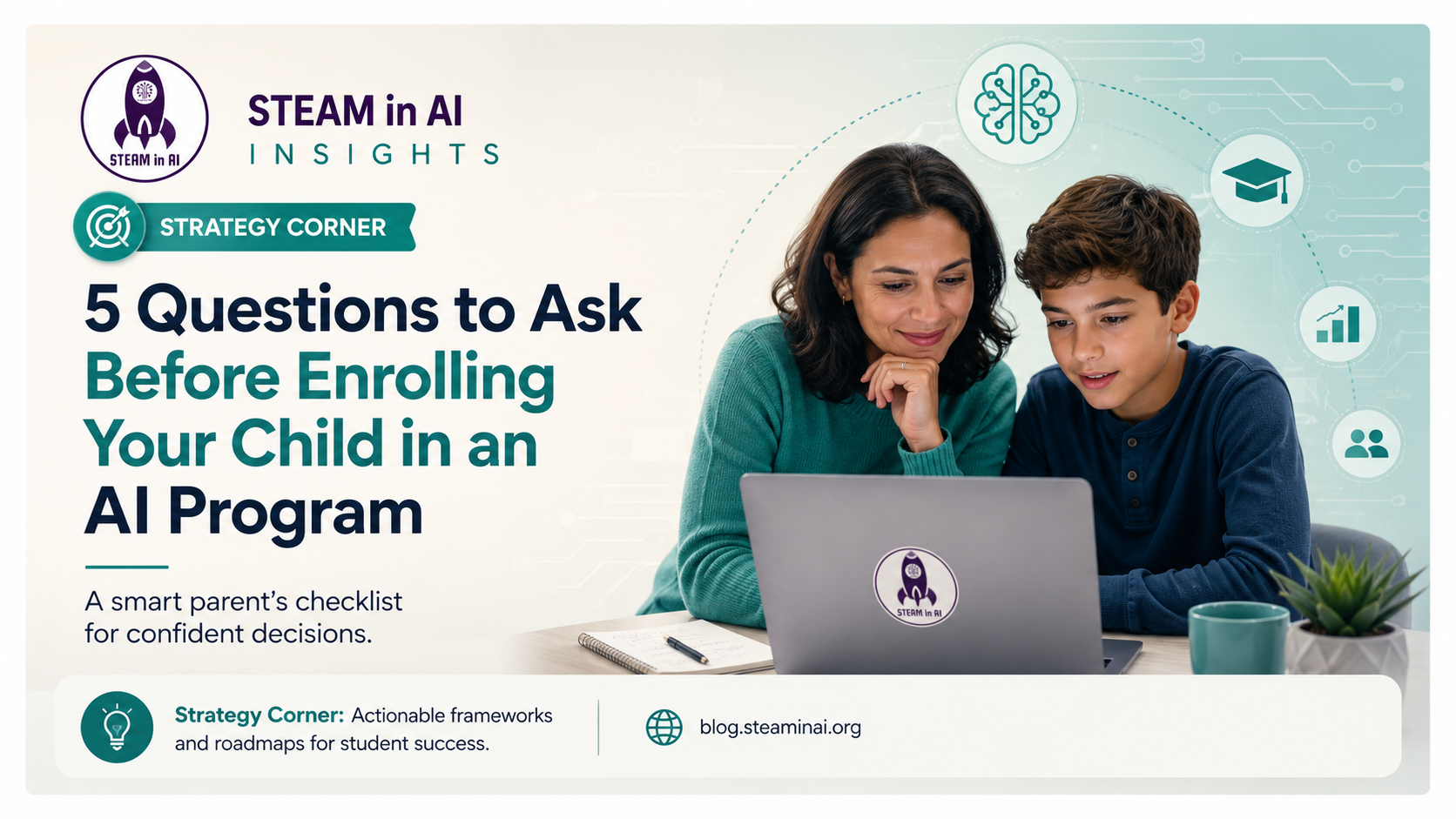
5 Questions to Ask Before Enrolling Your Child in an AI Program
The AI program market for high school students has never been more crowded. Parents navigating this space find program websites that all say roughly the same things: “prestigious university alumni,” “hands-on projects,” “college application impact,” “industry mentors.” The language is nearly identical from one program to the next.
Underneath the marketing, the differences are significant. These five questions cut through the noise—and what the answers reveal about a program’s actual quality.
1. How Many Students Share a Single Mentor?
Cohort size is the single most important structural question to ask about any mentorship-based program. A mentor working with 15 students cannot give your child the same attention as a mentor working with 3.
When a program says “small groups,” ask for the exact ratio. Ten students per mentor is not a mentorship program—it’s a class. Five students or fewer per mentor means each student’s project actually gets reviewed, challenged, and developed in real time.
At STEAM in AI, every cohort is capped at five students. This is not a marketing claim—it’s a constraint built into how we operate. The work we do with students requires genuine attention, and genuine attention requires small groups.
2. Is the Mentor an Industry Professional or a Graduate Student?
A graduate student instructor can teach a curriculum. An industry professional with years of applied experience in machine learning, data science, or AI product development can do something different: they can tell your student whether their approach makes sense in the real world, where their reasoning breaks down, and what a working solution actually looks like.
There’s also a meaningful difference in what a recommendation letter from each can say. A letter from a graduate student says “your child completed the program well.” A letter from a principal engineer, or from someone who has presented research at NeurIPS or served as a Grand Judge at ISEF, says something more specific and credible.
Ask any program: who exactly will be mentoring my child? What is that person’s industry background? Can you share their LinkedIn or bio?
3. Does My Child Own the Project Idea—or Does Everyone Build the Same Thing?
Many programs assign all students the same project type: build a disease detector, model climate change data, classify images from a dataset. Students learn from this. But they don’t own it.
The projects that resonate in college applications are the ones where a student can answer: Why did you build this? What problem did you notice? What decisions did you make? Template projects can’t generate those answers—because the student didn’t choose the problem.
Ask any program: does every student work on their own original project, or do students follow a common curriculum to a predetermined output? The honest answer tells you a great deal.
At STEAM in AI, students identify their own problem first. The mentor then helps scope it, challenge it, and build toward a working solution. The idea belongs to the student from the start.
4. What Have Past Students Actually Produced—and Can You Name Them?
Testimonials on program websites are easy to generate. “My student learned so much” proves nothing. What you want to see is specific, named, verifiable outcomes.
Has a program’s student won a competition you can look up? Published work you can find? Been accepted to a college the program can name, connected to a project they can describe?
STEAM in AI students have earned placement in the U.S. Presidential AI Challenge, built applications that are deployed and in use, and gone on to selective universities with AI projects at the center of their applications. We name our students (with their permission) because real outcomes should be verifiable.
When a program can’t point to specific students with specific outcomes, ask why.
5. Does the Program Work for Students Without a Coding Background?
A student interested in applying AI to fashion design, community health, music production, or social policy shouldn’t have to become a computer scientist first. The most compelling AI projects often come from students who bring deep domain knowledge—they understand the problem—and pair it with mentorship that handles the technical scaffolding.
Ask any program: can my student participate meaningfully if they don’t have a Python background? If the answer is no, that program has pre-selected for a narrow type of student and may not be the right fit for yours.
At STEAM in AI, both our AI Research and AI Build tracks are designed to work for students across all academic backgrounds and interests. No coding background is required to start. The student brings the problem and the curiosity. The mentor brings the technical expertise.
The Underlying Question
All five of these questions point to the same thing: does this program treat your child as an individual, or as one of many students moving through a standardized experience?
The programs that produce standout college application projects are the ones where the student owns something real by the end—something they chose, built with genuine mentorship, and can speak about in depth.
Start With a Conversation
If you’re evaluating AI programs for your student, we’d rather talk with you than sell to you. Book a free Strategy Consult and we’ll walk through your student’s interests, goals, and timeline together—no obligation.
STEAM in AI is currently forming Cohort 2. We accept a maximum of five students per cohort, and spots are filled on a first-come basis after the consult.


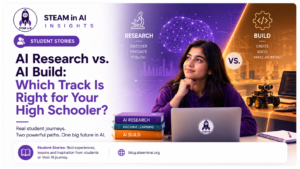
AI Research vs. AI Build: Which Track Is Right for Your High Schooler?
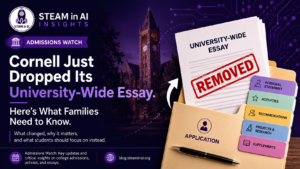
Cornell Just Dropped Its University-Wide Essay. Here's What Gets Students In Now.