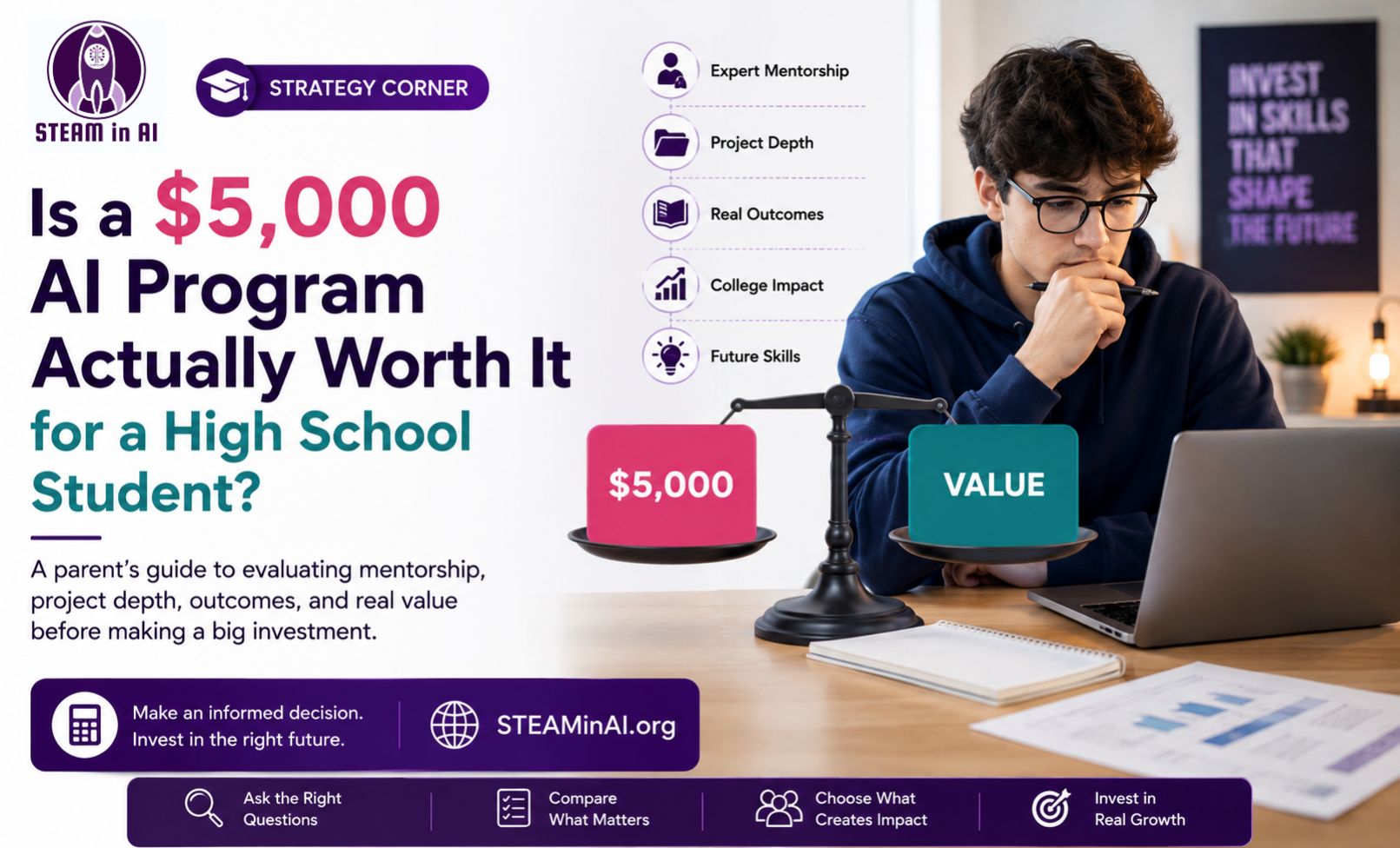
Is a $5,000 AI Program Worth It for a High School Student?
Is an AI program worth it when the sticker price is $5,000? Parents ask us this constantly, and the honest answer is that no website in this category will help you decide, because they all describe themselves the same way. This is the question most parents are really asking when they start comparing AI programs, even when they phrase it as “which one is best.” A $5,000 price tag for a summer or semester program is a real amount of money, and it deserves real scrutiny rather than a reflexive yes because a website looks polished.
The short answer
Sometimes. An AI program worth it at that price is one that produces something a student can still defend in an interview a year later, and wastes it when every student leaves with the same template project. Three questions settle whether an AI program worth its fee is in front of you: ask for the mentor by name, ask whether two students in the same cohort build different things, and ask what happens at week thirteen. The STEAM in AI Intensive sits in this band: twelve weeks, two mentors, a project schedule written for that one student before it starts, and a pathway that continues past the final week.
New to us? Sit in on a free STEAM in AI Live Lab before you decide anything — no form, no call, just watch a session.
Here’s what should actually be true for that kind of investment to make sense — and what to watch for when it isn’t.
What a $5,000+ program should include
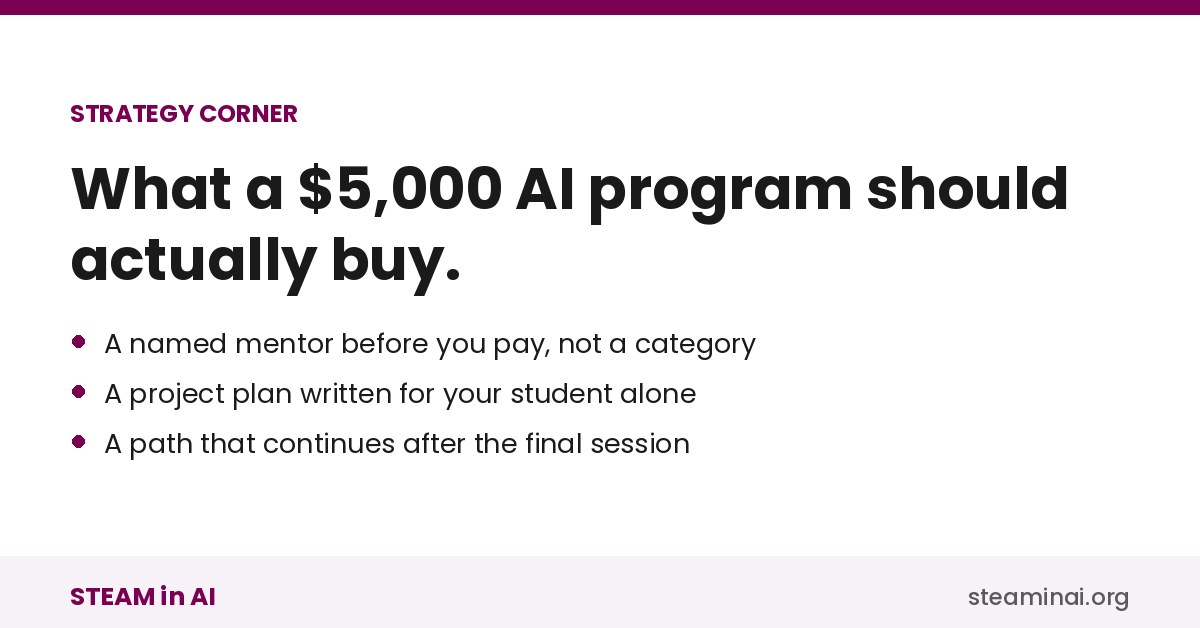
A named mentor, before you pay. Not “we will match you with a mentor from our network”. An actual person, with a real background you can look up, before enrollment is final. If a program can’t tell you who’s mentoring your student until after payment, that’s a structural gap, not an oversight. A reasonable request: ask for the mentor’s name and LinkedIn profile. A program that hesitates has told you something.
Sustained 1:1 time, not group sessions marketed as personal. A “personalized” program with a 5:1 or 10:1 student-to-mentor ratio is a small class, not 1:1 mentorship. Both have value, but they’re not the same product and shouldn’t carry the same price.
A real, specific deliverable. Not “a certificate of completion” — a paper, a working prototype, a deployed tool, a dataset and analysis, something the student can show and speak to in detail six months later. If you can’t get a program to describe the deliverable in concrete terms before enrolling, ask again before paying.
Enough hours for the work to be real. Ten one-hour sessions over ten weeks is a meaningfully different commitment than twenty-five sessions over four months. Neither is wrong, but the price should track the actual time investment, not just the brand.
The question almost nobody asks — and should
Here is the one that separates a purchase from an investment: what happens when the program ends?
Most families discover the answer too late. The twelve weeks finish, the certificate arrives, and the project stops. Half-built, never launched, already going stale a full year before the student submits an application. The student who was going to keep working on it goes back to school in September and never opens the file again.
That’s the real risk with a $5,000 program, and it’s rarely the money. It’s that the work has no runway.
So ask directly: can my student keep going after the program ends, and with whom? Some programs run as a single fixed engagement — three to six months, or a set number of sessions — and end cleanly by design. That’s honest, and for some students it’s exactly right. But if your student is likely to want to take the project further — add features, launch it publicly, enter a competition, present it, write it up — a program with no path past week twelve will cost you more in lost momentum than it saved in fees.
Red flags across the category
- Every student’s final project looks the same. If the “independent project” is really a guided template with swapped variables, it won’t read as independent to an admissions officer who’s seen a hundred of them.
- The mentor changes mid-program without notice. Continuity matters for genuine mentorship; a program that reassigns mentors without explanation is treating the relationship as fungible.
- Marketing copy hints that publication or competition results are guaranteed. No legitimate program can promise a publication or a competition win. Programs that hint at this in marketing copy are setting expectations they can’t control.
- The price is the same regardless of session count, duration, or deliverable type. A flat price across very different scopes of work suggests the pricing does not track what the student receives.
What the STEAM in AI Intensive includes at that price
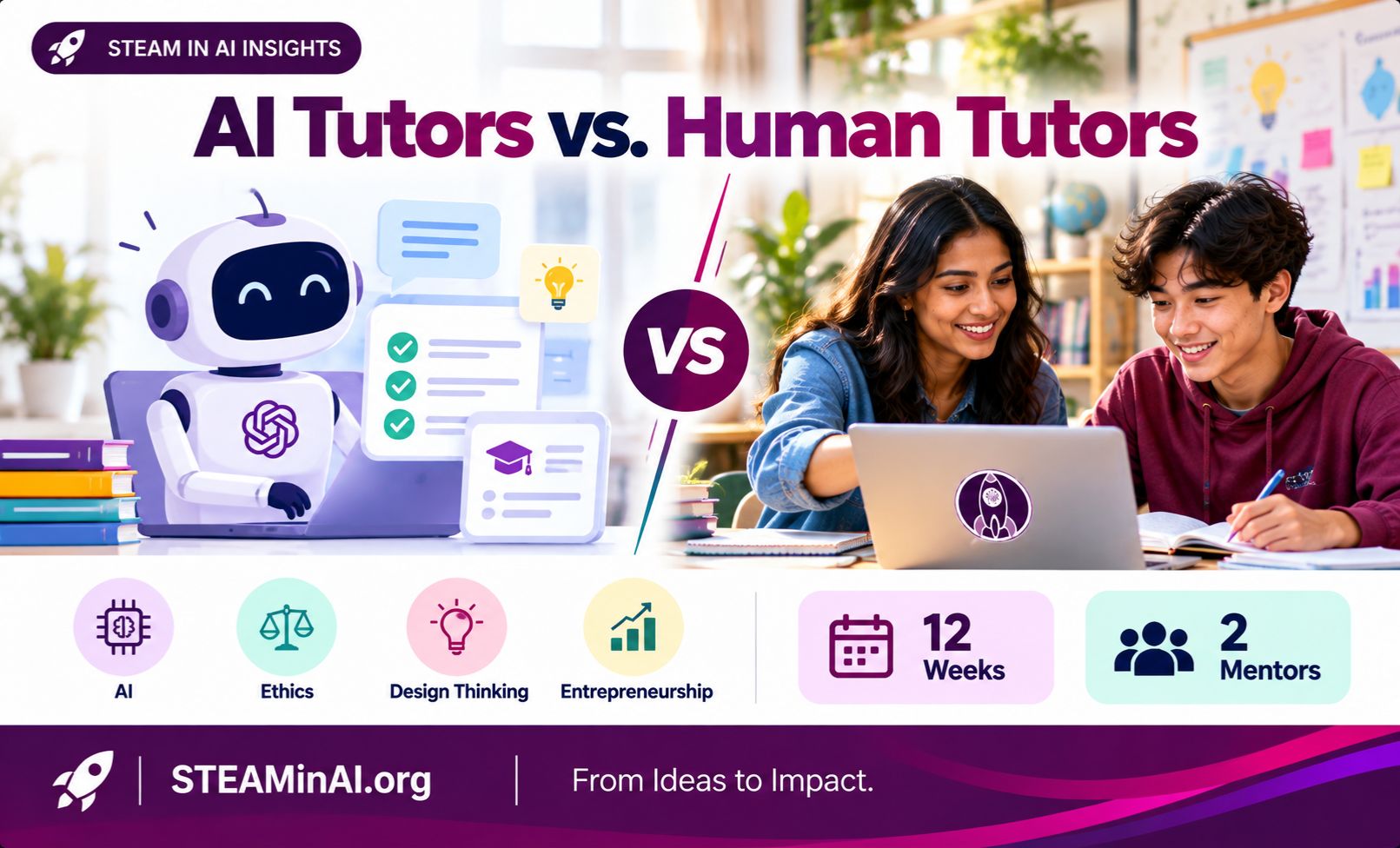
Since the question is whether the number is justified, here is what sits inside it at STEAM in AI. Twelve weeks. Two mentors rather than one, a curriculum mentor across the cohort and a named industry project mentor matched to the student. A week-by-week project schedule written for that student before the program starts. A choice between building something and researching something, rather than the program choosing for them. Ethics, design thinking and entrepreneurship taught alongside the AI.
And no hard stop at week twelve. STEAM in AI students carry the project into competitions, App Store submissions, conferences and publications, which is the part parents tell us matters most. Admission is by fit assessment only, which also means we say no, including to families who want to pay.
The “can a student just buy their way in” question
It’s a fair objection, and it’s worth answering directly rather than dodging it: a paid mentorship program cannot buy your student admission anywhere, and no honest program should market it that way. What it can buy is time, structure, and expert attention. The same things a free selective program provides to students who win a competitive admissions process instead of paying a fee. Neither path buys the outcome. A $5,000 program that delivers a real mentor and a real project gives your student the same raw material that a free program like RSI gives the students it admits — the difference is the gate, not the substance. A $5,000 program that doesn’t deliver that raw material is worse than the free alternative, not better, regardless of price.
What would make an AI program worth it for your student
The honest test isn’t “is this program prestigious” — it’s “will my student walk away with something specific enough to talk about for twenty minutes in an interview, six months from now, without checking notes.” That requires: a real mentor relationship, enough time for genuine iteration (including failure and revision, not just a straight line to a finished product), and a deliverable that’s actually theirs.
A free program that meets that bar (RSI, a strong independent project with a teacher-mentor) can outperform a $6,000 program that doesn’t. And a $5,000 program that genuinely delivers sustained 1:1 mentorship and a real outcome can be worth significantly more than its sticker price, because the alternative — an unfocused summer, or a generic camp — has its own real cost in missed time.
What you are actually buying for the fee
Few programs itemise this, so it is worth asking for. We do, because the number only looks large until you see what sits underneath it. Below is the same breakdown we walk families through on a consult call.
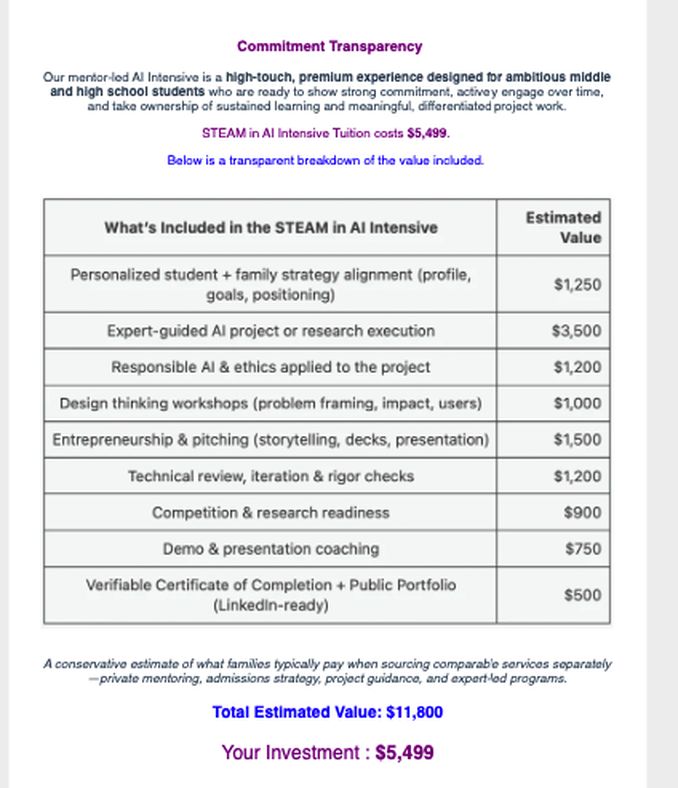
Roughly $11,800 of itemised value, priced at $5,499. We publish it because a family comparing four programs deserves to see the arithmetic rather than guess at it.
How this applies to STEAM in AI specifically
STEAM in AI’s Intensive runs at approximately $5,499 for the high school program. Measured against the criteria above:
On named mentors: students work with practising engineers and researchers we name before enrollment — Juliana Shihadeh, whose research on bias in AI image generation was published in AI & SOCIETY; Marius Fleischer, an AI architect at NVIDIA; Mustafa Shah, an AI engineer at Roblox; Tanvir Ahmed Shaikh at Genentech. And Dhruv Diddi at Turo. You can look every one of them up before you decide. There’s also a structure most families don’t know to ask about: every student has two mentors, not one. A Curriculum Mentor teaches the AI, ethics, design thinking and entrepreneurship across the cohort, while a separate 1:1 Project Mentor is matched to that individual student’s build.
On the deliverable: it’s a defined AI Build or AI Research outcome chosen with the student rather than assigned, and the model is explicitly 1:1 rather than a small-group ratio marketed as personal.
What happens after week twelve
On what happens after week twelve: students can continue with us past the Intensive, and many do. Adding features, launching publicly, entering competitions, presenting, or writing the work up. One student joined at fourteen with no coding background, built an AI skin-tracking agent during the Intensive with her NVIDIA mentor, then kept working with us for the following year with a Roblox engineer to take it to the App Store and into the Presidential AI Challenge, where her project was accepted and recognised with a certificate signed by the President. The twelve weeks were the start of that, not the whole of it.
Who gets in, and who built the curriculum
On admission: we accept students solely on a fit assessment — no GPA cutoff, no test scores, no prerequisites. That also means we decline students, including ones we like, when the fit is not there. A program that accepts everyone who can pay is selling a place; a program that declines is selling a judgement.
On who designed it: the curriculum was built by an ISEF Grand Award judge and NeurIPS presenter who also teaches AI for Business at Stanford Continuing Studies to working Silicon Valley professionals. That combination is the relevant qualification here — judging competition research at the highest level, presenting at the field’s most demanding venue, and teaching the applied side to adults who use it at work. It covers both tracks a student might choose, Build and Research, and it’s the reason the program can tell the difference between a project that looks impressive and one that is.
On what is actually taught: the curriculum is not only AI. Every student also works through ethics, design thinking and entrepreneurship, following the same five steps regardless of subject. Identify a real problem, research it with the people who have it, think through what could go wrong, build, and then be able to explain what changed. The third step is the easiest one to skip, and it is the one that makes a student sound different in an interview.
Where an AI program worth $5,499 still might not be worth it for you
Whether that’s the right fit for a specific student still depends on what they want to walk away with — a working product versus a formal research paper, a field-specific application versus pure technical depth — which is exactly the comparison worth making before enrolling in any program at this price point.
STEAM in AI vs. Polygence vs. Inspirit AI · Best AI programs for high schoolers: full guide
The expensive mistake is not the fee
A $5,000 program that produces something real is a bargain against the alternative. The genuinely costly outcome is a summer that produces a half-finished project nobody continues — because that costs the money and the year, and the year is the part you cannot buy back.
Every student who applies starts with a free AI Project & Fit Assessment, and we use it to decide as much as you do. We say no to students whose goals we are not the right fit for. If you want to find out which answer you would get, that conversation is the fastest route to it.
FAQ: is a paid AI program worth it?
Is a $5,000 AI program worth it for a high school student?
It depends entirely on what comes out the other end. An AI program is worth it when the student finishes with a build they made real decisions inside of, and can still explain a year later without notes. It is not worth it when the deliverable was produced on rails and looks like everyone else in the cohort.
How much do AI programs for high school students cost?
The range runs from free to roughly $10,000. University research programs such as RSI cost nothing but admit a tiny fraction of applicants. Group cohorts typically land between $1,500 and $3,000. One-to-one project mentorship, including ours at $5,499, sits at the top of the range because the contact hours are individual.
What should a $5,000 AI program include?
A named mentor you can look up before you pay, a project plan written for your student rather than the cohort, enough contact hours to justify the fee, and a path that continues after the final session. If a program cannot describe its deliverable in concrete nouns, the fee is buying a category rather than a product.
Do these programs guarantee college admission?
No, and any program implying otherwise should be disqualified on that basis alone. What a strong project does is give a student something specific and defensible to write and talk about. That is a real advantage, and it is not a guarantee.
How do I tell a good AI program from an expensive one?
Ask to see two project plans from different students in the same cohort. If they are genuinely different problems needing different technique, the personalisation is real. If they are one template with the variables swapped, you have your answer.
Ask us to justify the number before you spend it.
We publish the value breakdown above precisely so this conversation can be specific rather than salesy. Tell us about your student and we will say plainly whether we think the fee would be worth it for them. We turn away applicants who would not get $5,499 of value out of us.


AI Programs for High School Students Who Aren't Coders Yet
STEAM in AI vs. Polygence vs. Inspirit AI: Comparing 1:1 AI Mentorship Programs