AI Projects for Computer Science Applicants: What Separates Admits From the Pile
AI projects for computer science applicants face a problem no other major has, which is that admissions readers have seen thousands of them. Computer science is the most oversubscribed undergraduate major in the country. At many universities the CS admit rate is materially lower than the overall admit rate, which means a student applying to CS at a school admitting fifteen percent may be facing something closer to five.
Every one of those applicants has taken AP Computer Science. Most have built something. A great many will describe a personal project in their application. So the question is not whether to have a project. It is what makes one project read differently from four thousand others.
What does not differentiate
Being honest about this saves time.
A tutorial project. If the work followed a course, a YouTube series, or a template, an admissions reader who has seen it fifty times will recognise the shape. This is not about dishonesty. It is that the project demonstrates the ability to follow instructions, which is not in doubt.
Breadth of languages. “Proficient in Python, Java, C++, JavaScript and Swift” reads as a list, not evidence. Depth in one, applied to something real, is worth more.
A working app with no problem behind it. Plenty of students build competent applications nobody needed. Competence is assumed at this level. Judgement is not.
▶ Watch students present these projects
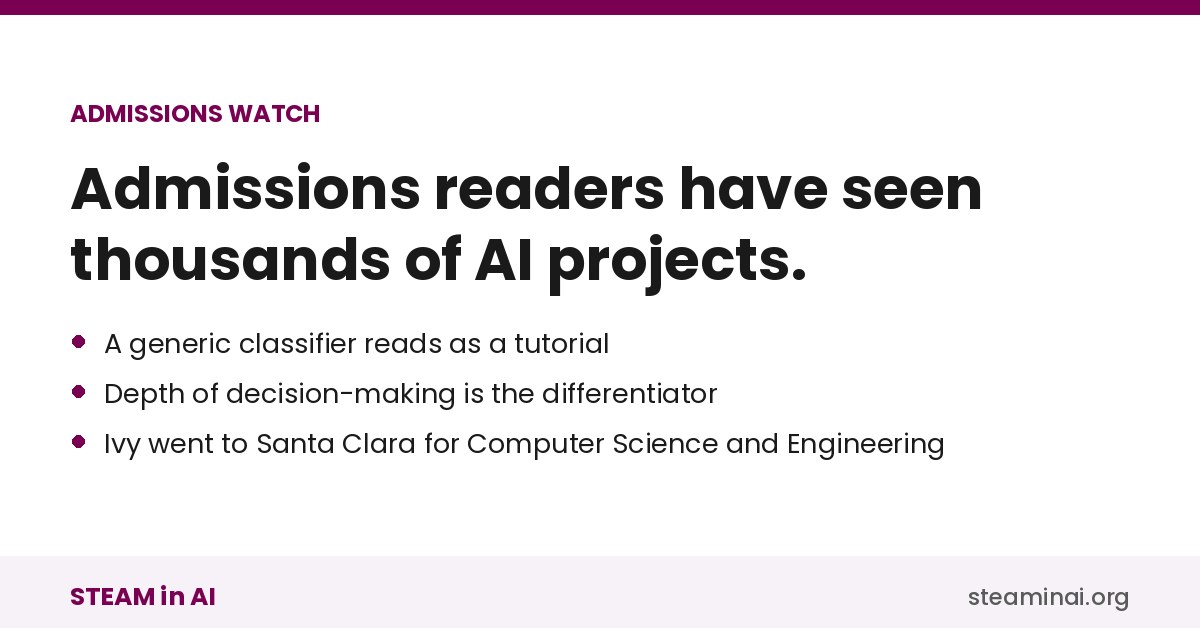
What differentiates AI projects for computer science applicants: a problem with teeth
The projects that read well have a technical difficulty that is legible. A reader can see why it was hard, even skimming.
Ivy, now studying computer science and engineering at Santa Clara, built a financial fraud detection model. The technical core is the interesting part: under one percent of the transactions in her dataset were fraudulent. That single fact makes the problem genuinely difficult, because a model that labels everything “not fraud” scores 99% accuracy and is completely worthless. Her work went into feature selection, handling class imbalance, and hypothesis testing. The same problems a working data scientist faces.
An admissions reader does not need a machine learning background to understand why that is hard. That legibility is the whole trick.
What also differentiates: an unusual application of an ordinary technique
Marcell, now studying computer science at Harvey Mudd and since an intern at Bloomberg and Intuit, built a social media presence analyzer. A tool helping teenagers entering the workforce audit what an employer would see before sending a resume.
The underlying techniques are not exotic. The application is. He came in caring about equity and access, and his mentor Troy Kling recognised that he understood something specific: how the world judges you before you walk in the door. The project is the technical expression of that observation.
That is a project only Marcell writes. Which is precisely why it works.
Build or research: the choice STEAM in AI leaves to the student
In much of this category the deliverable is settled before the student arrives. STEAM in AI asks the student to choose: an AI Build track that ends in a working product, or an AI Research track that ends in a defensible finding. For a computer science applicant this matters, because the two produce completely different application narratives and completely different interview conversations.
Ivy chose the harder statistical problem and built fraud detection on a dataset where under one percent of transactions were fraudulent; she studies Computer Science and Engineering at Santa Clara. Marcell came in as a beginner, built a tool that helps teenagers audit their online presence, went to Harvey Mudd for Computer Science, and has since interned at Bloomberg and Intuit.
The third route: real constraints
Hugo built a model to detect atrial fibrillation. An irregular heart rhythm that raises stroke risk. In ECG recordings, working with the same mentor.
The constraint is what makes it a real engineering project rather than a classification exercise. The goal was not merely an accurate model but one efficient enough to run on an embedded system: small enough for a cheap wearable monitor, which would put cardiac screening within reach of people who cannot get a cardiology appointment.
Anyone can throw a large model at a problem. Fitting one onto a wrist involves trade-offs, and trade-offs are what engineering actually is.
The pattern underneath strong AI projects for computer science applicants
None of these students started as exceptional programmers. Marcell was a beginner. Hugo’s project plan has “install Python” in week one.
What they had was a problem that was genuinely theirs and a mentor who scoped the technical work to their real starting point while keeping the problem hard. The difficulty lived in the problem, not in a requirement that the student already be advanced.
For a CS applicant specifically, that ordering matters more than it does for almost any other major. Because the reader has seen every version of a technically competent project by a student with nothing particular to say.
Two questions to ask before starting AI projects for computer science applicants
Could someone else have written this project description? If yes, it will not differentiate, however well executed.
Can you explain in one sentence why it was hard? If the difficulty needs three paragraphs of setup, it will not survive a skim. Ivy’s is one clause long: fewer than one percent of the examples were the thing she was looking for.
What is AI project mentorship? · Best AI programs for high schoolers: full guide
Every CS applicant will have a project. Most will have the same one.
The uncomfortable arithmetic of this major is that competence no longer separates anyone. By the time your student submits, thousands of applicants will describe a working application built to a reasonable standard. The differentiator is a problem worth solving and enough time to have gone somewhere non-obvious with it. And time is the input that cannot be added later.
We work with a small number of students because scoping a hard problem to a real starting point takes a mentor’s full attention, and we turn down students whose goals we are not the right fit for. A free AI Project & Fit Assessment is how we work out which is which.
The same project, five other ways
A tool that scans a teenager’s public posts sounds like a computer science project, and for Marcell it was — he studies Computer Science at Harvey Mudd and has since interned at Bloomberg and Intuit. But the question underneath it belongs to several other fields, and this is the exercise we run at STEAM in AI with families who cannot yet see how a project connects to their student’s direction.
| Toward psychology | What people disclose about themselves when they believe nobody is reading, and how that changes the moment they know someone is. |
|---|---|
| Toward marketing or communications | Personal brand as a measurable thing. What a recruiter’s first ten seconds actually weigh, and whether it matches what the candidate thinks they are projecting. |
| Toward sociology | Whose posts get read harshly and whose get read charitably. The same sentence does not cost every student the same amount. |
| Toward law or public policy | What an employer may lawfully consider, what they do consider, and the distance between the two. |
| Toward business | Who would pay for this. Whether it is a product or a feature, and what it would cost to run for ten thousand users rather than ten. |
None of those is a different project. Each is the same build with a different question underneath it, and the question is the part an admissions reader remembers. That is what we mean when we say a STEAM in AI project is designed around the student: the student’s direction chooses the question, and the question shapes the build.
FAQ: AI projects for computer science applicants
What AI projects stand out for computer science applicants?
Projects with a specific problem and an honest account of what broke. A generic image classifier reads as a tutorial. A system built for a problem the student actually has reads as a person.
Is computer science too competitive to bother with an AI project?
The competition is the reason to do one well rather than a reason to skip it. What differentiates is not the topic but the depth of decision-making the student can describe afterwards.
Do I need to publish research to be competitive for CS?
No. A working build with real performance numbers can be as persuasive as a paper, and often more defensible in an interview. Students choose a build track or a research track with us for exactly this reason.
Where have students who built AI projects with us ended up?
Ivy went to Santa Clara for Computer Science and Engineering. Julia went to Duke for Statistical Science and Computer Science, having started with no coding at all.
What tools should a CS-bound student actually learn?
The professional stack rather than a teaching wrapper. PyTorch, scikit-learn, version control, and enough deployment to put the thing somewhere real.
The strongest AI projects for computer science applicants are the ones nobody else could have built.
We design each project backwards from the student and the intended major, which is how two students in the same cohort end up with builds an admissions reader would never confuse. Tell us where your student wants to apply.