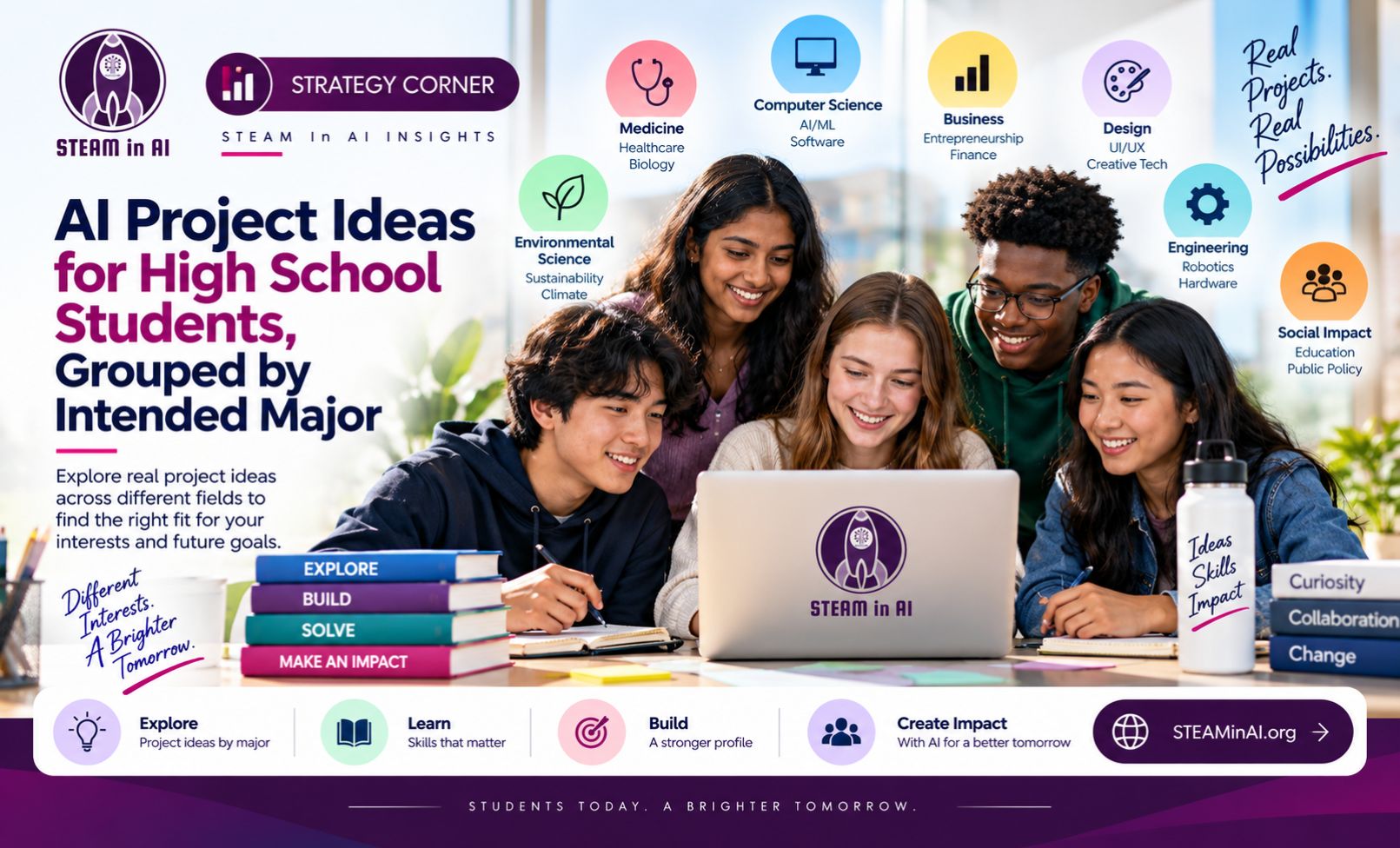
AI Project Ideas for High School Students, Grouped by Intended Major
Most lists of AI project ideas fail students in the same way. They offer a title, the title sounds impressive, and three weeks in the student discovers there is no real question underneath it. So this list is organised differently. It starts from the major a student is heading toward, because that is what makes a project defensible in an application.
Below are thirty AI project ideas, grouped by intended field, followed by the test we use to separate an idea that will hold up from one that will stall.
First, the test that separates good AI project ideas from bad ones
Before the list, apply this. A project worth twelve weeks has four parts, and a student should be able to state all four in one breath.
- A question that a specific person would want answered.
- A method the student can actually execute, not one they have read about.
- An artifact at the end that someone else can examine.
- A limitation the student can name honestly.
If any part is missing, the idea is a topic rather than a project. Topics stall around week five. Projects do not, because a question keeps pulling the student forward when the enthusiasm runs out.
“Build a chatbot” is a topic. “Can a chatbot help my grandmother’s assisted living community answer the same twelve questions staff answer every day?” is a project.
AI project ideas for future computer science majors
These students usually need the opposite of encouragement. They need a constraint that forces them toward a user rather than toward a benchmark.
- A fraud detection model tuned specifically to keep false positives under one percent, since that is the number that matters operationally.
- An accessibility checker that flags where a course website fails a screen reader.
- A tool that compresses lecture recordings into searchable notes, tested with real classmates.
- A model that predicts which library books never get checked out, built from public catalogue data.
- An on-device classifier that works without a network connection, with the tradeoffs measured.
- A system that detects when two pieces of student writing came from the same generator.
AI project ideas for future business and economics majors
Here the technical piece stays modest on purpose. The interesting work sits in the market question.
- An email assistant for older adults, tested with actual older adults rather than with classmates.
- A pricing analysis of a local business category, using scraped public listings.
- A demand forecast for a school store or a family business, validated against last year.
- A tool that reads job postings in one industry and maps which skills appeared this year but not last.
- A study of whether AI generated product descriptions convert differently from human written ones.
- A model estimating the true cost of a subscription bundle versus its parts.
An idea from a list is a starting point, not a project.
The version that survives twelve weeks is almost always narrower and stranger than anything on a list, because it comes from something the student personally noticed. We spend the first two weeks finding that.
How STEAM in AI turns an idea into a project
A list gets a student to a topic. Getting from a topic to a project is the part that needs a person. At STEAM in AI, that happens before week one: the student’s project mentor writes a week-by-week schedule for that student alone, built from their interests, activities and intended major, and no two are alike.
Then the project runs through five steps — identify the problem, research and empathy, ethical considerations, prototype and build, impact and story. The third step is the one a list cannot give you, and the one that turns an idea from this page into something a student can defend a year later.
For future biology and health majors
Biology students often assume AI project ideas require a wet lab. These do not, and each one runs on data a student can obtain independently.
- A classifier for plant disease from leaf photographs, trained on images the student collects locally.
- An analysis of how symptom checker apps handle the same complaint described in different ways.
- A model that flags likely drug interactions from a public pharmacology dataset.
- A study of whether wearable sleep data predicts anything the student can independently verify.
- A tool that makes clinical trial eligibility criteria readable by a patient.
- An audit of how a public health dataset represents different populations, and who is missing.
AI project ideas for future policy, journalism and social science majors
These are frequently the strongest projects we see, and almost nobody suggests them.
- A study of how a recommendation feed shapes what teenagers read over four weeks.
- An analysis of local government meeting transcripts to find what actually gets discussed.
- A comparison of how three news outlets frame the same policy story, measured rather than asserted.
- Research on whether AI detection tools produce false accusations, and against whom.
- A map of where a city’s service requests come from and where they get resolved fastest.
- An examination of how a translation model handles a low resource language the student speaks.
For future design, art and humanities majors
Humanities students are rarely offered AI project ideas at all, which is precisely why these read as original.
- A tool that helps a museum describe its collection to visually impaired visitors.
- An interactive piece that makes a model’s failure modes visible to a non technical audience.
- A study of what generative image models produce when asked for people from the student’s own community.
- An archive project that makes a family’s or community’s oral history searchable.
- A typography or layout assistant built around one specific accessibility constraint.
- A study of how a language model handles a literary form it was barely trained on.
How to narrow any of these AI project ideas in one conversation
Take an idea from the list and run it through three questions in order.
- Who specifically is affected? Name an actual person if possible. Vagueness here is the leading cause of abandoned projects.
- What would change if you found the answer? If nothing changes, keep looking.
- What is the smallest version you could finish in ten weeks? Then build that, not the ambitious version.
Students consistently resist the third question, because the small version feels unimpressive. Nevertheless, a finished small project outperforms an abandoned large one by an enormous margin, in applications and in learning.
What about students who cannot code yet?
Roughly half the students who start with us have written no code at all. Consequently, none of these AI project ideas assume prior programming, and several of the strongest projects we have supervised came from students who learned the tooling as they went.
What we cannot supply is the question. That has to come from something the student already notices, which is why the coding question turns out to matter far less than families expect.
Working through this with a student right now?
Send us the two ideas they cannot choose between. We will tell you which one has a question underneath it and which one is a topic wearing a project’s clothes. No obligation attached.
Where this list came from
Every category above reflects projects our STEAM in AI students have actually completed, mentored by practitioners from NVIDIA, OpenAI, Roblox, Genentech and Turo. The National Science Foundation and similar bodies publish open datasets that make many of these feasible for a high school student working alone.
Use the list as a prompt rather than a menu. The best project a student does will be a variant of something here, bent toward a thing only they would have noticed.


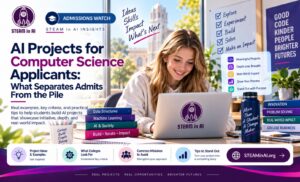
AI Projects for Computer Science Applicants: What Separates Admits From the Pile

An AI Project With No Coding Experience: Julia Started at Zero and Went to Duke