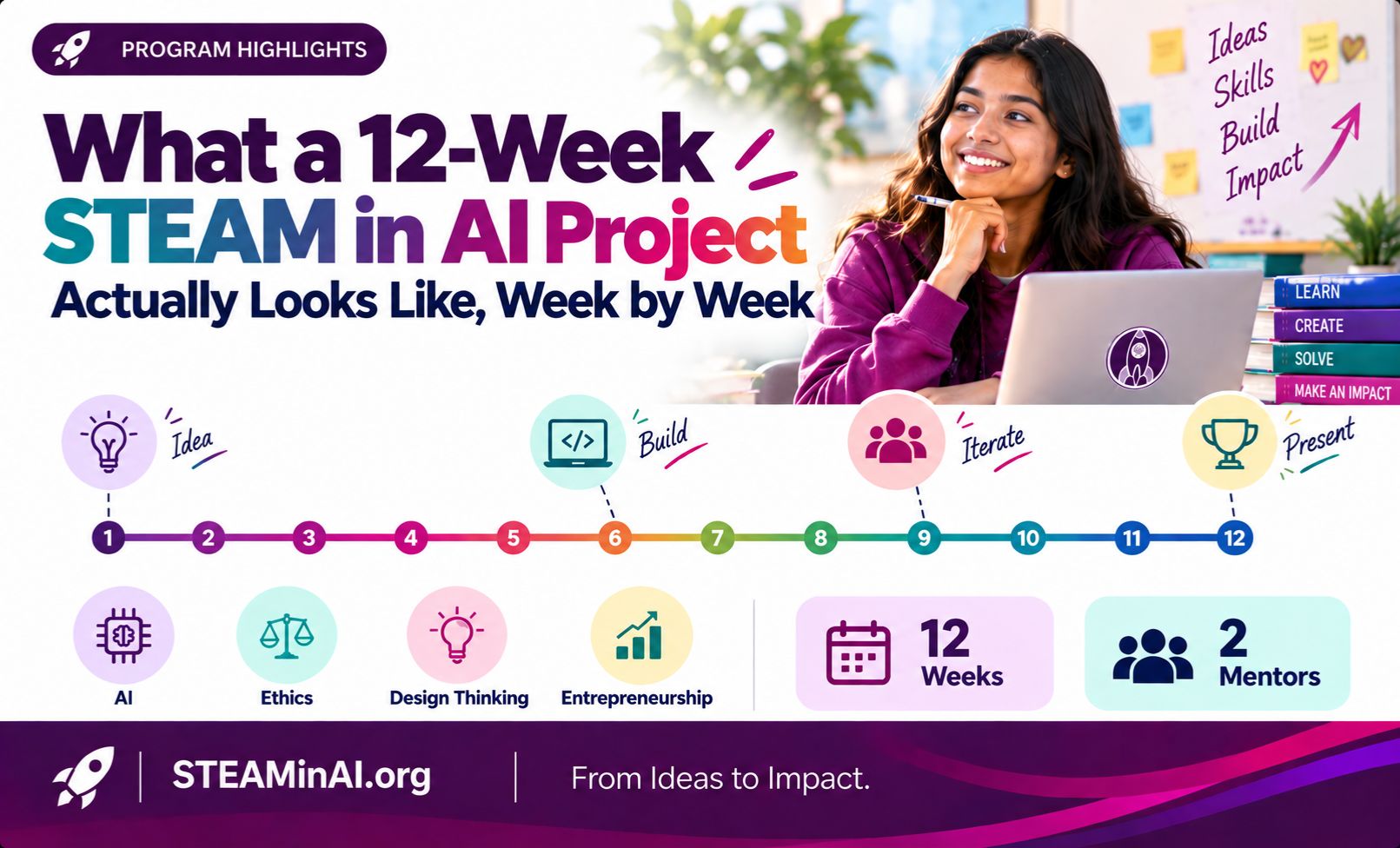
What a 12-Week STEAM in AI Project Actually Looks Like, Week by Week
A 12-week AI project sounds abstract until you see the weeks laid out, so here is a real plan rather than a marketing summary.
Every program in this category describes itself in adjectives. Personalized. Rigorous. Industry-led. Hands-on. The words are free, which is why everyone uses them, which is why they no longer tell a parent anything.
So instead of describing our program, here is an actual project plan. Written by a mentor for one specific student, before the program started.
The student and the problem behind one 12-week AI project
Hugo joined wanting to work on something medical. What he and his mentor, Troy Kling, settled on was detecting atrial fibrillation. An irregular heart rhythm that raises stroke risk. In electrocardiogram recordings.
The framing they chose is worth noting, because it is the difference between a school assignment and a project. The goal was not simply an accurate model. It was an accurate model efficient enough to run on an embedded system — small enough for a cheap wearable heart monitor, which would put a form of cardiac screening within reach of people who cannot access a cardiology appointment.
That constraint is what makes the engineering interesting. Anyone can throw a large model at a classification problem. Making one small enough to run on a wrist is a real design problem with real trade-offs.
Week 1: install Python
This is not a typo, and it is the most important line in the document.
Week one is Codecademy: syntax, strings, conditionals, functions, lists and dictionaries. The end-of-week session covers getting Python running on his own machine, learning to plot with Matplotlib, and — as a first real exercise — writing a script that renders a Mandelbrot set.
Week two finishes the language: loops, classes, file input and output, and the differences between Python 2 and 3. By the end of that session he has used scikit-learn for the first time and downloaded a real database of ECG recordings.
Two weeks in, he has gone from no programming to having a professional dataset open on his laptop.
Week 3: learning what a heartbeat looks like as a signal
Before touching machine learning, he has to understand the physiology and the physics.
The week covers the cardiac cycle and how to read an ECG, then moves to signal processing: reading .mat files, and using a filter to strip out baseline wander and high-frequency noise. The assignment is to loop through every recording in the database, denoise each one, and plot the filtered signal on top of the original. Then adjust the filter parameters until the result looks right.
That last instruction is the one a template would not contain. The mentor does not hand him the correct parameters. He experiments until he can see the difference, which means he has to develop judgment about what “clean” means.
The STEAM in AI Framework the twelve weeks run on
Every STEAM in AI project moves through the same five steps, whatever the subject: Identify the Problem, something the student has actually observed rather than been assigned. Research and Empathy, talking to the people who have the problem. Ethical Considerations, what this could get wrong and who it would affect. Prototype and Build, the smallest useful version first. Impact and Story, what changed and how to explain it to someone who was not there.
The third step is the easiest one to skip, and it is the one admissions readers notice. Before any of it starts, the student’s mentor writes a week-by-week schedule for that student alone, which is why two STEAM in AI students in the same cohort are rarely doing the same thing in the same week.
Week 4: finding the heartbeats
Now he writes a heartbeat detector: take a clean signal, find each beat. The plan explicitly permits him to ignore recordings that are extremely noisy. A small note that reflects how real signal work actually proceeds.
The end-of-week session is a collaborative debugging session with Troy, followed by brainstorming how one might quantify “randomness” in the intervals between beats. That question is the heart of the whole project: atrial fibrillation is, essentially, irregularity in those intervals. The mentor walks him to the doorway of the insight rather than handing it over.
Weeks 5 to 10: the model, and the argument
From there the plan moves through building the classifier, quantifying its performance honestly, and producing a final presentation. The stated end goal is a Python script that can detect atrial fibrillation in ECG signals it has never seen before. The only test that means anything.
If time allows, he explores other arrhythmias. Time frequently does not allow, and the plan says so.
What a real 12-week AI project plan reveals about how this works
Three things, none of which we could have persuaded you of by asserting them.
The plan admits it will not go to plan. There is a line stating that specific dates exist to give the project structure, but that actual progress may run faster or slower, and that meeting dates flex around holidays and school. A program selling a guaranteed outcome does not write that sentence.
The mentor is a person with a calendar. Weekly Zoom sessions to review progress and prepare the next week, plus availability for questions between sessions. Not a cohort call. Not office hours shared across thirty students.
Everything is real. The dataset is a published research database. The tools are the tools working engineers use. The physiology is actual cardiology. Nothing has been simplified into a teaching version of itself.
Why we publish a real 12-week AI project plan
Because a document like this exists for every student, and because no two of them look alike.
Hugo’s ten weeks are cardiac physiology and signal processing. Another student’s are retrieval-augmented generation and municipal policy data. Another’s are imbalanced-class learning, where under one percent of the examples are the thing you are trying to find. These are not the same curriculum with the subject swapped. They require different mathematics, different tools, and different mentors.
That is what “personalized” is supposed to mean, and it is fair to ask any program to prove it the same way: show me two plans from two students in one cohort.
We are happy to.
Is a $5,000 AI program actually worth it?
We write the 12-week AI project plan before anyone pays
One mentor wrote the document above for one student, before his program started, and that mentor would spend ten weeks with him. Most families never see anything like it until they have already committed. And by then the difference between a real plan and a template is no longer a hypothetical question.
We write one of these for every student we accept, which is part of why we accept a small number. If you want to see what yours would look like, that is what the Fit Assessment produces.
Three students, three completely different plans
The schedule above belongs to one student. Every STEAM in AI student gets a 12-week AI project schedule of their own, written by their project mentor before the program starts, and they do not resemble each other. Three from the same period:
| Ivy | Imbalanced-class learning, feature selection and hypothesis testing, applied to financial fraud where under one percent of transactions were the thing she was hunting. She studies Computer Science and Engineering at Santa Clara. |
|---|---|
| Nila | Retrieval-augmented generation, municipal open data, and a go-to-market plan for putting the result into schools. She studies Information Science at UIUC. |
| Raina | Fourteen, no coding at all. Python first, then image data over time, then an App Store submission. Her work was accepted into the Presidential AI Challenge. |
Put three real plans side by side and the contrast does the arguing. It also answers the question families are right to ask — whether every student ends up with the same final project — with documents rather than assurances.
FAQ: the 12-week AI project timeline
What happens in week one of a 12-week AI project?
It depends on the student, which is the point. Hugo began at an introduction to Python because that is where he was. A student who already codes starts at problem framing instead. A program that runs the same week one for everyone is running a course.
When do students usually get stuck?
Around weeks five and six, when the first approach stops working. That is the most valuable part of the whole 12-week AI project, because the decision to change direction is the thing a student can still explain in an interview a year later.
What does a finished project actually look like?
A working build with real performance numbers, or a research write-up with defensible method. Hugo finished with an ECG model for detecting atrial fibrillation. Others finished with apps, dashboards and papers. The tooling is the same professionals use, including PyTorch and scikit-learn.
Do all students in a cohort build the same thing?
Not now. We write each student a project plan before the program starts, around their interests and intended major. Earlier cohorts did share a build, and we moved away from that deliberately.
How many hours a week does it take?
Plan for a few hours of independent work between sessions. Students who treat it as homework finish; students who only show up to sessions tend to stall in the middle weeks.
Every plan above was written for one student. Yours would be too.
We write the week-by-week before the program starts, which is why we need to know what your student is interested in before we can say anything useful. Ask us what week one would look like for them.



AI Projects for Data Science Applicants (and Statistics Majors)
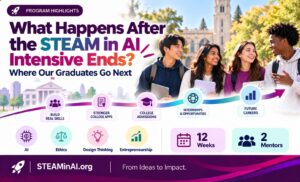
What Happens After the STEAM in AI Intensive Ends? Where Our Graduates Go Next