AI in College Admissions Just Got Congress’s Attention: What Parents Need to Know
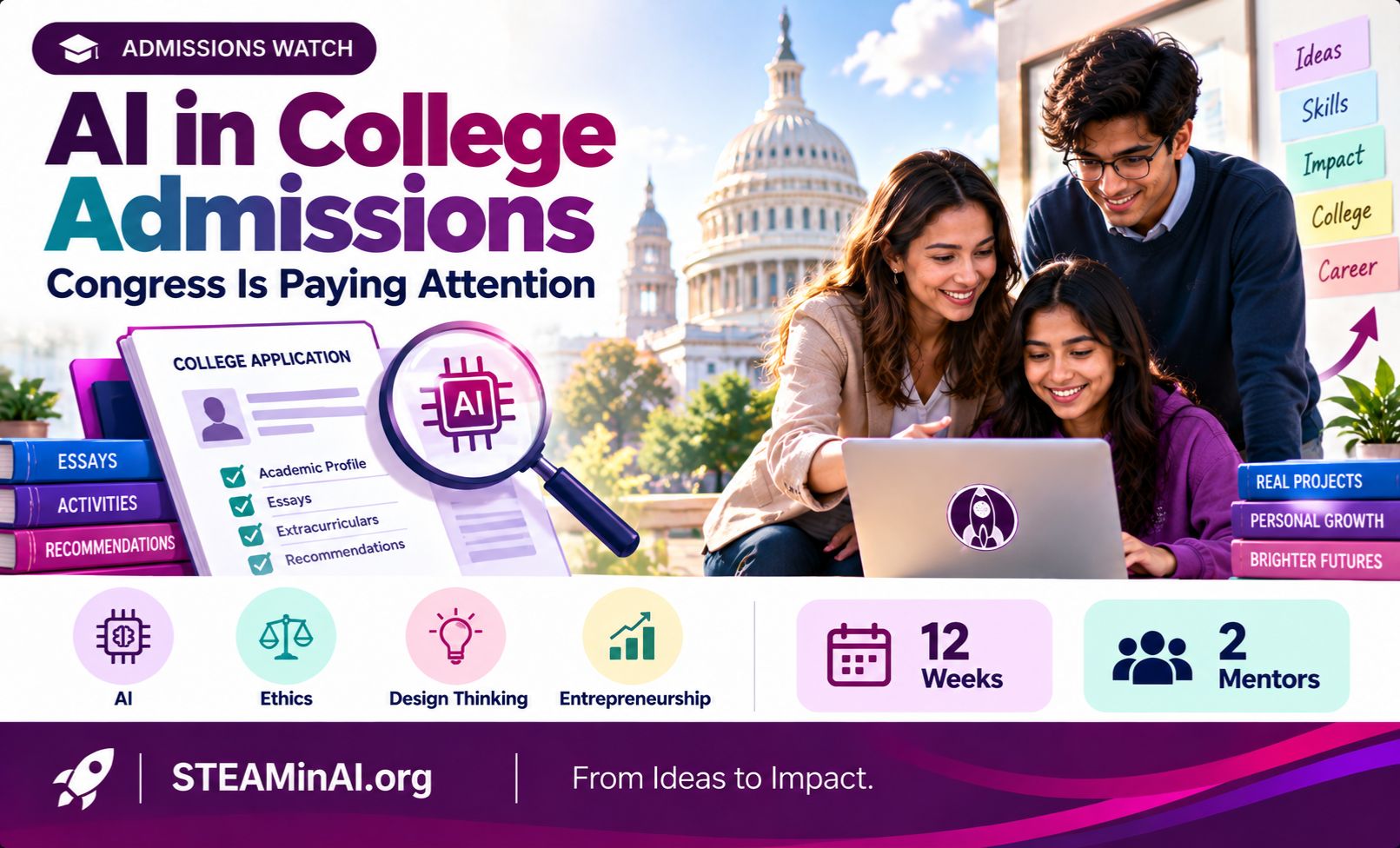
Two things happened in Washington this week that point at the same question: who — or what — is actually reading your student’s college application? A new bill was introduced to regulate AI in admissions, and it follows a federal investigation already underway into how colleges use AI to decide who gets in.
A New Bill: The AI Education and Workforce Readiness Act
U.S. Rep. Suzanne Bonamici introduced the Artificial Intelligence Education and Workforce Readiness Act this week. If passed, it would require federally funded colleges to run risk assessments on the AI tools they use, prohibit training AI models on student data, and add safeguards against biased or opaque decision-making in admissions and financial aid. As one lawmaker put it, “AI should be a tool for student success, not an uncontrolled threat.”
The realistic timeline: this bill won’t move until after the midterm elections at the earliest, so nothing changes for students applying this cycle. But it signals where the regulatory conversation is heading, and it’s worth watching if your student is a year or two out from applying.
A Federal Investigation Already Underway
The bill follows something bigger that’s already in motion: the House Education and the Workforce Committee has asked the Government Accountability Office (GAO) to formally investigate how colleges use AI in admissions and scholarship decisions. The committee is asking three specific questions: how widespread AI use actually is in admissions and scholarship selection, how colleges monitor those tools for accuracy and bias, and how effectively colleges detect and handle applicants’ own use of AI in their essays and materials.
This matters because, until now, most of what families have heard about “AI reading your essay” has been anecdotal — a school admits it uses a chatbot to triage applications, a report claims some institutions use AI to help make final decisions. This is the first time a federal body has been asked to actually document how widespread that is.
What This Means for Applicants Right Now
Nothing changes for this application cycle. No new law is in effect, and the GAO investigation is a fact-finding process, not a ban. But the direction is clear enough to plan around. Colleges are already using AI somewhere in the admissions pipeline — an initial application screen, an essay-authenticity check, a scholarship-matching tool — and that use is about to get a lot more scrutiny and disclosure.
Why a Real Project Holds Up Where a Polished Essay Does Not
An essay-authenticity check is only a problem if there is nothing behind the essay. A student who can walk an admissions reader — or an AI screening tool, for that matter — through the actual decisions they made on a real project has nothing to hide, because there is a real answer to every follow-up question.
That is easier to prove than most families realize. Every STEAM in AI student works with two named, checkable mentors — not one — across the project: a curriculum mentor for the whole cohort, and a separate 1:1 mentor from industry matched to that student’s own build. Both are findable on LinkedIn before a family ever pays. A project vouched for by two real people, by name, is not the kind of thing an authenticity check should worry about.
The Real Takeaway for Families
The safest assumption for any student applying in the next few years: write in your own voice, and be able to talk fluently about your own project and thinking in an interview or follow-up, because authenticity checks are only going to get more common. This is exactly the muscle we build in the STEAM in AI Intensive — students build a real, defensible AI project they can explain and defend in their own words, not a polished essay that raises questions the moment someone asks a follow-up.
FAQ: AI in College Admissions
Does this new bill change anything for my student’s current application?
No. The bill won’t move until after the midterm elections at the earliest, and no new law is in effect. Nothing changes for this cycle.
Are colleges actually using AI to screen applications right now?
Some are, in some part of the pipeline — an initial screen, an essay-authenticity check, or scholarship matching. That is exactly what the GAO investigation is trying to document at scale for the first time.
What should my student actually do differently because of this?
Write in their own voice, and be able to defend their work in a follow-up conversation. A real project with a real story behind it holds up under scrutiny in a way a polished-but-generic essay does not.
How does STEAM in AI make sure a project is really the student’s own work?
Two named mentors work with every student, not one: a curriculum mentor across the cohort and a separate 1:1 project mentor from industry, both checkable on LinkedIn before a family enrolls. A student who built the project with real people watching each week can explain it under any follow-up question.
More on AI and College Admissions
- AI in College Applications: Penn’s New Rule Turns the Essay Into an Interview
- AI Projects for Computer Science Applicants: What Separates Admits From the Pile
- An AI Project With No Coding Experience: Julia Started at Zero and Went to Duke
Regulation is still catching up to the technology. Your student’s project doesn’t have to wait — it just has to be real.