NYC Just Banned AI in Schools Through 8th Grade. Here’s What It Actually Says.
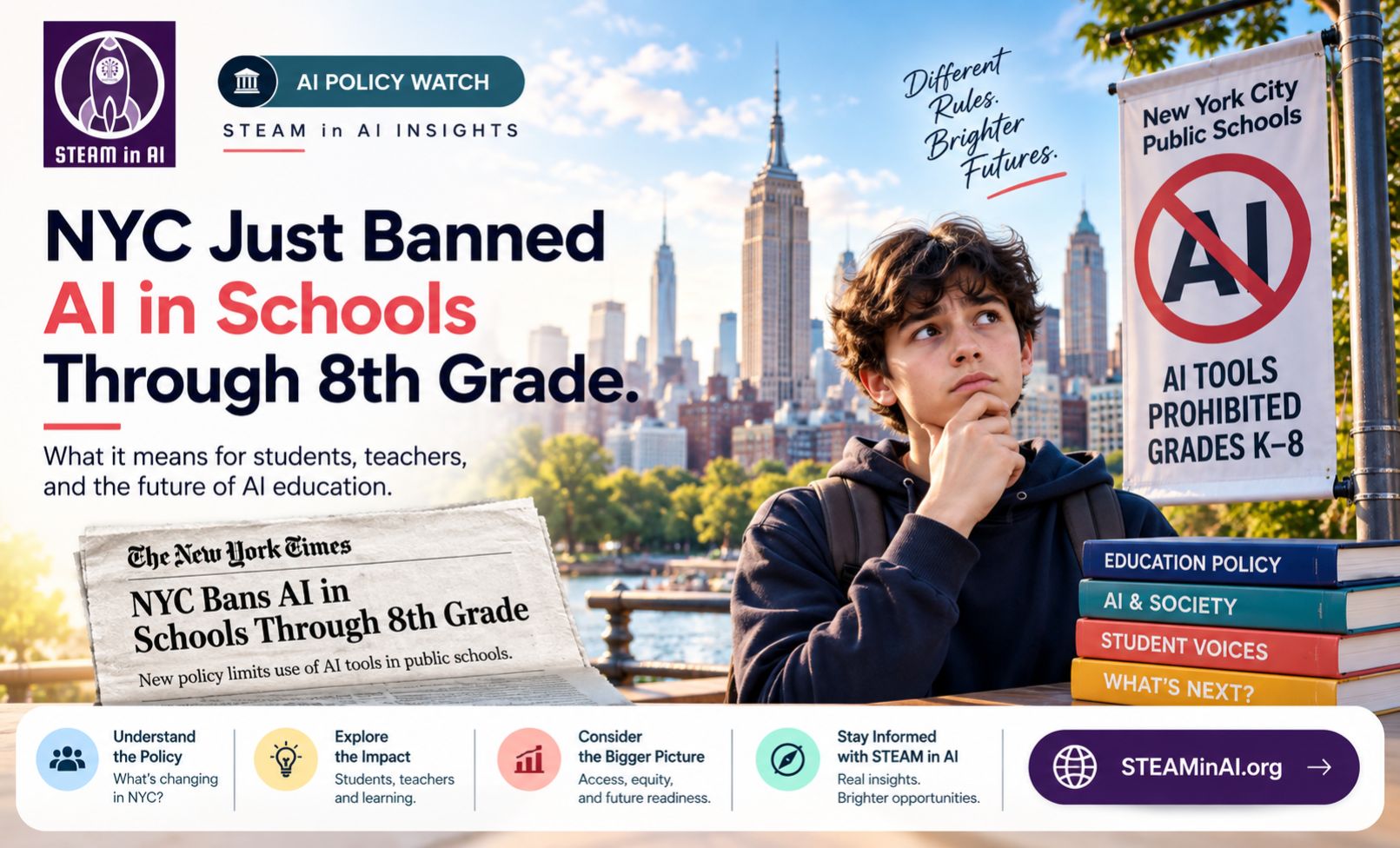
New York City just enacted the nation’s broadest AI ban in schools: a generative AI moratorium announced September 2, 2026 by Mayor Zohran Mamdani and Schools Chancellor Kamar Samuels. It takes effect with the 2026–27 school year — eight days after the announcement — across New York City’s roughly 1,600 public schools.
Here’s what this AI ban in schools actually does, because the headlines are simplifying it.
What the AI ban in schools covers, and where
Student-facing generative AI — chatbots, AI tutors, anything a student interacts with directly — is prohibited from PreK through 8th grade. The city is disabling AI features inside 38 existing software contracts to enforce it, including the AI components of the Amira reading tutor and parts of the Houghton Mifflin Harcourt curriculum.
High school is different. Generative AI is permitted there, but capped: five approved pilot programs (Quill, Edia, Brisk Teaching, Playlab, and Intel AI-Ready Schools) with a combined enrollment limit of 50,000 students district-wide.
The screen-time limits nobody’s talking about
Alongside the ban, NYC set daily device-use caps by grade band:
- PreK–2: no individual device use at all
- Grades 3–5: 30 minutes per day
- Grades 6–8: 45 minutes per day
- High school: no restriction
Why NYC decided on an AI ban in schools
The reasoning district leaders gave is consistent with what we’ve heard from parents all year: schools want younger students reading, writing, and reasoning on their own before AI enters the picture. Advocacy groups called the policy “a step in the right direction,” though some — including former deputy mayor Richard Buery — pushed back on the blanket approach, arguing it disrupts lesson planning and feedback tools that already work.
Los Angeles and other major districts are reportedly watching closely. If NYC’s approach holds, this AI ban in schools is likely to become the template other cities reach for.
What this means for your student
An AI ban in schools that covers a 6th-grade classroom doesn’t touch what a high schooler builds with a mentor on a Saturday. And it doesn’t change what colleges and employers are now looking for: not whether a student has used AI — that’s assumed — but whether they’ve built something real with it, ethically, with an actual understanding of how it works.
That’s the gap a supervised, mentor-led AI project is built to sit in. If your student is curious what that looks like in practice, see our guide on what AI project mentorship for high school students actually involves. The ethics-first grounding this policy is implicitly asking for — thoughtful, supervised, age-appropriate AI use — is the same grounding our AI Build and AI Research tracks have always been built on.
If your student wants to be part of that instead of waiting on policy to catch up, start with a free 45-minute AI Project & Fit Assessment. Interests, project ideas, Build or Research track, competitions, admissions goals — if we’re not the right fit, we’ll tell you.
Sources: NYC Mayor’s Office, Chalkbeat, CNN Business