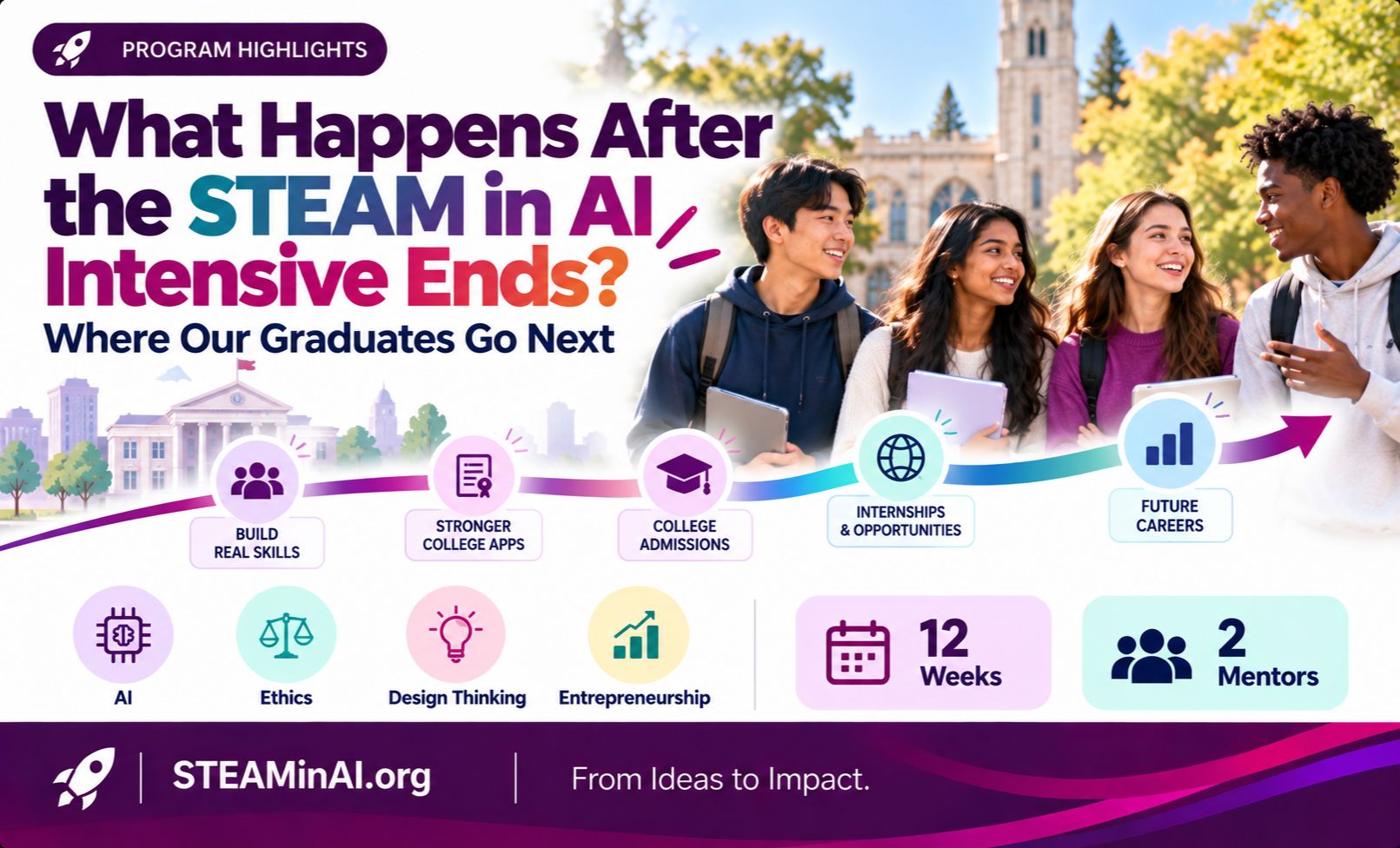
What Happens After the STEAM in AI Intensive Ends? Where Our Graduates Go Next
Almost nobody asks what comes after the STEAM in AI Intensive, or after any twelve-week program, and that gap is where most high school projects quietly die. Every conversation we have with a parent eventually arrives at the same question, usually near the end, often phrased almost apologetically: and then what?
▶ Watch Raina’s full Live Lab on YouTube
They have understood the twelve weeks. They can picture the mentor, the project, the final presentation. What they cannot picture is September — when the program is over, school starts again, and the thing their student built either becomes something or quietly stops existing.
That instinct is correct, and it is the most underrated risk in this entire category.
After the STEAM in AI Intensive: the gap nobody plans for
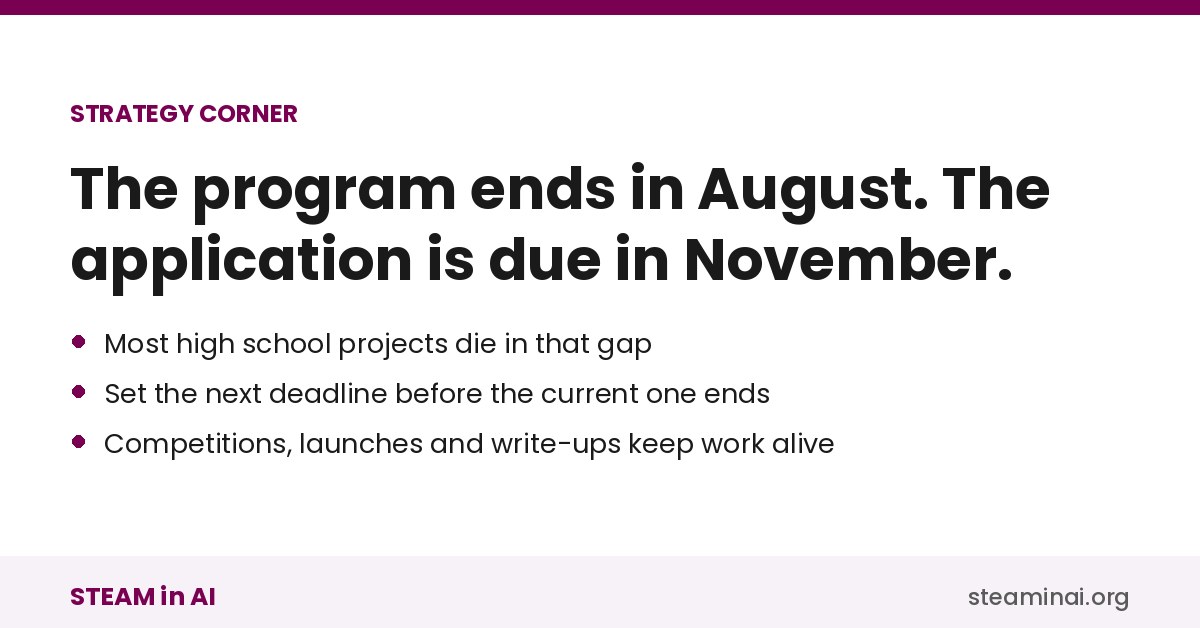
Consider the actual timeline. A summer program ends in August. The student is a rising junior. Their college applications are submitted in November — of the following year. That is roughly fifteen months between finishing the project and writing about it.
Fifteen months is long enough for a half-built prototype to become embarrassing. It is long enough for the student to forget the details that made the work interesting. It is also, and this is the part families miss, long enough to do something genuinely significant with the project — if there is any structure supporting it.
Many programs are not designed to provide that structure, and they are not hiding it. A program that runs three to six months, or sells ten or twenty-five sessions, has told you exactly where it ends. That is honest, and for a student who wants one contained, well-executed experience, it is the right product.
The mismatch happens when a family buys a fixed engagement while imagining a runway.
What “keeping going” actually means
It is worth being concrete, because “continued support” is a phrase that can mean almost nothing.
Features and versions. The first working version of anything is rarely the interesting one. The second and third versions — where the student discovers what real users actually need — are where the story lives.
Public launch. Getting something into an app store, or deployed and usable by strangers, is a different kind of accomplishment from getting it working on a laptop. It also introduces genuinely hard problems: reliability, privacy, review processes, the gap between a demo and a product.
Competitions. ISEF, Regeneron, the Presidential AI Challenge and others all have submission windows that rarely align with when a summer program happens to end. A project that cannot be worked on in the interim simply misses them.
Conferences and write-ups. Student research venues and poster sessions exist, and turning a build into a written argument is a distinct skill worth learning.
Each of these takes months, not weeks. None of them fit inside a twelve-week window.
What this looked like for one student
Raina joined at fourteen, before starting high school, with no coding background and no extracurricular record to speak of. What she had was a problem she had lived with: years of dermatologist appointments with no straightforward way to tell whether her skin was actually improving.
During the twelve-week Intensive she worked with Marius Fleischer, an AI architect at NVIDIA, and built an AI skin agent that tracked her condition over time. At the end of the program she had a working prototype. In most versions of this story, that is where it stops.
Instead she kept going for the following year, working with Mustafa Shah, an AI engineer at Roblox and a Georgia Tech computer science graduate. The prototype became a web application, then a mobile application submitted to the App Store. She entered it in the 2026 Presidential AI Challenge, where the project was accepted and met every participation criterion.
She did not win the competition, and we would not tell you she did. What she has is a year and a half of documented, escalating work on a problem she chose herself. Which is a substantially different thing to talk about than a summer project.
The twelve weeks were the beginning of that. They were not the whole of it.
Why the pathway after the STEAM in AI Intensive does not stop at week twelve
This gap is the reason the pathway after the STEAM in AI Intensive matters, and it is why STEAM in AI is built as a pathway rather than a summer. Students continue past the twelve weeks as far as the project justifies: more features, an App Store submission, a competition entry, a conference talk, a publication.
Raina is the clearest illustration of what happens after the STEAM in AI Intensive. She finished her twelve weeks at fourteen with no prior coding, spent a further year on the same project, took it to the App Store, and had her work accepted into the Presidential AI Challenge. Parents tell us this is the part that reassured them most, because it is the difference between a project that ends in August and one that is still alive in November when applications are due.
After the STEAM in AI Intensive: the other kind of after
There is a second version of this that is quieter and arguably more important.
Siyona built a health-technology AI application using Stanford Health imaging data as a high school junior. She is now a junior at UC Davis studying biomedical engineering. A field the high school project pointed directly at. The project did not continue as a product. It continued as a direction.
For a lot of students, that is the honest outcome, and it is worth more than a launched app. The point of the work is not always the artifact. Sometimes the point is that a sixteen-year-old finds out what they want to spend four years studying, with enough evidence to be confident rather than hopeful.
The question that reveals what happens after the STEAM in AI Intensive
Whichever program you are considering, ours included, ask it plainly: can my student keep working on this after the program ends, and with whom?
Listen for whether the answer involves a person. “You’ll have lifetime access to the community” is not the same as “the same mentor, or another one, will keep meeting with them.”
If the answer is that the program ends cleanly — take that seriously rather than as a mark against it. Plenty of excellent programs work exactly that way, and a student with strong self-direction may need nothing more. But know which one you are buying, because the difference does not show up until September, and by then the decision has been made.
Is a $5,000 AI program actually worth it? · STEAM in AI vs. Polygence vs. Inspirit AI
September arrives faster than the application does
The families who get this right are not the ones who found the best twelve weeks. They are the ones who thought about month six before they paid for month one. Because a project with somewhere to go keeps compounding while everyone else is starting over.
Our cohorts stay small enough that continuing is a real offer rather than a line in a brochure, and small enough that we cannot take everyone. The next cohort deadline is where to find out whether there is room.
Three students, three different afterwards
What happens after the STEAM in AI Intensive is not one thing, and the direction depends on the student rather than on a package. Three STEAM in AI graduates, three completely different second acts:
| Raina — kept building | Twelve weeks at fourteen with no coding at all, then a further year on the same project: more features, a privacy policy, an App Store submission, and finally a Presidential AI Challenge entry that was accepted and certificated. |
|---|---|
| Eli — took it to a competition | An email agent built for the seniors he volunteered with, carried forward into the Presidential AI Challenge, and then written about in the application that took him to USC for Artificial Intelligence for Business. |
| Siyona — followed the question into a degree | A high school project on health imaging, then Biomedical Engineering at UC Davis, where she is now a junior. Disclosure worth making plainly: Siyona is the founder’s daughter, and she went through the same program. |
None of those three was planned in advance. Each one happened because the project was still alive when the opportunity appeared, which is the entire argument for treating the twelve weeks as a beginning rather than a deliverable.
FAQ: after the STEAM in AI Intensive
What happens after an AI program ends for most students?
Usually nothing. The certificate arrives in August, the application is not due until the following November, and a half-finished project goes stale in between. The work does not fail because it was bad. It fails because nobody planned the next step.
How can a student keep a project alive after the program?
Give it a next deadline before the current one ends. A competition entry, an app store submission, a conference abstract or a public launch all create an external date that keeps the work moving.
What can a finished high school AI project turn into?
More than families expect. Ours have gone to app stores, to the Congressional App Challenge, to science fairs, and to the Presidential AI Challenge. Details in our Presidential AI Challenge guide.
Should I choose a program based on what comes after it?
If your student is likely to want to keep building, yes. A program designed as a single fixed engagement is honest and clean, and it will still cost a persistent student momentum that is hard to recover alone.
Does the project need to be finished before applications?
Finished matters less than living. A project with a visible history of decisions, failures and revisions reads better than a tidy one that stopped the day the program did.
Ask any program you are considering what month thirteen looks like.
Most cannot answer, because the engagement was designed to end. Ours does not have to, and the students who go furthest are usually the ones who decided on the next deadline before the last session. Bring us your student and we will map what comes after.


What a 12-Week STEAM in AI Project Actually Looks Like, Week by Week
AI in College Admissions Just Got Congress's Attention: What Parents Need to Know