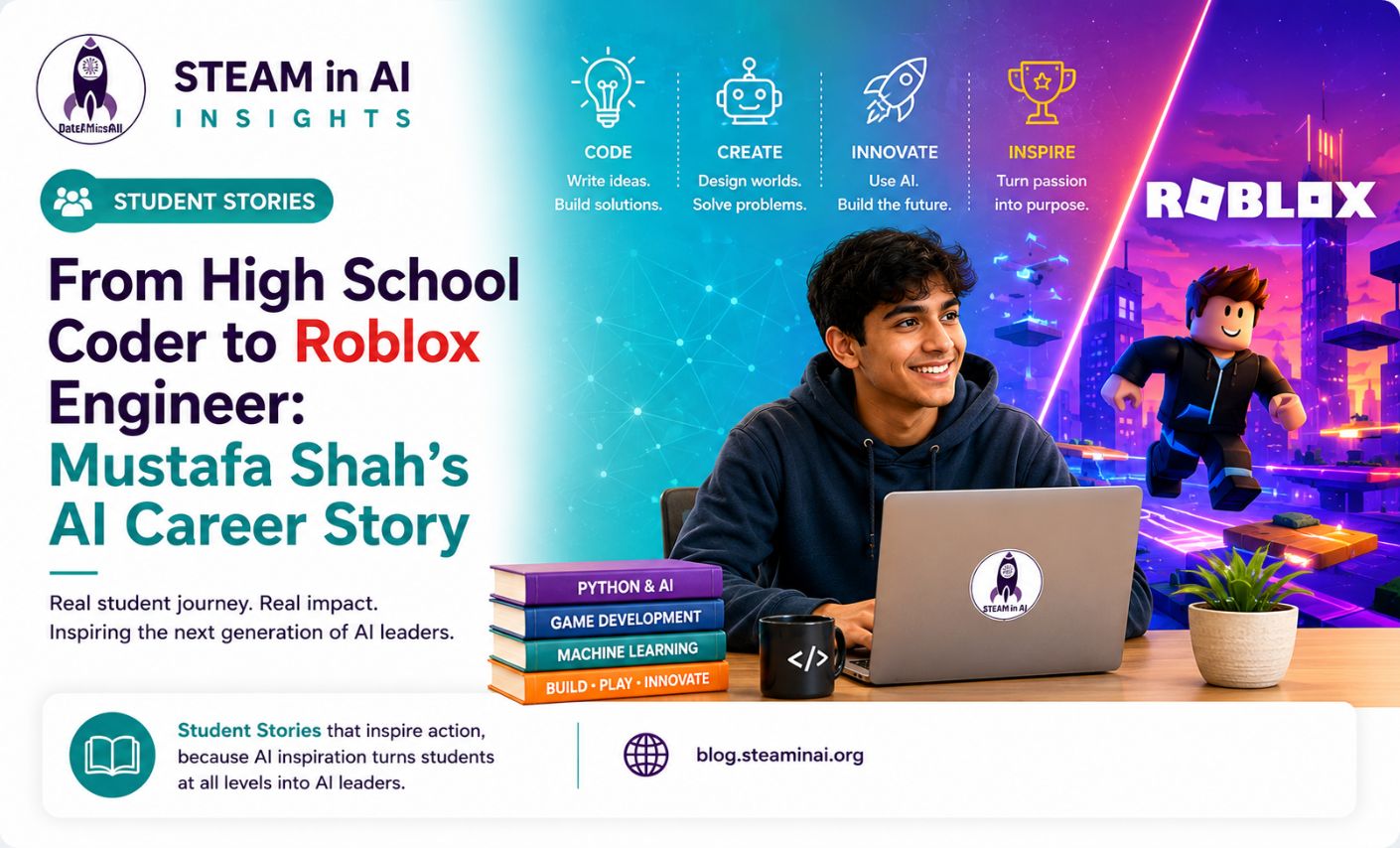
From High School Coder to Roblox Engineer: Mustafa Shah’s AI Career Story
Mustafa Shah was a high schooler who liked writing code — nothing unusual there. What is unusual is where that eventually led: a Software Engineer role at Roblox, alongside a Master’s in Computer Science at Georgia Tech. His path is proof that the gap between “kid who codes” and “engineer at a top tech company” is smaller than most families assume — if the path is built right.
From Classroom Curiosity to Real Code
Plenty of high schoolers take a coding class or build a small app. Very few turn that into a body of work substantial enough to matter for college admissions and, later, for hiring managers. The difference isn’t raw talent — it’s consistency, and having the right guidance at the point where most students stall out.
The Path to Georgia Tech and Roblox
Mustafa’s trajectory — from high school programming to a top computer science graduate program to an engineering role at a company with Roblox’s scale — didn’t happen by accident. It happened because his early projects were treated as the start of a body of work, not a one-time application booster.
What High Schoolers Can Learn From Mustafa’s Journey
The lesson here isn’t “learn to code.” It’s that the students who end up at companies like Roblox usually started years earlier with a small, unglamorous project they actually stuck with — and had someone around who could tell the difference between a project that goes nowhere and one that compounds.
Watch Mustafa’s Story
▶ Watch Mustafa’s full story on our YouTube channel
The Real Difference-Maker
Most students who want to break into tech are told the same generic advice: learn to code, build a portfolio, apply to internships. Almost none of them get an actual mentor who’s walked that exact path and can tell them which projects are worth their time and which ones are a dead end.
That’s the gap STEAM in AI mentorship closes — pairing students with people like Mustafa who’ve genuinely made this leap, not just people who teach the theory.
Every year we talk to families who assume their student either “has what it takes” for a career like Mustafa’s or doesn’t — as if it’s fixed. It isn’t. What separated Mustafa wasn’t some innate coding gift; it was starting early enough, and sticking with real projects long enough, to actually build a body of work.
We don’t take every student who applies. Our Fall Intensive cohort stays intentionally small, because mentorship like the kind that helped Mustafa only works one student at a time — not in a classroom of fifty.
Curious whether your student’s current path could lead somewhere like this? Check the next cohort deadline and see if there’s still room.