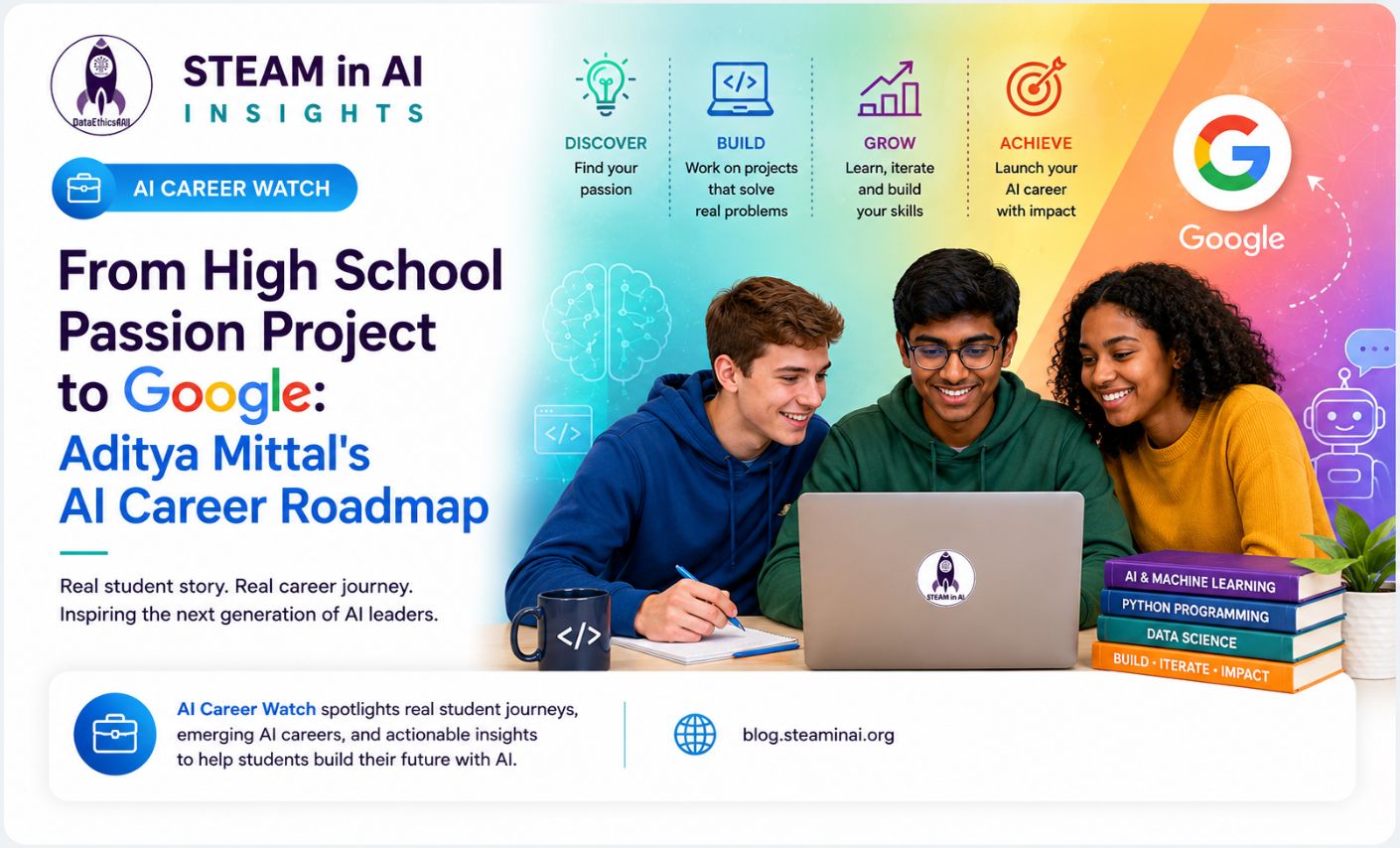
From Passion Project to Google: Aditya Mittal’s AI Career Roadmap
Every year, thousands of high schoolers start an AI project because it looks good on an application. Aditya Mittal started one because he was genuinely curious — and that difference is exactly why his ended up opening doors at Microsoft, Carnegie Mellon, and now Google.
The Project That Started It All
Aditya started building AI and machine learning projects while still in high school — not because a counselor told him to, but because he wanted to understand how the technology actually worked. That early, self-directed curiosity became the foundation for everything that came after: research experience at Carnegie Mellon, a stint at Microsoft, and now an incoming role on Google’s AI team.
What Actually Opens Doors in AI Careers
Here’s what most families don’t realize: admissions officers and hiring managers at companies like Google aren’t impressed by a long list of activities. They’re looking for evidence that a student can go deep on one real problem and stick with it. Aditya’s path from a high school project to CMU to Microsoft to Google wasn’t a straight line — but every step built directly on the one before it.
The Skills That Compound
The technical skills matter, but what actually compounds over time is the ability to pick a project worth sticking with, and to keep leveling it up rather than starting over every semester. That’s the exact gap STEAM in AI mentors work to close with students — not just teaching AI concepts, but helping students choose projects that can grow with them from high school into college and beyond.
What This Means for Your Student
If your student is building an AI project right now, the question isn’t whether it looks good on an application. It’s whether it’s the kind of project that can still be relevant three, five, or ten years from now. That’s the difference between a project built for a deadline and one built for a career.
Watch Aditya’s Story
▶ Watch Aditya’s full story on our YouTube channel
Why This Matters Right Now
If you’re waiting for your student’s project to look “impressive enough” before you take it seriously, that’s the same mistake most families make — Aditya’s project didn’t look like anything special when he started it either. What separated it wasn’t ambition on day one, it was that he kept building past the point where most students stop.
We don’t work with every student who applies. STEAM in AI keeps each cohort small enough that every student gets real, individual project mentorship — not a template. So the real question isn’t whether we can help; it’s whether your student’s current project (or the one they haven’t started yet) is the kind we can take somewhere.
Want to find out? Book a free 45-minute AI Project & Fit Assessment and we’ll tell you honestly.