STEAM in AI 2026 Summer Graduation: See What Your Student Could Be Building or Researching
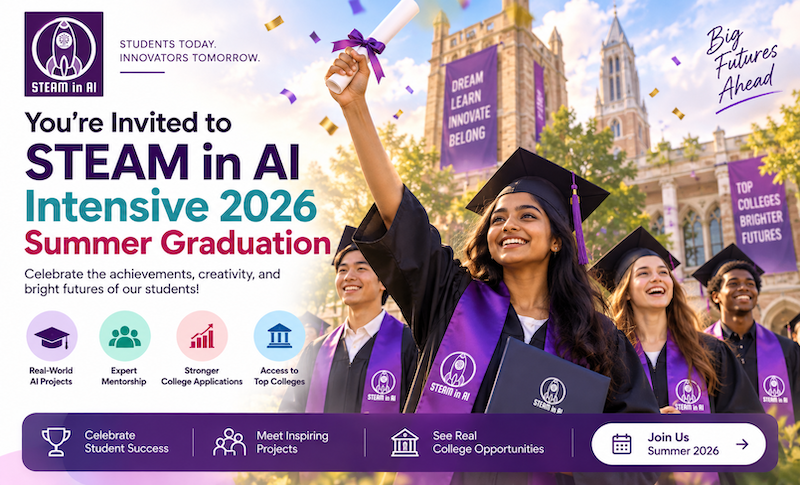
What actually happens at a STEAM in AI graduation
This ceremony features our AI Build track. Students choose between AI Build and AI Research when they start, and the Build cohort presents what they shipped: apps, tools and agentic platforms, demonstrated live rather than described on a slide. Firstly, it is not a slideshow of certificates. Each student presents the project they built, in their own words, to a room of people who did not watch them build it. That last part is the whole point. A student can nod along in a mentor session for twelve weeks and still not own the work. Standing up and explaining it to your grandmother, who has no idea what a neural network is, is the moment it becomes theirs. Every year we watch students discover they understand their own project better than they thought. Specifically, you will hear what the project does, why they chose that problem, what broke in week six, and what they would do differently. The honest parts land hardest.On the program
- Live demos of student AI Build projects
- What each graduate learned across our five pillars: AI, ethics, design thinking and entrepreneurship
- Recognition of the industry mentors who guided them, from NVIDIA, OpenAI, Roblox and Genentech
- An open Q&A with founder Shilpi Agarwal
Why we open the STEAM in AI graduation to friends and family
A program could end with an email. STEAM in AI ends with an audience, for a reason that has nothing to do with ceremony. A project a student can explain to a non-expert is a project they can explain in a college interview eighteen months later. The graduation is the first rehearsal for a conversation that matters much more, and a warm room full of people who love them is the right place to have it. Moreover, there is a second reason, which is simply that families earned it. Twelve weeks of Sunday sessions, of driving to the library, of hearing about an idea at dinner. Come see what it turned into.What the STEAM in AI graduation class of 2026 built
Naturally, every project in this cohort was designed for one student, around what that student was actually interested in and where they want to go next. No two are the same, which is why the presentations do not blur together. To give you a sense of the range, here is what previous STEAM in AI graduates presented at ceremonies like this one:- Ivy Zhuang built a fraud-detection model, and went to Santa Clara for Computer Science and Engineering.
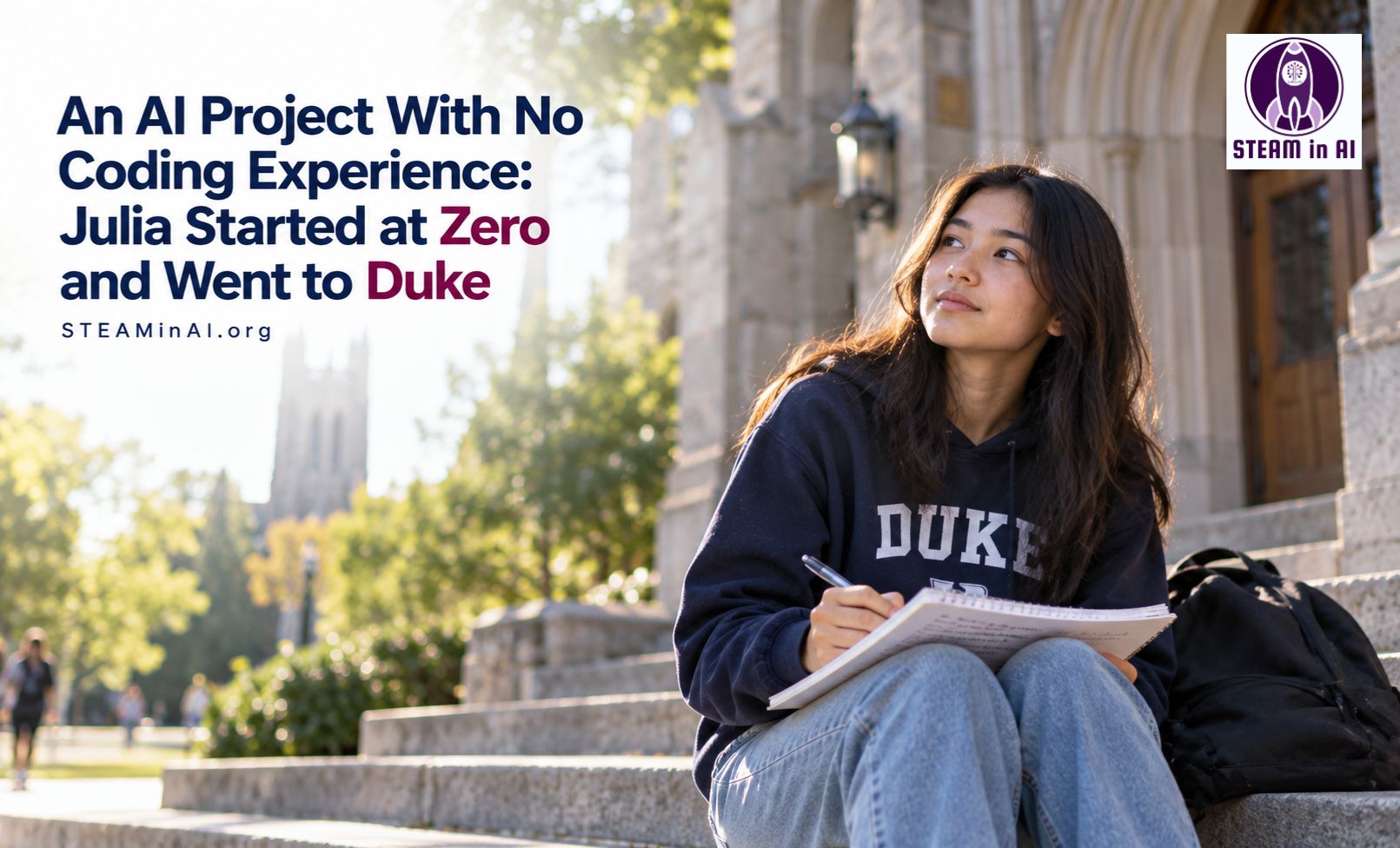
- Julia Kessman arrived without having written a line of Python and left with a working healthtech build. She is at Duke, studying Statistical Science and Computer Science.
- Nila Balavenkatesh presented at the Winter Intensive and went on to Illinois for Information Science.
- Eli combined business and AI, and is now at USC in Artificial Intelligence for Business.
- Marcell Gentles is at Harvey Mudd studying Computer Science.
- Raina came in with a problem she had lived with for years, built an app for it, and took it to the App Store.
The details, in short
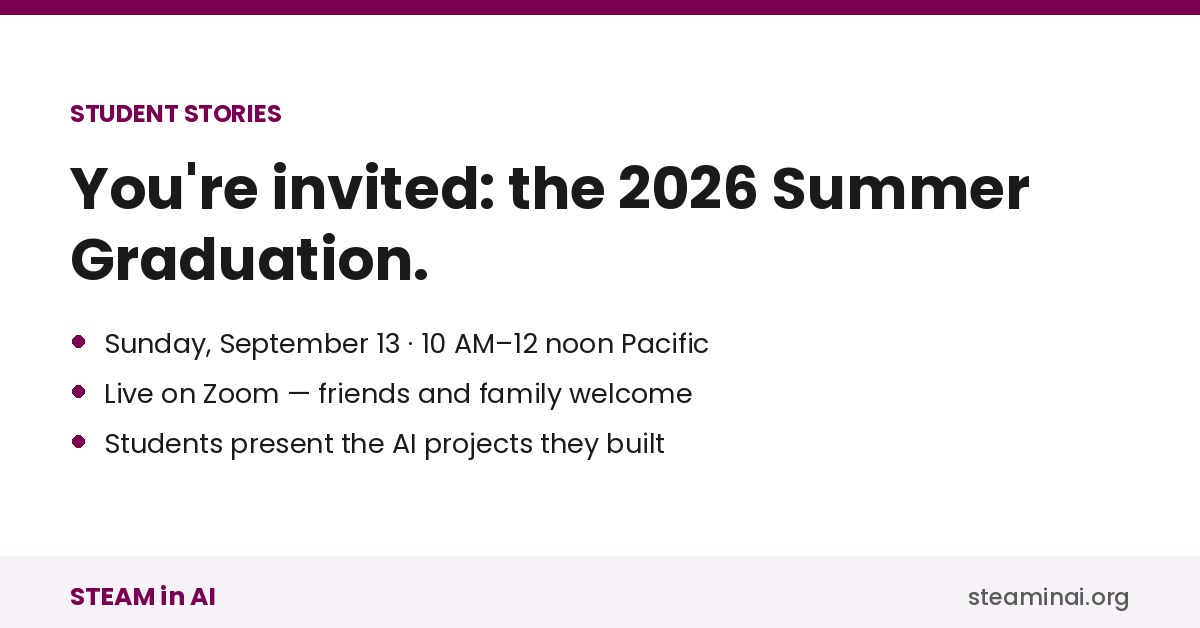
| What | The 2026 STEAM in AI Summer Graduation Ceremony |
|---|---|
| When | Sunday, September 13, 2026, 10:00 AM to 12:00 noon Pacific |
| Where | Live on Zoom. Register here and the link comes straight to your inbox. |
| Who can come | Friends and family of our students, and anyone curious about what a high school AI project actually looks like. Open to all. |
| Cost | Free |
| How long | Two hours. Plan for a full presentation from each graduating student, plus time for questions. |
If your family is not part of this cohort
Even so, you are still welcome, and you may find it more useful than a brochure. Parents comparing AI programs usually get shown polished case studies. A graduation is the unedited version. You will see what a real high school AI project sounds like when a sixteen-year-old explains it without notes, and you will be able to judge for yourself whether that is what you want for your student. So come and watch, and ask the students questions. It is the most honest thing we do.FAQ: the STEAM in AI graduation
Do I need to register for the STEAM in AI graduation?
Yes, so we can send you the Zoom link. Registration is free and takes under a minute. Register for September 13 here.Can I invite family who know nothing about AI?
Please do. The presentations are built for exactly that audience, and a student explaining their work to someone outside the field is the whole point of the day.Can I attend if my student is not in the program?
Yes. Families considering the Intensive are genuinely welcome, and we would rather you saw the real thing than read about it. Start with the five categories of AI programs if you are still mapping the landscape.Will the ceremony be recorded?
We record every STEAM in AI graduation so families who cannot attend live can watch afterwards, and so students have something to keep. Attending live is better, because the students can hear you.Are these AI Research projects or AI Build projects?
This ceremony is the AI Build cohort, so expect working software demonstrated live. Students pick Build or Research at the start of the Intensive, and both tracks are open with no prerequisites.What happens to these projects after graduation?
For many students, graduation is a milestone rather than an ending. Projects have gone on to app stores, competitions and conference submissions. We wrote about that gap and how to cross it in what happens after an AI program ends.My student wants to be at the STEAM in AI graduation next year. What now?
Come to this one first and see what it takes. Then talk to us. Admission runs on a fit assessment rather than a GPA cutoff, so the conversation is the actual first step.Frequently Asked Questions
Students present the AI projects they built during the twelve-week program. Each student explains what they created and how it works in a live session. It is the day they stop building and start demonstrating their work to family and guests.
The graduation is an open invitation. Parents, grandparents, siblings, extended family, teachers, counselors, family friends, and anyone who has been following the student’s progress is welcome to attend.
The graduation runs live on Zoom, so anyone can join regardless of location. Registration takes under a minute through the link provided on the event page.
Students present real AI projects they built during the program — working AI agents, research projects, and applied AI tools. Each project demonstrates hands-on skills the student developed over twelve weeks of building.
The graduation ceremony runs for two hours, from 10:00 AM to 12:00 noon Pacific time. Each student has dedicated time to present their project and answer questions.