How to Build an AI Project in High School (No Coding Required)
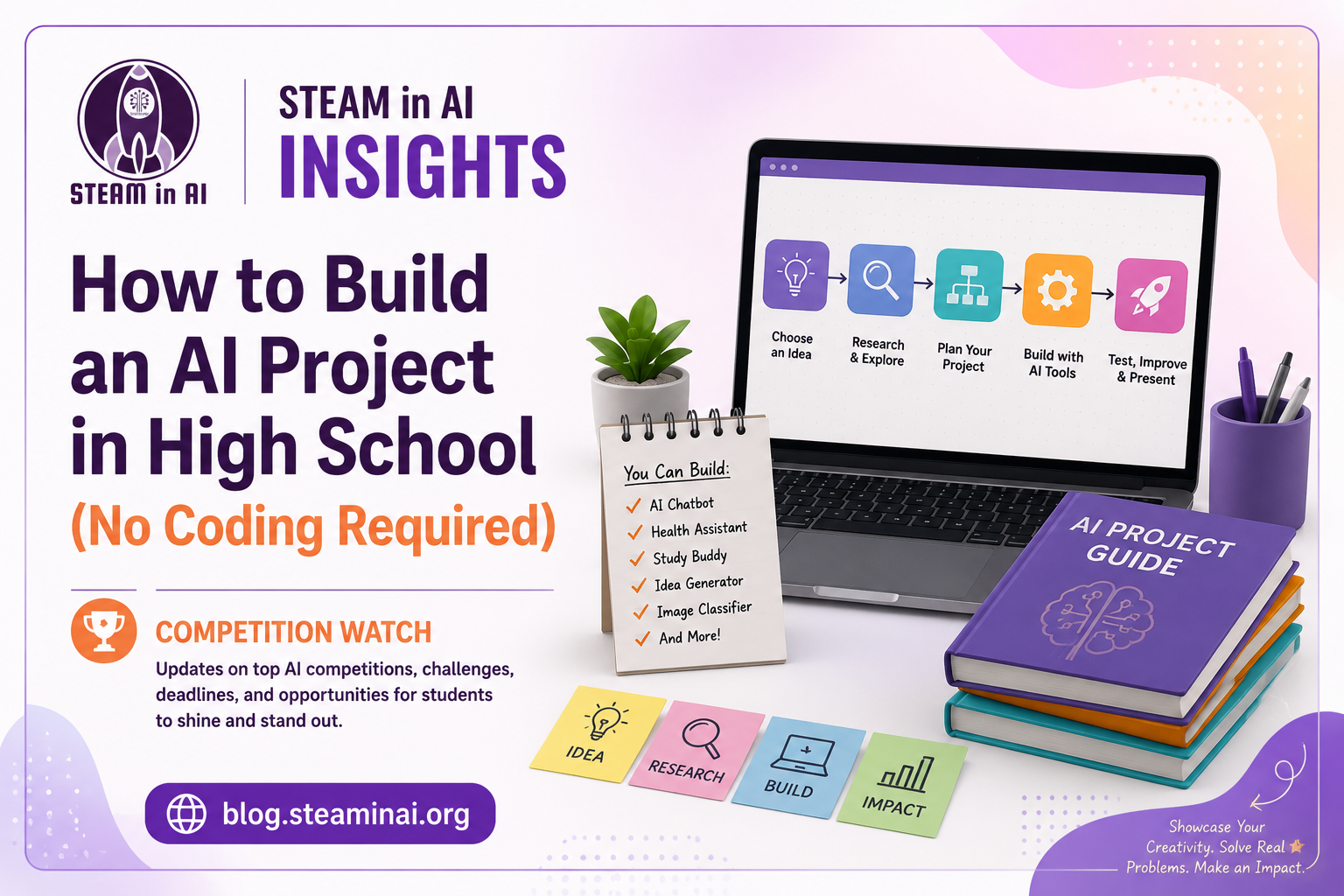
You can build an AI project in high school without knowing how to code. The most impressive AI projects in college applications don’t come from students who spent years learning Python. Instead, they come from students who clearly identified a real problem and used available AI tools to solve it.
This guide walks you through exactly how to build an AI project as a high school student in 2025. It works whether you have zero technical experience or some programming background.
Step 1: Start with a problem, not a technology
Students often make one mistake: they start with “I want to learn machine learning” instead of “I want to solve X.” Strong AI projects begin with a specific, personal problem the student actually cares about.
STEAM in AI students have built problem-first AI projects across many domains. One student frustrated by inconsistent dermatology advice built a skin health app. Another student who struggled with traditional tutoring built a personalized study tool. Meanwhile, a student-athlete recovering from a knee injury built an ACL injury prediction model.
Your problem doesn’t need to be world-changing. Instead, it needs to be specific, personal, and solvable with available data or tools.
Step 2: Choose your approach — no-code, low-code, or full code
AI project tools in 2025 span a wide spectrum of technical complexity:
- No-code tools (best for beginners): Google Teachable Machine, AutoML, Lobe.ai, Runway ML. These let you train and deploy AI models through a visual interface with no programming required.
- Low-code tools (some scripting): Hugging Face Spaces, Streamlit, Gradio. You can build functional AI apps with fewer than 50 lines of Python using pre-built components and models.
- Full code (for students with Python experience): Jupyter notebooks, scikit-learn, TensorFlow, PyTorch. More control, steeper learning curve.
A compelling no-code project beats a mediocre full-code project every time. So, choose the tool that lets you finish, not the one that sounds most impressive.
Step 3: Find your data
Most AI projects need data to train or test a model. Fortunately, free and high-quality datasets exist for virtually any domain:
- Kaggle.com — the largest public dataset library, with datasets on healthcare, sports, finance, environment, and more
- UCI Machine Learning Repository — academic datasets across hundreds of domains
- Google Dataset Search — search engine for publicly available datasets
- Data.gov — U.S. government open data on education, health, transportation, and more
- Collect your own — surveys, photos, sensor readings. Original data collection makes a project uniquely yours.
Step 4: Build a working prototype (it doesn’t need to be perfect)
College applications don’t require a production-ready product. In fact, a working prototype that demonstrates your idea and shows measurable results is more than sufficient. “Working” means: given an input, it produces a meaningful output. That’s it.
Additionally, document your process as you build. For instance, take screenshots, write notes, and record short videos. This documentation becomes the raw material for your project writeup, college essay, and interview answers.
Step 5: Validate and present your results
The difference between an AI project and a strong AI project is whether you present your results with evidence. How accurate is your model? Who exactly does it help? Given more time, what would you do differently?
There are several ways to validate your project. For example, you can enter a science fair or AI competition, publish your model on Hugging Face, or present to a mentor or community organization. Submitting to a high school research journal is another strong option. Moreover, any external validation significantly strengthens how the project reads in a college application.
How long does it take to build an AI project in high school?
With a mentor guiding the process, a college-application-ready AI project typically takes 8 to 12 weeks at 3–5 hours per week. Without mentorship, students often spend 2–3x longer on the same project. As a result, they get stuck on technical problems that an experienced mentor can resolve in minutes.
STEAM in AI’s 12-week intensive pairs every student with a 1:1 industry mentor from Google, NVIDIA, Roblox, or Genentech. Therefore, each student finishes with a portfolio-ready AI project built around their specific interest. No prior coding experience required.
Book a free 45-minute strategy session. We’ll map a specific project direction for your student before the next cohort fills.
Ready to build your AI project?
STEAM in AI pairs high school students 1:1 with mentors from Google, NVIDIA, and OpenAI to build a real, portfolio-ready AI project — no coding required. Book a free strategy session to get started.