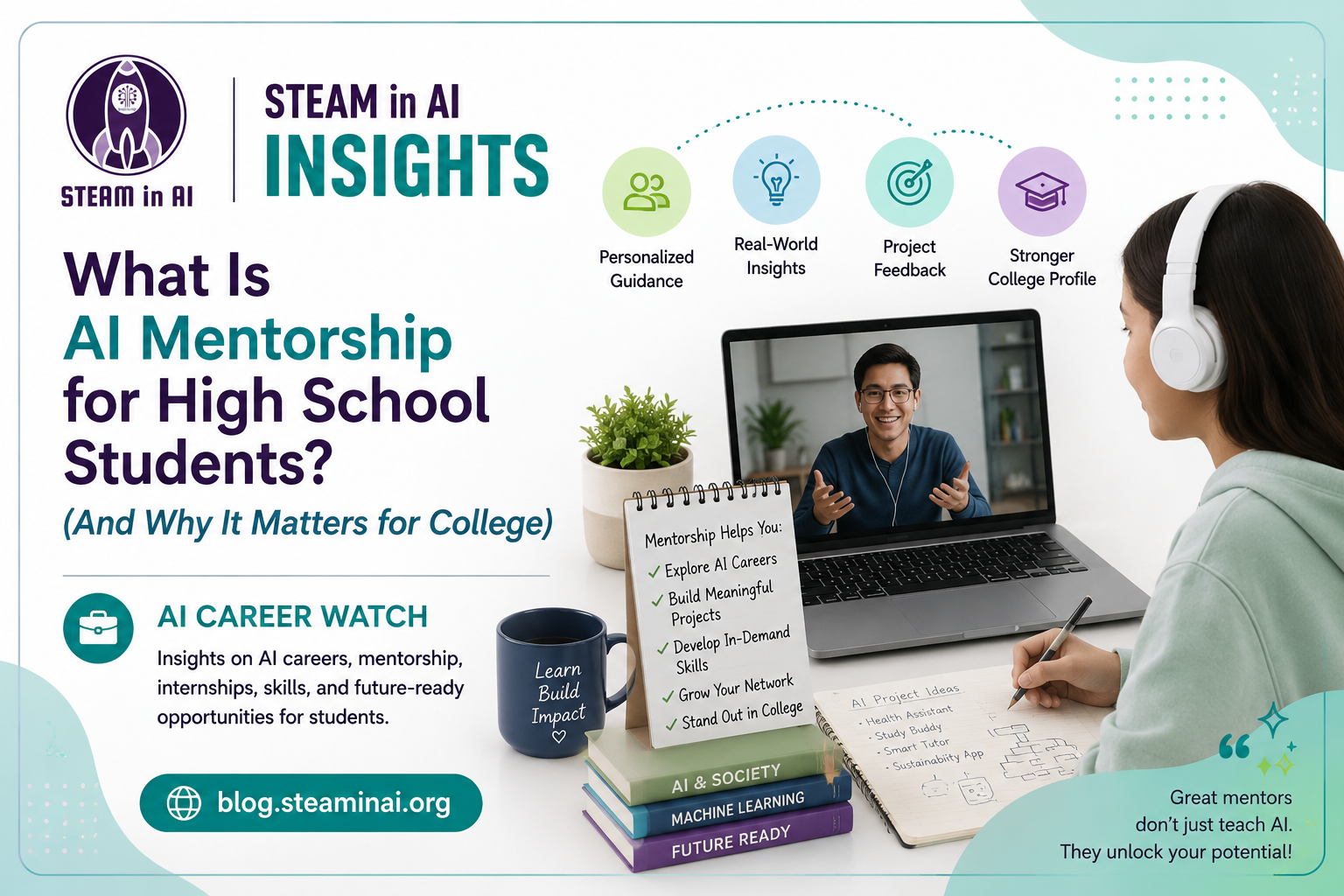
What Is AI Mentorship for High School Students? (And Why It Matters for College)
AI mentorship for high school students is a structured, 1:1 program. An experienced AI professional — typically an engineer, researcher, or product leader at a major tech company — guides a student through building an original AI project over several weeks or months. Unlike tutoring or camps, mentorship produces a finished, student-owned project. Students can use it in college applications, competitions, and interviews.
How is AI mentorship different from an AI camp or course?
The difference comes down to output and personalization. An AI camp teaches the same curriculum to 20–30 students. It typically ends with a shared or template project. An AI course delivers video lectures with no human interaction. AI mentorship is 1:1 — the mentor and student work together on a project the student defines, based on a problem the student actually cares about.
The result of mentorship is unique to the student. When a STEAM in AI student builds an AI app to detect early signs of skin conditions, that project exists nowhere else. It’s theirs to own, present, and build upon.
What does an AI mentor actually do?
A good AI mentor does several things a course or camp cannot:
- Scopes the project — helps the student translate a vague interest (“I want to do something with AI and healthcare”) into a specific, buildable project (“we’ll train a classification model on dermatology image data”)
- Unblocks technical problems — when a student gets stuck on data preprocessing or model accuracy, the mentor solves the problem in minutes instead of days
- Maintains quality standards — ensures the student’s work is genuinely good, not just done; the mentor stakes their professional credibility on every project they guide
- Prepares the student to present — teaches the student how to explain their work to an admissions officer, interviewer, or competition judge
Who are the mentors in STEAM in AI?
STEAM in AI mentors are active employees at Google, NVIDIA, OpenAI, Roblox, and Genentech. They’re not recent graduates or grad students — they’re working professionals who build AI systems at scale. STEAM in AI matches each mentor to students whose project interests align with the mentor’s domain expertise.
This matters. A Google engineer mentoring a student on a natural language processing project brings real production knowledge — not textbook knowledge. That depth shows in the quality of the work and in how the student talks about it.
What kind of AI projects do high school students build through mentorship?
STEAM in AI students have built:
- A skin disease detection app using computer vision (the student noticed a gap in accessible dermatology care)
- An ACL tear classification model using MRI data (student-athlete recovering from their own injury)
- A Depolarization GPT that rewrites partisan content into neutral language (student interested in media and civic discourse)
- A personalized learning AI for students with ADHD (student who struggled with traditional classroom methods)
- An AI tool that matches high school students to research opportunities based on their interests and GPA
Every project starts with a real problem the student personally cares about. The mentor’s job is to help the student build a working solution — not to assign a project from a template.
How do students get access to AI mentorship?
STEAM in AI’s 12-week AI Intensive is open to high school students in grades 9–12. Students need no coding background, GPA threshold, or prior AI experience to apply. STEAM in AI accepts students who demonstrate curiosity, a specific problem to solve, and the commitment to finish.
Cohort 2 applications close May 30, 2026. Book a free 45-minute strategy session with founder Shilpi Agarwal. You’ll discuss your student’s interests, explore potential project directions, and determine if the program is the right fit.
See what 1:1 AI mentorship looks like in practice.
STEAM in AI students have been admitted to Duke, USC Marshall, Harvey Mudd, and UC Berkeley’s MET program after completing their AI projects. Book a free strategy session to learn how it works.