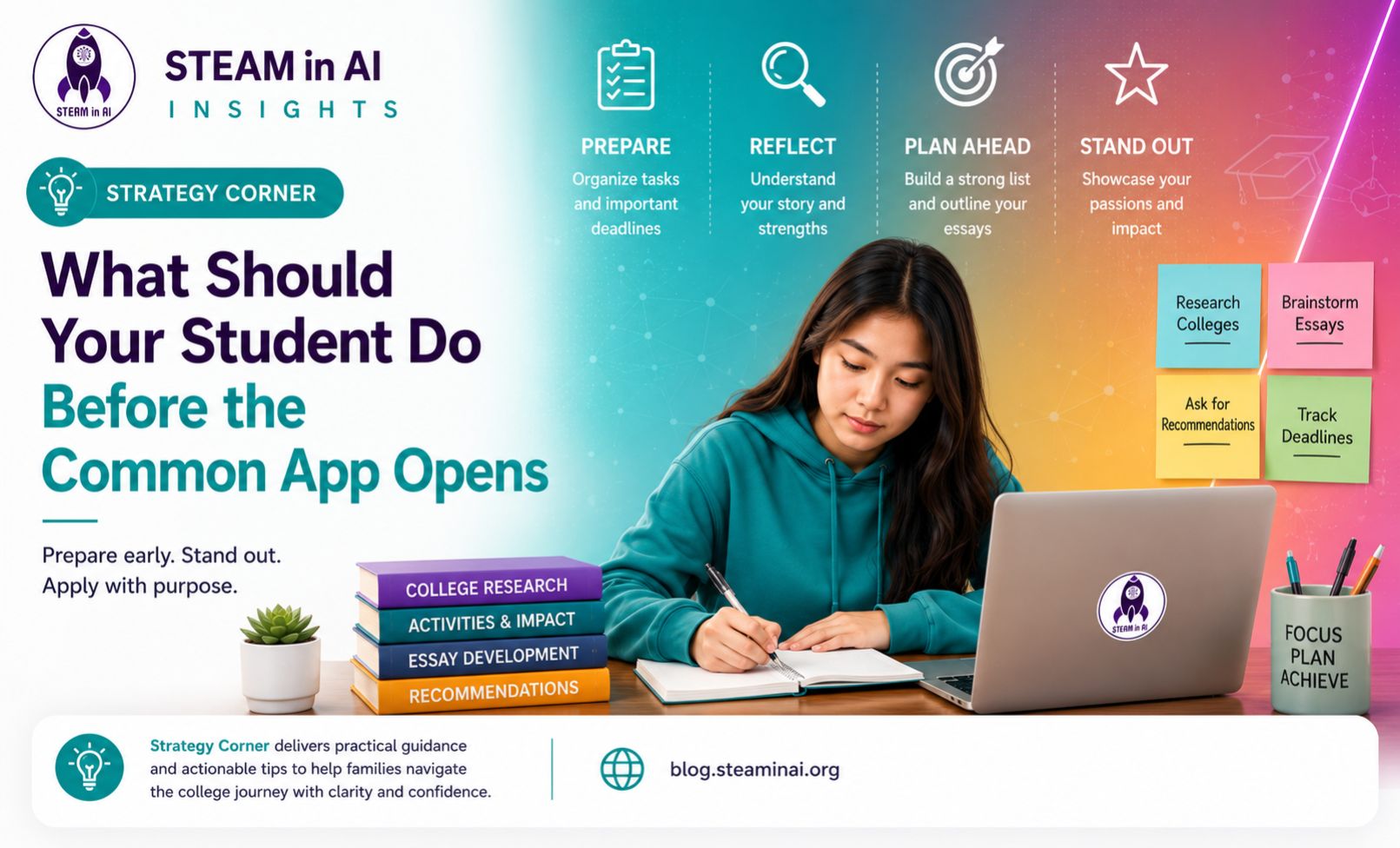
What Should Your Student Do Before the Common App Opens? The 3-Week Checklist
The Common App opens on August 1 every year — and the three weeks before it open are quietly the highest-leverage stretch of the whole admissions calendar. Here’s the short answer to what your student should do with them: open the account on day one, deepen one activity instead of adding five, rebuild the testing plan, and line up one piece of real evidence. Below is the full checklist we’d give any family — whether or not you ever work with us.
1. Open the Common App account on day one — not “sometime in August”
Not because admissions rewards speed, but because early setup turns abstractions into a plan. The moment the account exists, the essay prompts, the activity list’s ten slots, and each school’s actual requirements stop being rumors and become a checklist your student can see. Families who open the account in week one consistently report the calmest fall — the work is the same; the panic is optional.
2. Go deep, not wide
The instinct in the final stretch is to add — a new club, a quick volunteer stint, anything to fill slots. Admissions readers see through accumulation instantly. The stronger move is the opposite: pick the one thing your student can genuinely deepen — a project, a research question, a competition entry — and give it real hours. One activity with visible depth outweighs five entries with none, because depth is the thing that can’t be faked.
3. Rebuild the testing plan
With every Ivy League school requiring the SAT or ACT again and other selective schools following, “we’re skipping the test” is no longer a strategy for a mixed list. Sort each school into test-required, test-optional, and test-blind using this year’s policies, and get official test dates on the calendar now — with room for a retake before applications are due.
4. Line up one piece of real evidence
Essays are shrinking, testing is back, and what’s left carrying weight is what a student can point to, explain, and defend. That’s evidence: a build they made, a question they researched, a competition they entered — work with their fingerprints on it. It doesn’t require connections. One of our students, a two-time ISEF Grand Award winner, started his research career with a single cold email to an MIT professor — the email worked because there was already real work behind it.
The order of operations most families get backwards
The application isn’t the starting point; the work is. The application is just how the work introduces itself. Which is why the best use of the pre-Common-App window isn’t polishing words — it’s starting (or deepening) the one project your student will still be talking about in interviews.
Here’s the part that actually separates applicants during these three weeks: everyone will have “started the Common App” by August. Almost nobody will have a real piece of evidence to point to when the essay or the interview asks “prove it.” If a mentored AI project is the piece your student is missing, we only take a limited number of students into each cohort, and if it isn’t the right fit, we’ll tell you honestly on a 45-minute AI Project & Fit Assessment call — interests, project direction, Build vs. Research pathways, and whether there’s enough runway left before applications open.
Cohorts fill on a rolling basis and the runway before the Common App opens is already short. Check the next cohort deadline before this admissions cycle closes it out.


How to Get a Research Mentor in High School (One Cold Email Reached an MIT Professor)

Do Ivy League Schools Require the SAT Again? Yes — All Eight. Here's What to Do