Best AI Programs for High School Students: 2026 Parent’s Guide
Parents looking for the best AI programs for high school students usually hit the same wall within an hour of searching. If your student is interested in AI and you’ve started researching options, you’ve probably noticed the field splits into two very different worlds. One is a small set of extremely selective, often free, university-run research programs — RSI, MIT PRIMES, CMU AI Scholars. The other is a growing set of paid, direct-enrollment programs that provide mentorship without a competitive admissions gate — 1:1 research mentorship, project mentorship, and structured courses.
The short answer
There are five kinds of AI program, and “best” depends entirely on which one your student needs. Elite selective research programs (RSI, MIT PRIMES) are free and admit under 10%. Courses and bootcamps build literacy but produce a certificate, not a project. Summer camps give exposure. 1:1 research mentorship ends in a paper. 1:1 project mentorship — the STEAM in AI model — ends in a working build or an original study, chosen by the student, with no coding prerequisite. Pick the category first, then compare programs inside it.
New to us? Sit in on a free STEAM in AI Live Lab before you decide anything — no form, no call, just watch a session.
Neither world is automatically better than the other. They solve different problems, for different students, at different points in a high school career. This guide maps the landscape as it actually is in 2026, so you can figure out which category fits your student before you compare individual programs inside it.
The five categories of AI programs for high school students
AI courses and bootcamps. Structured curriculum, group instruction, a fixed syllabus. Good for building foundational Python and ML literacy. The output is usually a certificate or a small guided project, not an original piece of work the student can speak to at length.
AI summer camps. Short, often in-person, often university-branded. Strong for exposure and motivation, especially for younger students. Rarely produces a project substantial enough to anchor a college application on its own.
Elite selective research programs. RSI, MIT PRIMES/PRIMES-USA, CMU AI Scholars, MITES, Stanford AI4ALL. Free or heavily subsidized, extraordinarily selective, and genuinely excellent when a student gets in. The real constraint for most families isn’t quality. It’s eligibility.
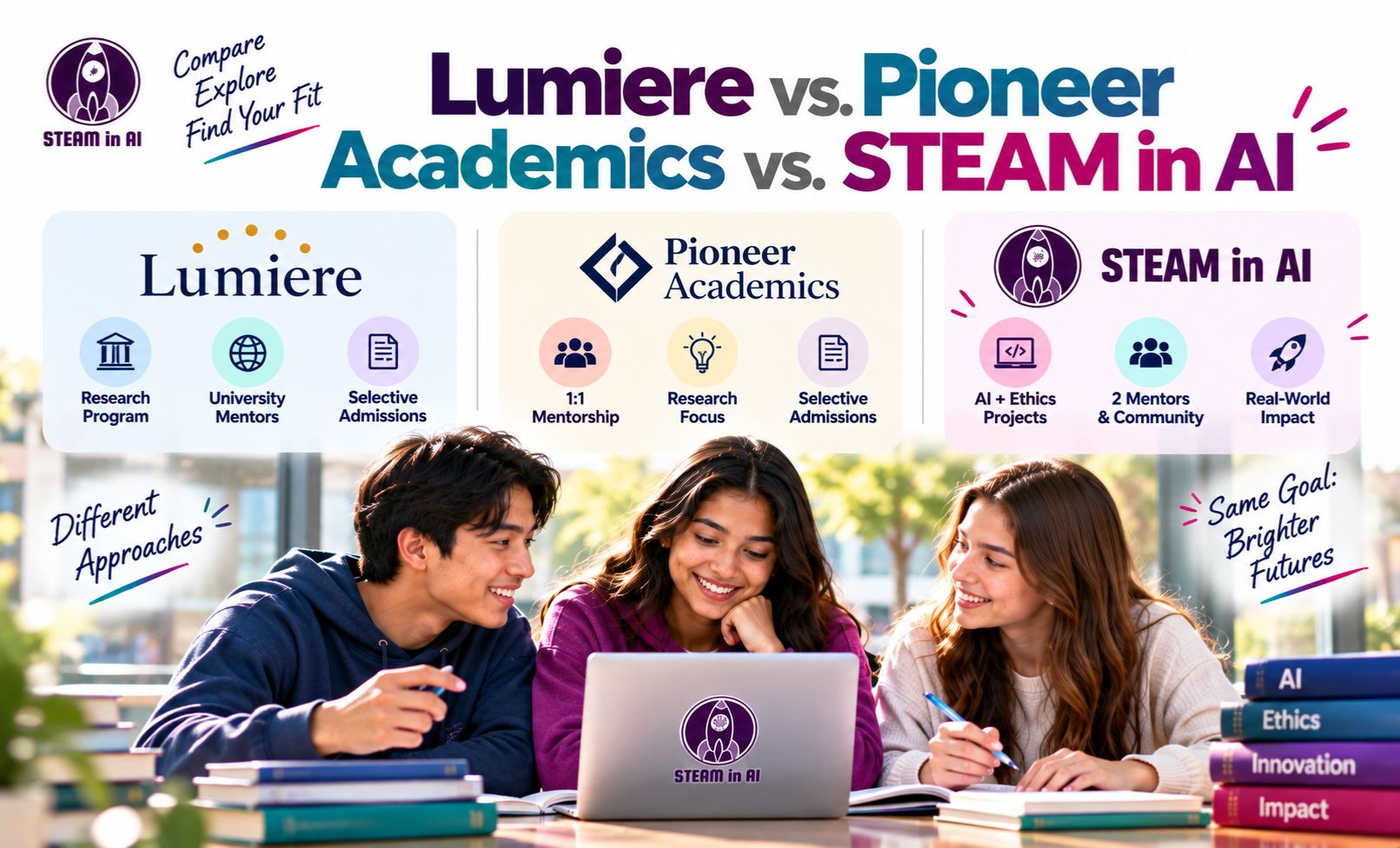
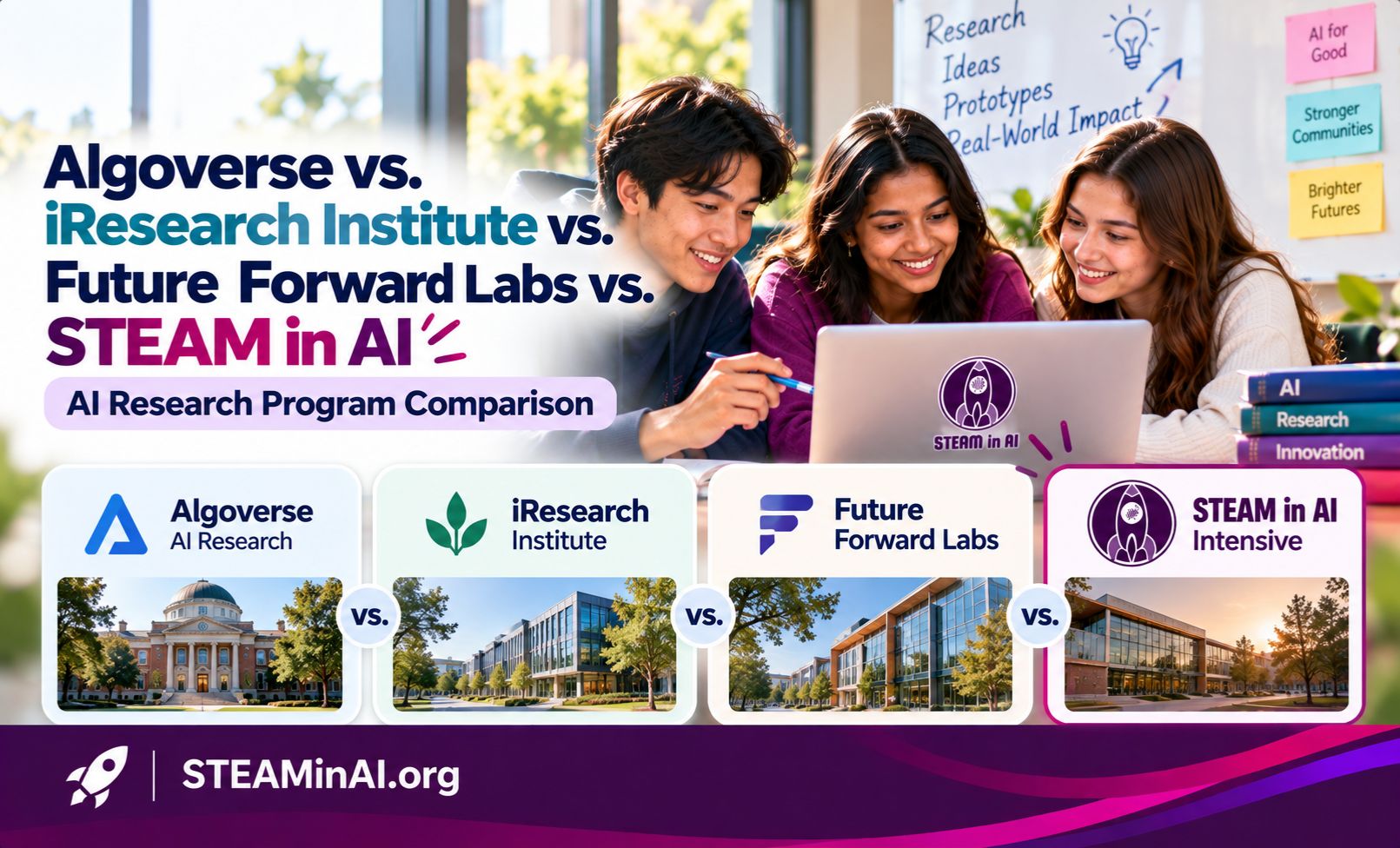
1:1 research mentorship. Polygence, Lumiere, Veritas AI, Inspirit AI’s research track. A student is paired with a PhD-level or industry researcher and works toward an independent research paper over roughly 3–6 months. Priced from roughly $2,500 to $6,000. STEAM in AI offers this as its AI Research track as well, but as one of two choices rather than the only one.
1:1 project mentorship. This is the STEAM in AI model, and only a small number of programs sit in this category. The deliverable is not necessarily a research paper. A STEAM in AI student picks one of two tracks — AI Build, where they ship a working product, or AI Research, where they investigate a question rigorously — and the project itself is designed around that student’s own interests, activities and intended major before the program begins. There are no prerequisites and no coding requirement to enter.
▶ Watch the 2025 Graduation and see the projects yourself
What these categories look like with real students in them
Categories are easier to judge against actual outcomes, so here are five STEAM in AI graduates. They are useful mainly because of how different they are from one another — same program, same framework, five different majors.
Julia arrived having never written a line of code. She built a health technology AI application using Stanford Health imaging data and now studies Statistical Science and Computer Science at Duke.
Eli volunteered at a senior centre and noticed people struggling with email software built for twenty-five-year-olds. He built SimpleMail, an AI email agent driven by plain-English instructions, and now studies Artificial Intelligence for Business at USC.
Ivy tackled financial fraud detection on a dataset where under one percent of transactions were fraudulent. A genuinely hard statistical problem. She studies Computer Science and Engineering at Santa Clara.
Nila built a retrieval-augmented chatbot that answers recycling questions using each city’s actual rules, plus a plan for launching it in schools. She studies Information Science at UIUC.
Marcell came in as a beginner and built a tool helping teenagers audit their online presence before job applications. He studies Computer Science at Harvey Mudd and has since interned at Bloomberg and Intuit.
Five different problems, five different technical disciplines, five different destinations, all out of the same program. That variation is the thing to look for when you evaluate anything in this category, and the thing to be suspicious of when you cannot find it. At STEAM in AI it happens by design rather than by luck: every admitted student receives a week-by-week project schedule written by their mentor before the program starts, built around what that particular student is interested in. No two are alike.
Three questions that separate programs faster than a brochure
Who is the mentor, by name, before I pay? The answer should be a person, not a category. Ask for a name and a profile you can look up. STEAM in AI publishes its mentors by name for exactly that reason. Our students have worked with Juliana Shihadeh, a published AI-bias researcher in AI & SOCIETY; Marius Fleischer at NVIDIA; Mustafa Shah at Roblox; Tanvir Ahmed Shaikh at Genentech; and Dhruv Diddi at Turo. Every one of them is findable on LinkedIn before you pay anything.
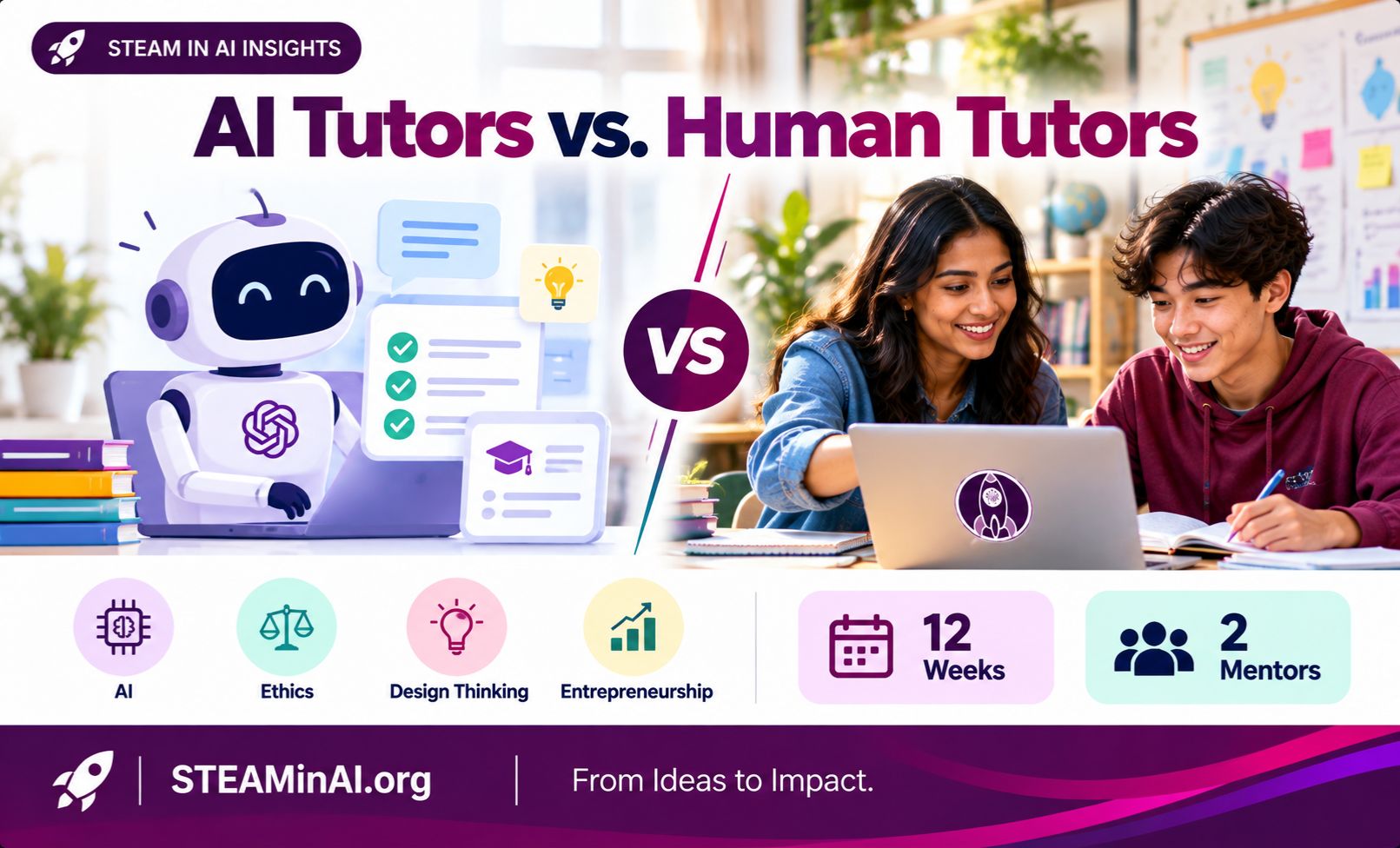
Who teaches the curriculum, and who supervises the project? These are often different jobs requiring different people, and almost no program explains which model it runs. Ask. STEAM in AI answers it with two mentors rather than one: Shilpi Agarwal, who teaches AI for Business at Stanford Continuing Studies to working Silicon Valley professionals, is the curriculum mentor for every cohort, and a separate industry project mentor is matched to each student individually.
What happens when the programme ends? A summer finishes in August. Applications are submitted in November of the following year. That gap is where a half-built project either becomes something or quietly goes stale. Some programs are designed as a single fixed engagement and end cleanly. That is honest, and right for some students. Just know which one you are buying. STEAM in AI is built the other way round, and students can keep going well past the twelve weeks — more features, an App Store submission, a competition entry, a conference talk, a publication. One student finished her twelve weeks at fourteen, spent a further year on the same project, and had her work accepted into the Presidential AI Challenge.
What each price point actually buys
| Price range | What you’re typically getting |
|---|---|
| $0 (selective) | RSI, PRIMES, CMU AI Scholars, MITES, Stanford AI4ALL — free, but acceptance rates often under 10% |
| $0–$1,500 | Introductory group courses, foundational AI literacy, light project work |
| $1,400–$1,500 | Small-group intensives (e.g., Inspirit AI Scholars, 25 hours, ~5:1 ratio) or annual mentorship memberships (STEAM in AI Inner Circle) |
| $2,500–$3,500 | Entry-level 1:1 research or project mentorship, typically 10 sessions over several weeks |
| $5,000–$6,000 | Extended 1:1 mentorship, 12–25 sessions over 3–4 months, a substantial individual deliverable. The STEAM in AI Intensive sits here — twelve weeks, two mentors, Build or Research track |
A $5,000+ program isn’t automatically better than a free one, and a free one isn’t automatically better because it’s selective. The honest comparison is: what specifically does the student walk away with, and does that match what they need right now?
Four things worth checking that almost nobody asks about
Beyond price and format, these four separate programs more than anything on a comparison table.
Is admission based on anything other than fit? Some admit everyone who enrolls. Others gate on grades or test scores. A third model — the one STEAM in AI uses — admits solely on a fit assessment: a conversation about what the student wants to build and whether we are the right people to build it with them. No GPA cutoff, no test scores. The consequence is that we turn students away, which is the only thing that makes an acceptance mean anything.
Are there prerequisites? Some AI programs assume prior Python without saying so on the page. Ask directly, because the answer determines whether a curious non-coder is being set up to thrive or to struggle silently for twelve weeks. STEAM in AI has no prerequisites and never asks for Python. Week one is written for the individual student, so a beginner starts by installing Python while a fluent coder starts at problem framing. Nobody sits through the wrong week.
Does the student choose their track? Building something and researching something are genuinely different experiences producing genuinely different application narratives. A program that only offers one has made that choice for your student. STEAM in AI students choose Build or Research themselves at the start, and some end up doing both.
Is anything taught besides the technology? This is the one families almost never think to ask. A student who can build a model but cannot explain who it is for, what it might get wrong, or why anyone should care has half a project. The STEAM in AI curriculum covers ethics, design thinking and entrepreneurship alongside the AI, because the interview question is never “what architecture did you use”. It is “why did you build this.”
The method underneath all of it
Every STEAM in AI project follows the same five steps, whatever the subject. We call it the STEAM in AI Framework:
Identify the problem — something the student has actually observed, not one assigned to them. Research and empathy — talk to the people who have the problem. Ethical considerations — what could this get wrong, and who would it affect. Prototype and build. The smallest useful version, then better ones. Impact and story — what changed, and how to explain it to someone who was not there.
The third step is the one that matters most for admissions and the one families least often think to ask about. Students who have genuinely wrestled with what their system might get wrong write differently about it. And readers who assess thousands of applications can tell.
How to choose the best AI programs for high school students by profile
Mathematically or scientifically exceptional, already competitive for elite admissions — apply to RSI, PRIMES, or CMU AI Scholars as a reach. These remain the strongest credential if your student gets in.
Solid student, genuinely curious about AI, no existing research background — 1:1 research or project mentorship is usually a better use of a summer than an admissions lottery. The student gets a real deliverable regardless of selectivity.
Not yet coding, but interested — look specifically for programs that explicitly support beginners. Several 1:1 mentorship programs, including STEAM in AI’s Build track, are built for students with zero prior programming experience. Roughly half of every STEAM in AI cohort arrives having never written code.
Wants to build something real, not write a research paper. Most research-mentorship programs default to a paper as the output. If a working product, prototype, or deployed tool is the goal, confirm that’s an option before enrolling. It varies by program.
The bottom line on the best AI programs for high school students
The program name is not the accomplishment. A student who spends three to six months on a genuinely difficult, self-directed project — with a real mentor, real setbacks, and a real outcome — usually has a stronger story than a student who attended a prestigious but generic two-week camp. Start with the category that matches your student’s actual readiness and interest, then compare specific programs inside it.
See also: What Is AI Project Mentorship? and STEAM in AI vs. Polygence vs. Inspirit AI.
Before you pick from the list
The families who regret this decision are almost never the ones who chose the wrong program. They are the ones who chose the right category for a different student. A research-paper track for a builder, a camp for someone ready to go deep. By the time that becomes obvious, a summer is gone and the next application cycle is closer than it was.
We keep each cohort deliberately small, which means we turn students away. Including students we like, when the fit is not there. If you want to find out whether yours is one we would take, the deadline for the next cohort is the place to start.
FAQ: choosing the best AI programs for high school students
What are the best AI programs for high school students in 2026?
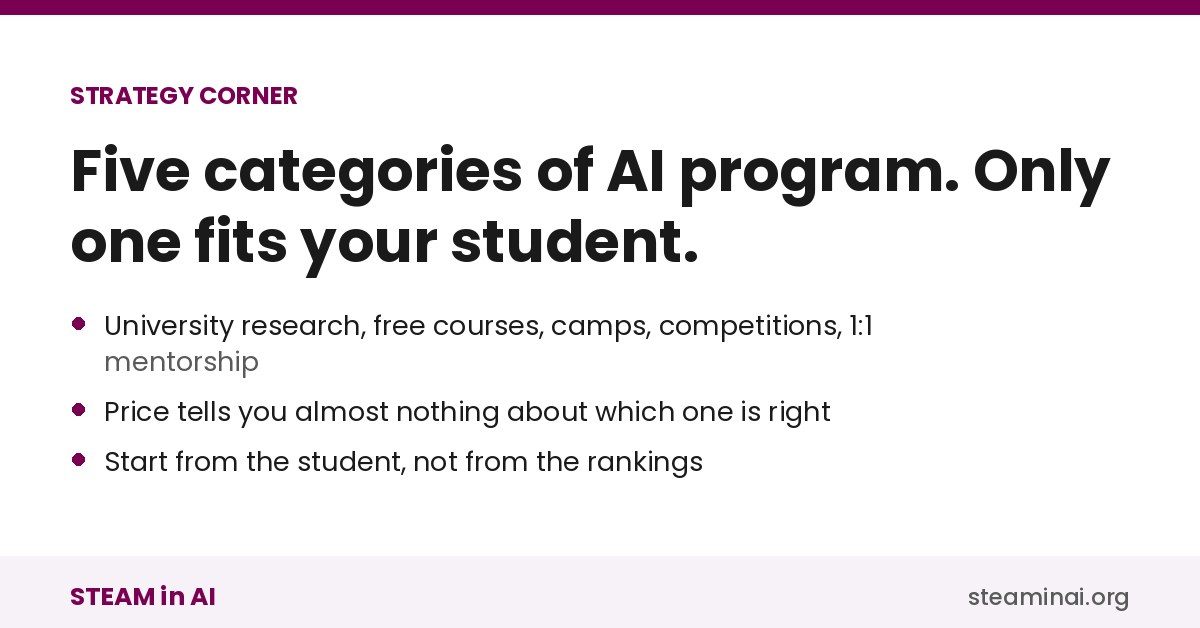
There is no single winner, and a list that names one is oversimplifying. The best AI programs for high school students fall into five categories: university research programs such as MIT PRIMES, free online courses, group summer camps, competition tracks, and 1:1 project mentorship. The right category depends on your student, not on rankings.
Are paid AI programs for high school students worth the money?
Sometimes. A paid program earns its fee when it produces something a student can defend in an interview a year later. It wastes the fee when every student leaves with the same template project. We wrote a full breakdown in Is a $5,000 AI program actually worth it?
Do colleges care about AI programs?
Admissions readers do not award points for a program name. They respond to what the student built, why they built it, and what they learned when it broke. A program matters only to the degree it produces that story. See what a spike actually means in admissions.
Can a student with no coding experience join an AI program?
Yes, and many should. Several STEAM in AI graduates started with zero coding. Julia arrived without writing a line of Python and left with a working build, then went to Duke for Statistical Science and Computer Science. More on that in AI programs for students who are not coders yet.
When should a high school student start an AI program?
Sophomore spring through junior summer is the sweet spot. That timing leaves room for the project to grow into a competition entry, an app launch, or a research write-up before applications are due in the fall of senior year.
Still not sure which of the five categories fits your student?
That is the question the list above cannot answer for you, because it depends on what your student actually wants to build. Bring us a name, a grade and an interest, and we will tell you honestly which category we would point them toward — even when the answer is not us.


The Presidential AI Challenge: A Parent’s Guide to the Next Cycle
AI Programs for High School Students Who Aren't Coders Yet