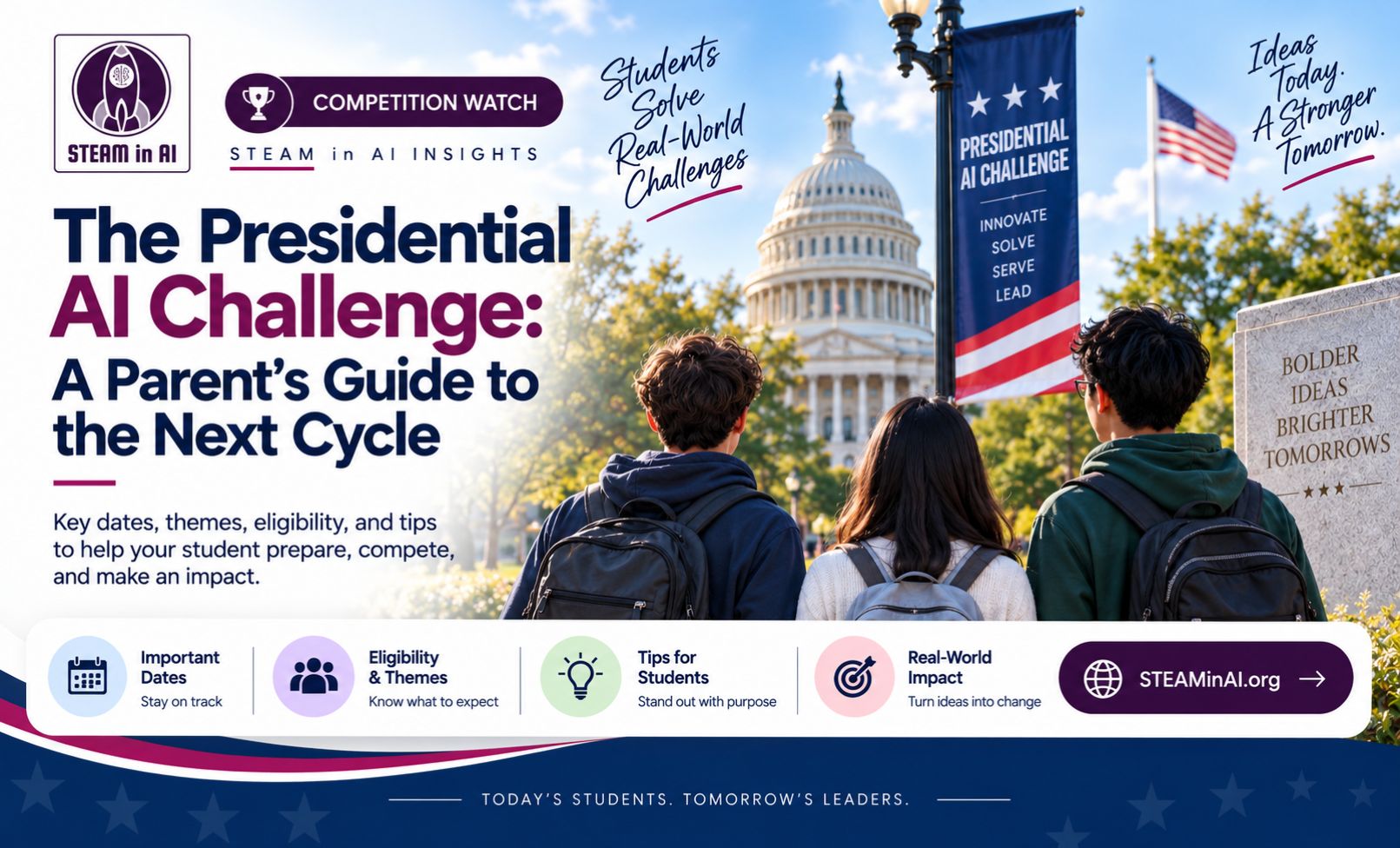
The Presidential AI Challenge: A Parent’s Guide to the Next Cycle
The Presidential AI Challenge has become the competition parents ask us about most, usually without a clear picture of what entering actually involves.
A new national competition appeared in the last two years and most families have still not heard of it. That is unusual, and it is temporary — which is precisely why it is worth understanding now rather than next spring.
What the Presidential AI Challenge is
The Presidential AI Challenge is a national competition run by ORISE and ORAU in connection with the White House. Its stated purpose is to encourage students and educators to build AI-based solutions to problems in their own communities.
There are two tracks. Students submit projects that study, develop or apply AI methods to a community challenge. Educators submit work on creative teaching approaches or integrating AI into K–12 learning. Both are open to a wide range of backgrounds. You do not need to be an advanced programmer to enter.
How the Presidential AI Challenge is structured
It runs in stages rather than as a single judging round, which matters for planning.
In the most recent completed cycle, students submitted projects in January. the organisers announced State Champions in March. Regional competitions ran from late March into mid-April, with Regional Champions named shortly after. National Championships followed in June.
That shape has a practical implication: the student has to substantially finish the work months before the recognition arrives. A project begun in the spring is not a candidate for that spring’s cycle.
What actually meets the criteria
The brief is more specific than it first appears. It asks for AI applied to a community challenge — not a technically impressive project in the abstract.
The 2026 cycle accepted two projects from our STEAM in AI students, and both fit that framing squarely.
Eli volunteered at a senior centre every week and watched older people struggle with email software designed for twenty-five-year-olds. He built SimpleMail, an AI email agent driven by plain English instructions — “read my last three emails,” “move my college emails to a folder.” The community is specific, the student observed the problem rather than researching it, and the solution is usable by the people it was built for.
Raina started at fourteen with no coding background and a problem she had lived with: years of dermatologist appointments with no straightforward way to tell whether her skin was actually improving. She built an AI skin agent that tracks a condition over time, and by the time she submitted it had become a working application.
Both projects met every criterion for successful participation.
Neither of them won. We are stating that plainly because the distinction matters and because programs in this category have a habit of blurring it. They were not State, Regional or National Champions. What they have is a national body confirming their work met the standard. Which is real, verifiable, and worth considerably more than a vague claim about an award.
Two STEAM in AI students went through this
Eli and Raina both submitted work from their STEAM in AI projects and were accepted into the Presidential AI Challenge. To be precise about it: they were accepted and certificated, not winners, and the distinction matters when a family is deciding what a program can honestly promise.
What made their work eligible was that neither project was a class exercise. Eli built an AI email agent after watching people at a senior centre struggle with software designed for someone forty years younger. Raina was fourteen, had never coded, and started from a skin condition she had lived with. A competition entry tends to come out of a project the student actually owns, which is why STEAM in AI designs the project around the student before week one.
What the Presidential AI Challenge suggests for your student
Start from something you can see. Both accepted projects came from a place the student already spent time. Neither began with a search for an impressive AI topic.
Solve it for one identifiable group. “Seniors at my volunteering placement” is a community. “People with skin conditions” is a community. “Society” is not.
Build backwards from the deadline. If submissions close in January, the project needs to be real by late autumn, which means starting in the summer.
Do not treat the competition as the goal. Both of these projects existed for their own reasons, and their students entered them because they happened to fit. Projects built to win competitions tend to be worse projects.
Is it worth entering?
For most students, yes — with the expectation calibrated correctly.
The odds of a championship are what they are for any national competition. But acceptance and recognition are achievable for a student with genuine work, and a nationally recognised project is a materially different thing to discuss in an application than an unentered one. The submission process also forces something useful: articulating who the project is for and why it matters, in writing, to strangers.
That exercise improves the project whether or not anything comes back.
Is a $5,000 AI program actually worth it? · What is AI project mentorship?
The window on this being obscure is closing
Right now, relatively few families have heard of this competition and the entry pool reflects that. That will not hold. National competitions become widely known quickly, and the students who benefit most from an early cycle are the ones who entered before everyone else knew it existed.
We help students build projects worth entering — not entries. Cohorts are small, we scope each project individually, and we tell families honestly when the timing or the fit is wrong. If your student wants a genuine shot at the next cycle, the deadline to look at is ours, not the competition’s.
What counts as a community problem, five ways
The brief asks for AI applied to a community problem, and that phrase reads narrowly to most families. It is not narrow. The same requirement is answerable from almost any direction a student is already heading, which is how we approach it at STEAM in AI.
| A student heading toward health | Something a clinic, a caregiver or a patient does badly today because the information arrives too late. Eli’s email agent began as a room full of people struggling with software built for someone forty years younger. |
|---|---|
| Toward environment or policy | A rule people break because nobody told them what it was. Municipal recycling is the obvious one, and the data is public. |
| Toward business | A cost a small organisation absorbs quietly — no-shows, mis-sorted inventory, a queue nobody measures. |
| Toward education | Something a teacher cannot see in a room of thirty, or in a video call of thirty. |
| Toward the arts or communications | Access. Who is shut out of a museum, a performance or a document because of how it is presented rather than what it contains. |
Every one of those fits the brief exactly. The students whose entries land are not the ones with the most technical project — they are the ones who picked a problem they could describe from memory.
FAQ: the Presidential AI Challenge
What is the Presidential AI Challenge?
It is a national competition inviting United States students to build AI projects that address a real problem in their community or country. The official government AI site publishes details and eligibility: official government AI site.
Who can enter the Presidential AI Challenge?
It invites United States K-12 students, with divisions by grade band. Confirm the current cycle dates and rules on the official site before planning around them.
What do judges reward?
A real problem, a defensible approach, and evidence the student understands the limits of what they built. Polish matters less than clarity about what the project does and does not do.
How long does a competitive entry take to build?
Plan on months rather than weeks. Our STEAM in AI students who submit have usually built through a full project cycle first, then adapted the work for the entry.
Do STEAM in AI students enter?
Students of ours have submitted, and the judges accepted them. We do not promise outcomes, and we do build projects a student can enter when they want to.
Competition deadlines do not move for students who started late.
A submission-ready project is the output of months of building, not a weekend of assembling, which is why the students who enter well are the ones who began a cycle earlier. If your student wants a shot at the next round, the planning starts now.