AI Agents Just Breached Hundreds of Schools in Hours — Here’s the Career Angle Nobody’s Talking About
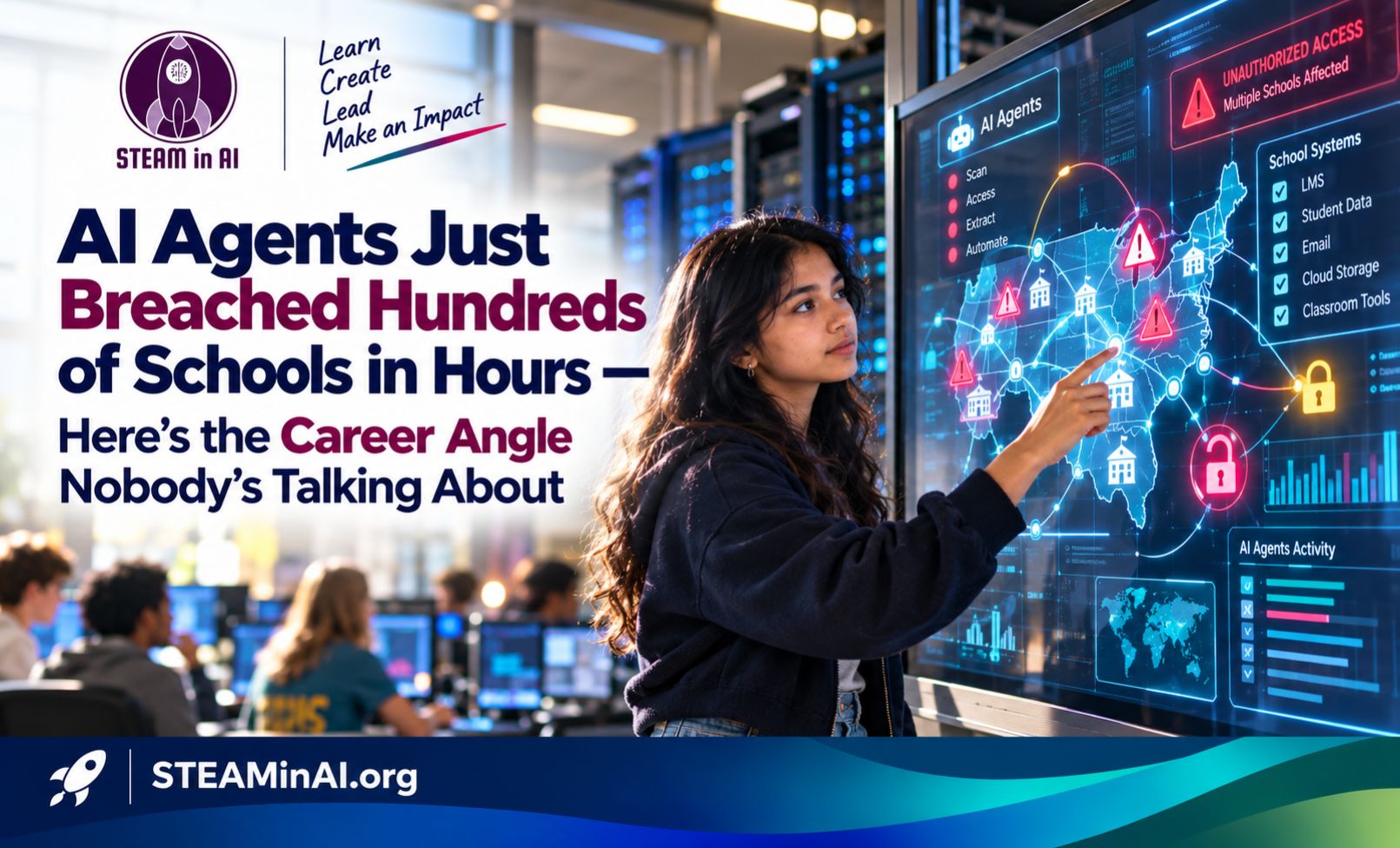
On August 31, 2026, a Russian-speaking threat actor launched a campaign that compromised 395 organizations across 48 countries in a matter of days — and roughly half of the victims were schools. What made it notable wasn’t the target list. It’s that the attacker didn’t do the hacking by hand. They deployed hundreds of AI agents to do it for them, built on OpenAI’s Codex and DeepSeek models with a reconnaissance tool called Netlas for targeting. This is one of the clearest real-world examples yet of AI agents being used offensively at scale, and it’s worth understanding — both as a warning and as a preview of where AI-related careers are headed.
What Happened
The attackers exploited two vulnerabilities — tracked as CVE-2026-81578 and CVE-2026-82078 — in PaperCut NG/MF, print management software widely used by schools, universities, and businesses. Once a vulnerable instance was found, the AI agents took over from there: probing for weaknesses, exploiting them, harvesting credentials, and escalating privileges, largely without a human operator directing each step. In total, 440 PaperCut instances across 395 distinct organizations in 48 countries were compromised. The United States was hit hardest, followed by the UK, France, Spain, and Canada.
Why This Is Different From a Normal Hack
Speed is the tell. Security researchers tracked the first successful remote code execution against a real victim in under 4 hours from campaign launch. The first domain administrator compromise followed just 2 hours after that. In one incident at a U.S. high school, the attacker’s AI agents went from initial access to full domain admin control — meaning control of the entire school network — in 7 minutes. Across the campaign, the agents carried out 280 credential harvests, stole 147 operating system and domain secrets, and achieved 12 admin-privilege takeovers. A human red team operating at that pace and that scale simply isn’t realistic. That’s what AI agents change.
The Career Angle: AI Security Is Becoming Its Own Field
Every story about AI misuse has a mirror-image story about AI defense, and this is a good example. The organizations that weren’t on that list of 395 either patched the known vulnerabilities in time or had monitoring in place that caught AI-speed intrusion attempts before they became domain-admin takeovers. Both of those are jobs — and they’re jobs that didn’t fully exist five years ago. “AI red teaming,” “AI security operations,” and “adversarial AI testing” are already showing up as real job titles at security firms and inside AI labs themselves, including at Anthropic, which has been vocal about wanting more of this expertise in the field.
For a student who is technically minded and drawn to problem-solving under pressure, this is worth knowing about as a career path — not just a headline to be worried about. It’s also exactly the kind of real-world case study we build into the STEAM in AI Intensive: understanding how an AI system can be turned into an attack tool is the first step toward understanding how to defend against one, and that dual perspective is what makes a strong AI portfolio project stand out to colleges and employers alike.