AI Mentors for High School Students: Who Actually Sits With Your Student
The best AI mentors for high school students are working professionals — engineers, researchers, and data scientists at companies like Google, NVIDIA, and Genentech — who guide students 1:1 through original AI projects. STEAM in AI pairs every student with an industry mentor matched to their interests, plus a Chief AI Architect who designs the project.
Not every program names the AI mentors for high school students it works with before a family enrolls, so it is worth asking early. Every program in this category makes some version of the same claim: expert mentors, industry professionals, PhD-level researchers. The phrasing varies. The specificity does not, because there usually is none.
That vagueness is doing work. “You will be matched with a mentor from our network” means the family is buying a category rather than a person, and will not learn which person until after they have paid. For a product whose entire value is a relationship, that is a strange thing to leave undefined.
So here are ours, by name, with links. Look them up.
The AI mentors for high school students we work with
Juliana Shihadeh
Juliana is a published researcher whose work sits precisely where AI meets ethics. Her paper “What does genius look like? Investigating brilliance bias in AI-generated images”, co-authored with Margareta Ackerman and David Loker, appeared in AI & SOCIETY. It examines how image generators like Midjourney, DALL·E and Stable Diffusion reproduce a bias children absorb as young as six: that intellectual brilliance is male.
You can read the paper. That sentence is the whole point of this post. When a program tells you a mentor does research, ask to see it.
Juliana has mentored five of our STEAM in AI students across two cohorts, and their destinations diverged completely. Statistical science and computer science at Duke, biomedical engineering at UC Davis, and others. One researcher, five students, five different paths.
▶ Watch Raina’s Live Lab with her mentors
The people, by name
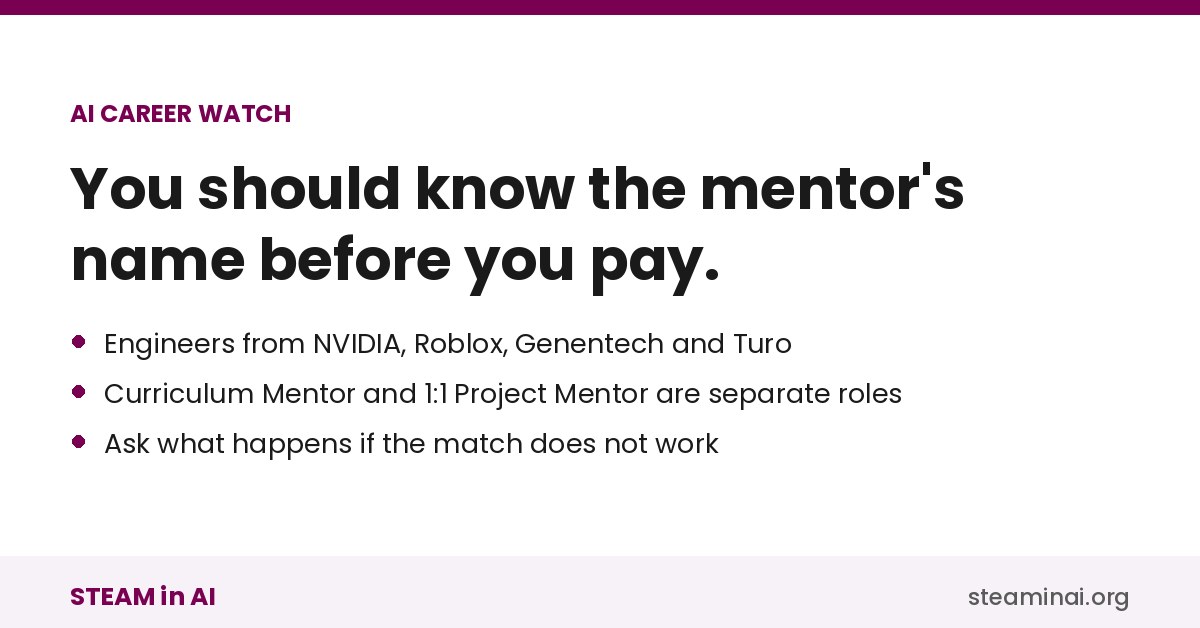
Marius Fleischer — NVIDIA
Marius is an AI architect at NVIDIA. He mentored Raina, who arrived at fourteen having never written code, through building an AI skin-tracking agent. And Eli, who built an AI email assistant for seniors that later went to the Presidential AI Challenge.
Both of those students were beginners. Scoping a genuinely ambitious project to a beginner’s actual starting point, without either patronising them or setting them up to fail, is a specific skill. It is not the same skill as being good at AI.
Mustafa Shah — Roblox
Mustafa is an AI engineer at Roblox with a master’s in computer science from Georgia Tech. He took over Raina’s project in its second year, when the work shifted from prototype to product. App store submission, reliability, the unglamorous problems that separate a demo from something strangers can use.
That handoff is deliberate. The mentor who is right for weeks one to twelve is not automatically right for month eighteen.
Tanvir Ahmed Shaikh — Genentech
Tanvir mentored Ivy, whose project tackled financial fraud detection where under one percent of transactions are fraudulent. Imbalanced-class problems are genuinely hard. A model that labels everything “not fraud” is 99% accurate and completely useless. And the work involved feature selection and hypothesis testing that would challenge a working data scientist.
Dhruv Diddi — Turo
Dhruv mentored Yidian, who built something unusually ambitious solo: a social platform with an AI model designed to reduce political polarization rather than amplify it. Most student projects get scoped down. That one was scoped up, because the student could carry it.
Troy Kling
Troy mentored Marcell, now studying computer science at Harvey Mudd and since interned at Bloomberg and Intuit, and Hugo, who built a machine learning model to detect atrial fibrillation in ECG recordings. Efficient enough to conceivably run on a cheap wearable heart monitor.
AI mentors for high school students come in two roles, not one
This is the structural detail most families never learn to ask about, and it changes what a student receives.
Shilpi Agarwal is the Curriculum Mentor for every cohort, teaching AI, ethics, design thinking and entrepreneurship. She is an ISEF Grand Award judge, a NeurIPS presenter, and teaches AI for Business at Stanford Continuing Studies to working Silicon Valley professionals.
The 1:1 Project Mentor is a different person, matched to the individual student’s build. Hugo needed someone fluent in signal processing. Ivy needed someone who had handled imbalanced datasets. Those are not the same person, and pretending one mentor can cover every project is how programs end up with every student building the same thing.
In some cases Shilpi has served as both. She was the project mentor for Nila, Aarav and Archit as well as their curriculum mentor. We would rather say that plainly than imply every student always gets two separate specialists.
How STEAM in AI matches a mentor to a student
Every STEAM in AI student works with two mentors, not one. Shilpi Agarwal, who teaches AI for Business at Stanford Continuing Studies to working Silicon Valley professionals, is the curriculum mentor for every cohort. A separate 1:1 project mentor is then matched to the individual student and their project.
The matching is why the bench spans research, product and industry rather than one of them. A student investigating algorithmic bias works with a published researcher. A student shipping a consumer app works with someone who ships consumer software for a living. Before week one, that mentor writes a week-by-week schedule for that student alone.
How to judge a mentor before you enrol
Ask any program you are considering for the name and profile of the person who would work with your student, before enrolling. Then find out what happens if the match does not work. Check whether the person teaching the curriculum also supervises the project.
The answers will separate programs faster than any brochure.
Is a $5,000 AI program actually worth it?
Good mentors have a finite number of seats
This is the part of the model that does not scale, and we would rather admit it than pretend otherwise. Each of the people above takes a small number of students at a time. When a cohort fills, the constraint is not enthusiasm or admissions philosophy. It is how many hours a working NVIDIA architect has in a week.
Which is why we would rather turn a student away than match them badly. If you want to find out who your student would work with and whether that person has room, the honest route is to ask us before the cohort closes.
FAQ: AI mentors for high school students
Can I see AI mentors for high school students before enrolling?
With us, yes. Families meet the mentor before committing. If a program will only describe a category of mentor rather than a person, you are buying a promise rather than a relationship.
Who works as AI mentors for high school students here?
Practising engineers and researchers in the United States, including Marius Fleischer at NVIDIA, Mustafa Shah at Roblox, Tanvir Ahmed Shaikh at Genentech and Dhruv Diddi at Turo. Juliana Shihadeh, whose AI-bias research appeared in AI & SOCIETY, has also worked with our students.
Are your AI mentors for high school students graduate students?
Ours are working professionals rather than graduate students. Both models can work. They produce different conversations, and a family should know which one they are paying for.
What is the difference between a Curriculum Mentor and a Project Mentor?
The Curriculum Mentor teaches AI, ethics, design thinking and entrepreneurship to the cohort. A separate 1:1 Project Mentor is matched to the individual student and their build. Splitting the roles is deliberate.
What if the match does not work?
Ask any program this before you enrol. We reassign. A program without a process for it has not thought the situation through.
Good AI mentors for high school students should be named before you pay, not after.
We will tell you who your student would work with and why we would pair them, and you can look that person up before deciding anything. Very few programs in this category will do that, and we think it should be the norm.
The STEAM in AI Inner Circle provides year-round access to AI mentorship from professionals at Google, NVIDIA, and OpenAI.
Students not ready for ongoing mentorship can start with the LaunchPad workshop to get a personalized AI project idea first.