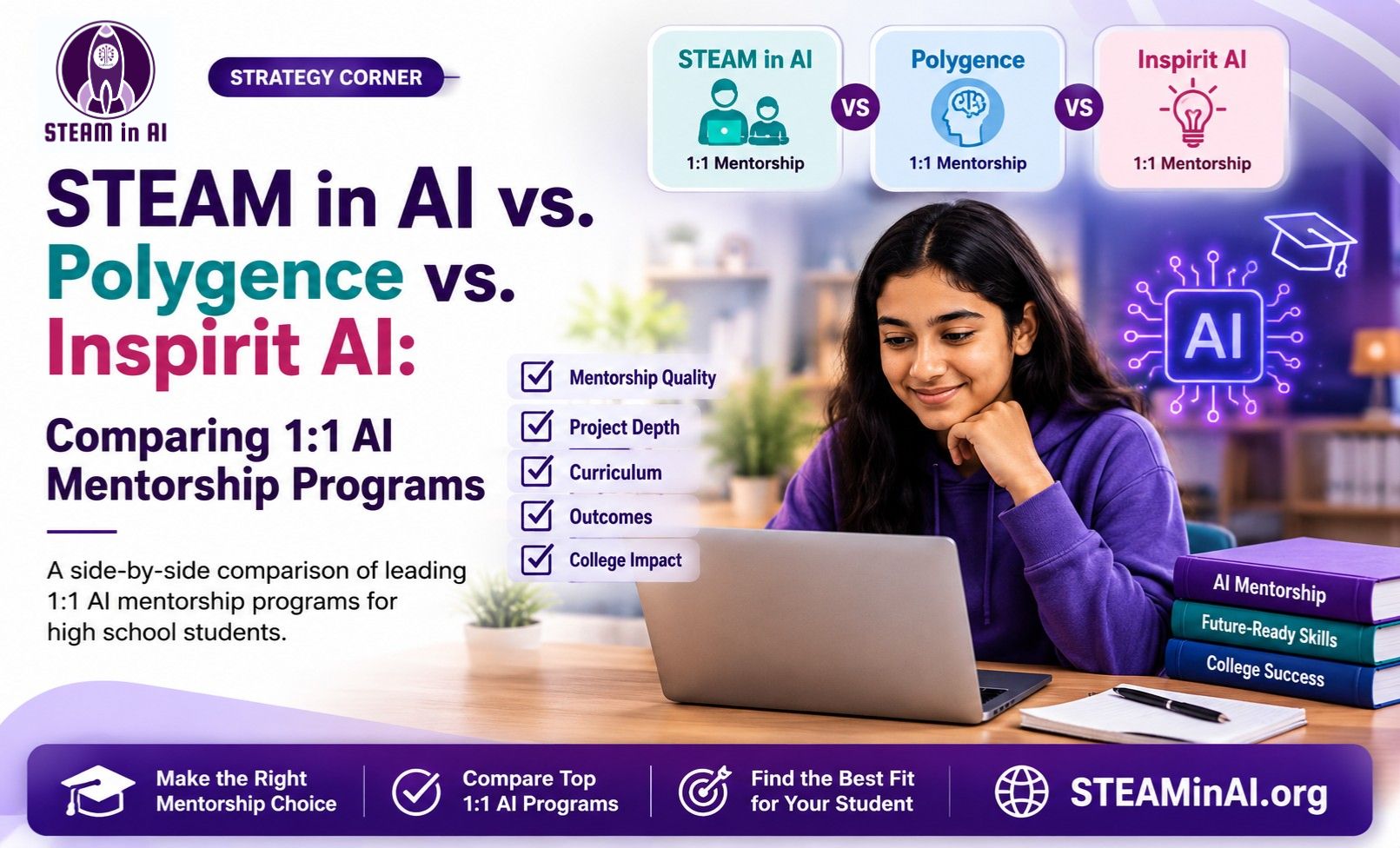
STEAM in AI vs. Polygence vs. Inspirit AI: Comparing 1:1 AI Mentorship Programs
If you are comparing STEAM in AI vs Polygence vs Inspirit AI, you have already worked out that the three websites say almost identical things. These three programs sit in the same general category. Direct enrollment (no competitive admissions gate), 1:1 mentorship, priced roughly $2,500–$6,000. That makes them genuinely comparable, and worth comparing honestly, because they’re not identical.
The short answer
All three are legitimate and they suit different students. Polygence is the strongest fit for a student who wants a research paper and an academic mentor. Inspirit AI suits a student who wants structured small-group instruction at a lower price. STEAM in AI suits a student who wants to choose between building something and researching something, works 1:1 with an industry practitioner, and is admitted on a fit assessment rather than on ability to pay. If your student cannot yet code, that last difference matters most.
New to us? Sit in on a free STEAM in AI Live Lab before you decide anything — no form, no call, just watch a session.
Program details, pricing, and mentor credentials change. Confirm current specifics directly with each program before enrolling. This comparison reflects each program’s publicly described structure as of 2026.
STEAM in AI vs Polygence vs Inspirit AI at a glance
| STEAM in AI | Polygence | Inspirit AI (1:1 Research) | |
|---|---|---|---|
| Model | 1:1 project mentorship — Build or Research track | 1:1 research mentorship, PhD-level mentors | 1:1 research mentorship, AI-researcher mentors |
| Duration | Varies by program (Intensive: multi-week; Inner Circle: year-round) | ~3–6 months | 10 or 25 one-hour sessions |
| Output | Working AI product, deployed tool, or research project — student’s choice | Independent research paper or prototype | Independent research project + paper/article |
| Coding required | No — Build track explicitly supports beginners | Not strictly, but research framing assumes some technical comfort | Varies by project scope |
| Domain flexibility | High — medicine, business, art, sustainability, and more, framed as AI applications | High — any research topic the student proposes | Primarily AI/ML-technical topics |
| Approx. cost | ~$5,499 (Intensive, high school) / $1,500/yr (Inner Circle) | ~$3,350 | $2,500 (10 sessions) / $5,000 (25 sessions) |
| College narrative | “Built X to solve Y” — product-and-outcome framing | “Researched X, found Y” — research-paper framing | “Researched X, found Y” — research-paper framing |
Where each one wins
Polygence’s real strength is topic breadth plus a structured research methodology. If your student already knows the exact question they want to investigate and wants the discipline of writing it up formally, this is a strong, well-established fit. Its Scholar Pathways option, for a student who wants to complete two connected projects over 6–12 months, is a genuine differentiator for building a longitudinal story.
Inspirit AI’s strength is depth on the technical AI/ML side specifically. Its mentors bring research-lab and industry AI backgrounds, and the program is explicit about taking a student from research-question formulation through experimentation to a written result. For a student who wants machine-learning research specifically, this is a tightly scoped, credible option.
STEAM in AI’s strength is flexibility of output and domain. A student doesn’t have to want to write a research paper to get real mentorship. The Build track produces a working product, and both tracks explicitly suit students applying AI to a field they already care about (pre-med, business, policy, the arts) rather than treating AI as an isolated technical subject. It is also the only one of the three that welcomes a student with zero coding background from day one, and the only one offering a year-round membership model (Inner Circle) rather than a single fixed engagement.
Two differences the comparison table cannot show
Feature tables flatten the things that actually vary most between these programs. Two are worth stating directly, and both are questions you should put to all three.
Whether you learn the mentor’s name before you pay. Polygence and Inspirit both describe mentor quality in categories — PhD-level, AI researchers — which is accurate and also unfalsifiable until after enrollment. We name ours: Juliana Shihadeh, whose research on bias in AI image generation appeared in AI & SOCIETY; Marius Fleischer, an AI architect at NVIDIA; Mustafa Shah, an AI engineer at Roblox; Tanvir Ahmed Shaikh at Genentech; Dhruv Diddi at Turo.
That is not a claim that our STEAM in AI mentors are better than theirs. It is a claim that you can check ours before deciding, and that this should be normal rather than unusual.
Whether the engagement has an end date. This is the structural difference that matters most and appears in no comparison chart. Polygence runs roughly three to six months. Inspirit sells ten or twenty-five sessions. Both end cleanly by design — which is honest, and correct for a student who wants one contained, well-executed experience.
Our STEAM in AI students can continue past the Intensive, and many do. Raina finished the twelve weeks with a working prototype, then kept going for another year — app store submission, a competition entry — with a different mentor suited to that later stage. Whether that matters depends entirely on your student. For one who will want to keep building, it matters a great deal. For one who wants a defined project and a clean finish, it does not.
Ask all three programs the same two questions. The answers will tell you more than this table does.
The two differences worth stating plainly
Two things do not fit in a comparison table. First, STEAM in AI is built around the student choosing between an AI Build track and an AI Research track, while a research-mentorship model defaults to a paper as the deliverable. That choice changes what the student walks away with and what they can write about.
Second, the STEAM in AI curriculum covers ethics, design thinking and entrepreneurship alongside the technical work, because the question a student gets asked in an interview is never which architecture they used. It is why they built it. Both differences are checkable before you pay anything: the mentors are named, and admission is by fit assessment rather than by who can pay.
STEAM in AI vs Polygence vs Inspirit AI: where each is a weaker fit
Polygence and Inspirit both default toward a research-paper output. If your student wants to build and ship something functional rather than write about it, confirm that’s actually an option before enrolling, since it’s not the default framing for either.
STEAM in AI does not offer the same breadth of research-topic flexibility outside AI applications that Polygence’s general research-mentorship model does. A student wanting to research a non-AI question with AI methods incidentally involved will get more from Polygence’s broader mandate.
What “personalized” means when it is real
Every program in this category uses the word. Here is a test that cuts through it: ask to see the project plan for a specific student, and ask whether that plan existed before they enrolled.
We write a week-by-week schedule for every student before their program begins, shaping it around what that student is interested in, what they already do, and where they think they are heading. One student’s ten weeks are cardiac physiology and signal processing. Another’s are retrieval-augmented generation and municipal policy data. A third’s are imbalanced-class learning where under one percent of the examples are the thing you are hunting for.
Those are not the same curriculum with the topic swapped. They need different mathematics, different tools and different mentors. Which is exactly why the 1:1 project mentor is matched per student rather than assigned by cohort.
The honest verdict on STEAM in AI vs Polygence vs Inspirit AI
There isn’t a single winner here. These are three legitimate options solving overlapping but distinct problems. A student who already knows they want a formal research paper on a specific question is well served by Polygence or Inspirit. A student who wants to build something real, hasn’t coded before, or wants mentorship framed around a field they care about rather than AI as an abstract subject, is generally better served by STEAM in AI’s project-mentorship model.
What is AI project mentorship? · Is a $5,000 AI program actually worth it?
All three of these fill up
Direct-enrollment programs have no admissions gate, which families read as “we can decide later.” What they actually have is capacity limits. The mentor your student would have been matched with takes a finite number of students, and the good matches go first. Which is why the family who decides in March gets a materially different experience from the family who decides in June.
We hold cohorts small on purpose and would rather tell you honestly that Polygence or Inspirit fits your student better than fill a seat badly. If you want to know which way that call goes for your student, start with the deadline.
STEAM in AI vs Polygence vs Inspirit AI: the questions parents ask
STEAM in AI vs Polygence: what is the actual difference?
Polygence runs at scale and matches students with graduate-student and PhD mentors after enrolment, usually around a research paper. We are far smaller, name the mentor before you pay, split curriculum teaching from 1:1 project mentorship, and let students choose a build track or a research track.
Which is better for a student who wants to build an app rather than write a paper?
Look closely at the deliverable each program is designed around. Research-first programs optimise for a paper. If your student wants a working product in an app store, ask directly how many students finished with one last cohort.
How do the prices compare?
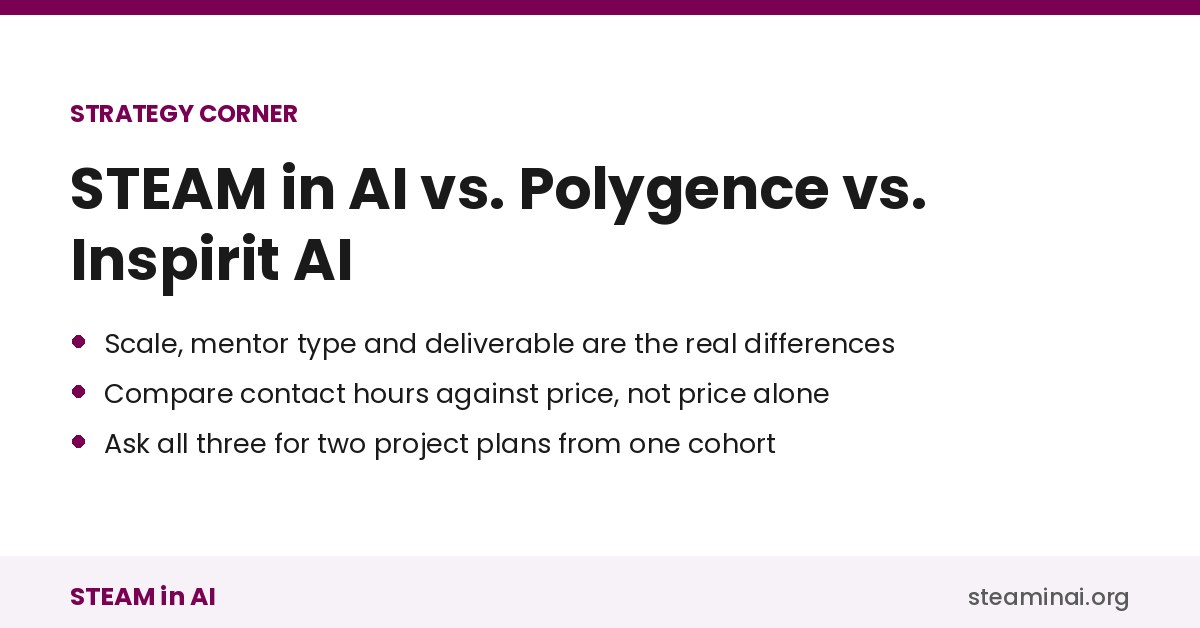
All three sit in the low thousands, and the fee alone tells you little. Compare contact hours against price, and ask whether the hours are one-to-one or shared. Our own breakdown is in Is a $5,000 AI program actually worth it?
Is Inspirit AI a good alternative?
Inspirit AI runs cohort-based programs taught largely by students and alumni of top universities, which suits a student who wants structure and peers. It is a weaker fit for a student who needs an individually designed project.
What should decide it?
What the student walks away with, and whether they can still explain it a year later without notes. Ask all three for two project plans from different students in one cohort. The answer is usually obvious.
We are comfortable being compared. Bring us the other two.
Tell us what Polygence or Inspirit quoted you and what your student wants to build, and we will tell you where we would genuinely be the weaker choice. Cohorts are small enough that we would rather place a student well than fill a seat.


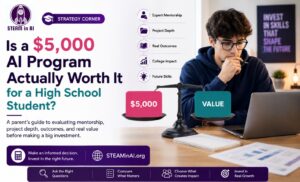
Is a $5,000 AI Program Worth It for a High School Student?
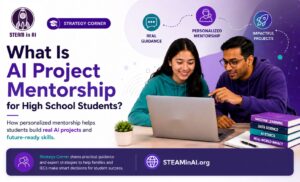
What Is AI Project Mentorship for High School Students?