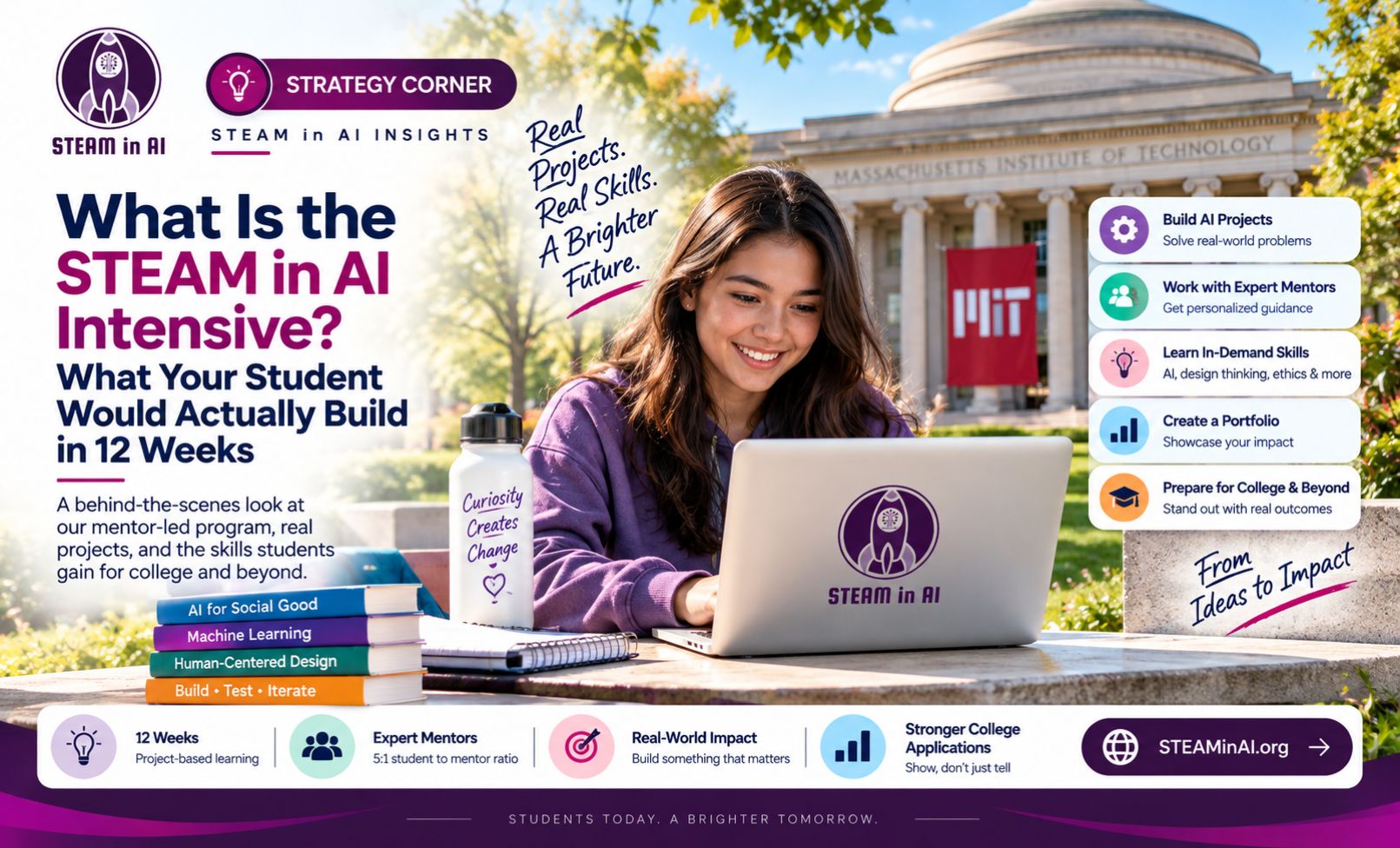
What Is the STEAM in AI Intensive? What Your Student Would Actually Build in 12 Weeks
The STEAM in AI Intensive is a twelve-week, one-to-one AI mentorship program for high school students. A student builds one original project, designed around their own interests and intended major, with two mentors rather than one. There is no coding prerequisite, and admission is by fit assessment only: no GPA cutoff and no test scores.
The short answer
Twelve weeks. Two mentors. One original project. The student picks an AI Build track (ship a working product) or an AI Research track (investigate a question rigorously). Their project mentor writes a week-by-week schedule for that one student before week one, so no two students in a cohort do the same thing. Roughly half of every cohort arrives having never written a line of code. Graduates have gone to Duke, USC, UIUC, Santa Clara, Harvey Mudd and UC Davis.
Watch a free Live Lab before deciding anything — no form and no sales call.
What a student actually does in the STEAM in AI Intensive
Every project moves through the same five steps, whatever the subject. We call it the STEAM in AI Framework.
- Identify the problem. Something the student has actually noticed, not something assigned to them.
- Research and empathy. Talking to the people who have the problem, before building anything for them.
- Ethical considerations. What this could get wrong, and who it would affect. It is the step almost nobody expects, and the one admissions readers notice.
- Prototype and build. The smallest useful version first, then better ones.
- Impact and story. What changed, and how to explain it to someone who was not in the room.
Around week five most projects break. The data is wrong, the model will not converge, or the original question turns out to be unanswerable. That week is anticipated rather than avoided, and it is usually the part a student ends up writing about.
Two mentors, not one: how the STEAM in AI Intensive is staffed
This is the structural difference most families never think to ask about. Every student in the STEAM in AI Intensive works with two people:
- A curriculum mentor across the whole cohort — Shilpi Agarwal, who teaches AI for Business at Stanford Continuing Studies to working Silicon Valley professionals.
- A 1:1 project mentor matched to that individual student, drawn from industry: NVIDIA, Roblox, Genentech, Turo, OpenAI, plus published academic researchers.
Mentors are named publicly before anyone pays, and every one is findable on LinkedIn. A student investigating algorithmic bias works with a published researcher. A student shipping a consumer app works with someone who ships consumer software for a living.
Who the STEAM in AI Intensive is for
The two filters most families apply — can the student already code, and are they heading into STEM — are the two that predict least. We select on something else.
| A question they keep returning to | Not an interest, a question. “Why do the mental health apps my friends download get deleted within a week?” is a project. “I like psychology” is not, yet. |
|---|---|
| Evidence of finishing something hard | A club run for two years, a season trained for, a job held, a mediocre game shipped to three users. Something that stopped being fun and continued anyway. |
| A tolerance for being stuck | Week five arrives for everyone. Students who read it as information keep going. Students who read it as failure disengage. |
Who it is not for
We say no every term, including to families who want to pay.
- The student who has not agreed to it. If a parent arranged this and the student is compliant rather than curious, twelve weeks will be miserable for everyone.
- The student with no room in the calendar. Six to eight hours a week is real.
- The student who wants a credential, not a project. They exist, they are not bad kids, and this is not right for them.
What a student leaves with
A STEAM in AI Intensive student finishes with an artifact — a working build or a defensible research finding — plus documentation, a project journal, and a recorded presentation they can defend under questioning. The project belongs to the student.
It also does not stop at week twelve. Students continue as far as the work justifies: more features, an App Store submission, a competition entry, a conference talk, a publication. One student finished at fourteen with no prior coding, spent a further year on the same project, took it to the App Store, and had her work accepted into the 2026 Presidential AI Challenge.
The fastest way to find out whether this fits is to watch one.
Live Labs are free, open, and not a sales call. Sit in, see how a mentor actually works with a student, and decide afterwards.
How admission to the STEAM in AI Intensive works
There is one gate: a fit assessment. It is a thirty-minute conversation, not a test. We ask what the student has been curious about lately, what they finished that was harder than expected, and what they would do if their idea turned out to be wrong at week six. Nobody prepares for that last question, which is why we ask it.
Afterwards we tell the student and the family what we concluded, including when the answer is no.
Where STEAM in AI Intensive graduates have gone
Six named students, with their projects, are set out in full here: STEAM in AI outcomes, where six students actually got in. Duke in Statistical Science and Computer Science. USC in Artificial Intelligence for Business. UIUC in Information Science. Santa Clara in Computer Science and Engineering. Harvey Mudd in Computer Science. UC Davis in Biomedical Engineering.
Two of those six are what a family would have predicted from an AI program. The other four are the point.
Bring us one student and we will tell you honestly.
Thirty minutes, no GPA cutoff, no test scores. If the right answer is a research program, a summer job, or another year of maturity, we will say that instead.



An AI Project With No Coding Experience: Julia Started at Zero and Went to Duke

AI Projects for Data Science Applicants (and Statistics Majors)